Unit V of the CBSE Class 12 Psychology paper carries 9 marks out of 70. It is a compact unit that rewards precision: the therapeutic relationship, the factors that heal, systematic desensitisation, Ellis’s ABC model and the four steps of rehabilitation are all standard answers, and each has an exact list the examiner is looking for.
What is inside
- Chapter at a glance — a one-page mind map covering all eleven syllabus topics
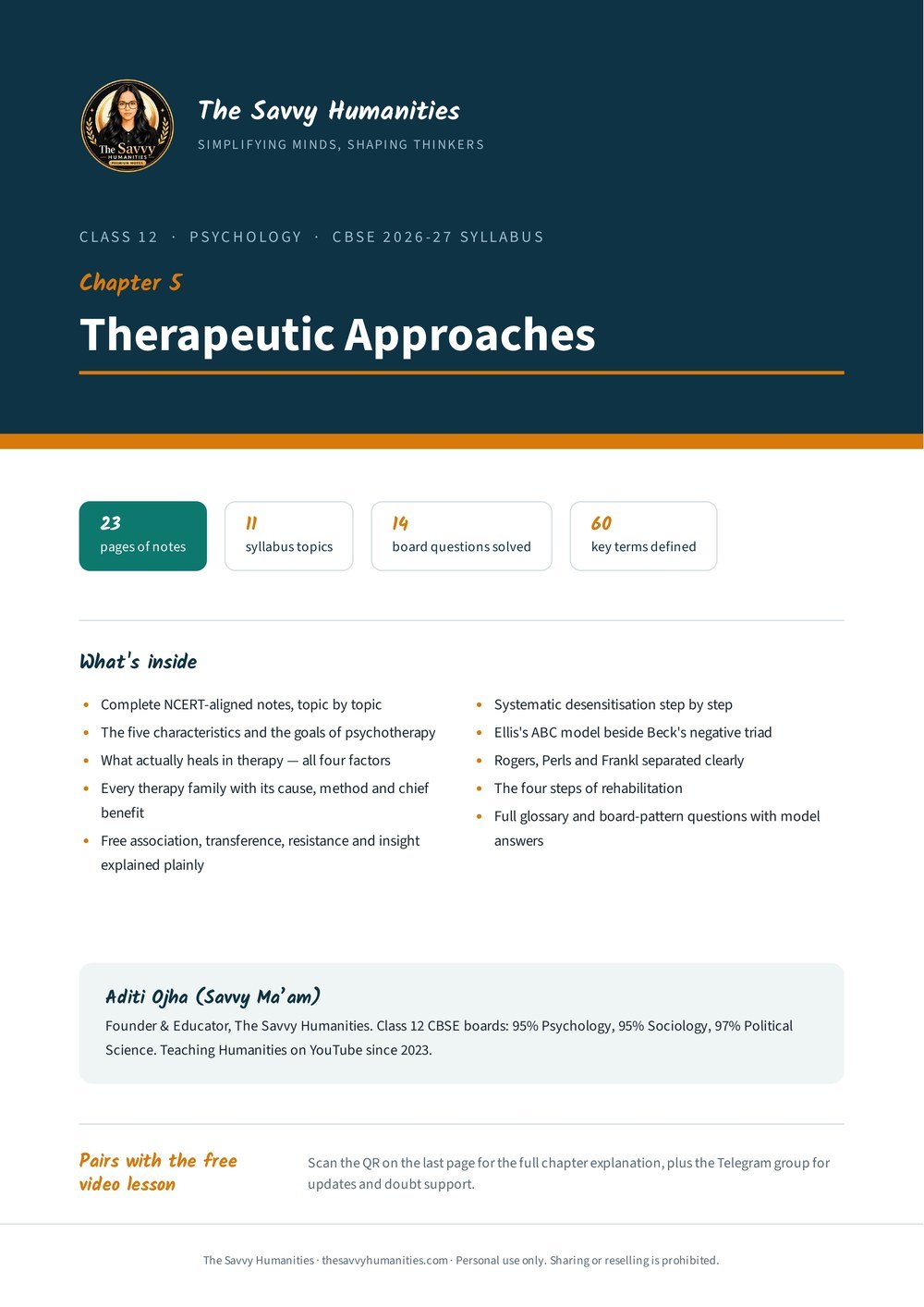
- Complete topic-by-topic notes, NCERT-aligned, in CBSE’s own topic order
- The five defining characteristics of psychotherapy and the goals of therapy
- The therapeutic relationship — contractual and time-limited, unconditional positive regard, empathy and confidentiality
- What actually heals in therapy — all four factors: the techniques used, the therapeutic alliance, catharsis, and the non-specific factors
- Every therapy family with its cause, method and chief benefit, which is exactly how CBSE frames the comparison questions
- Psychodynamic therapy: free association, dream interpretation, transference, resistance, interpretation, insight and working through — explained plainly rather than left as jargon
- Behaviour therapy: faulty conditioning as the cause, reinforcement and the token economy, modelling, and Wolpe’s systematic desensitisation step by step
- Cognitive therapy: Ellis’s rational emotive therapy and the ABC model beside Beck’s negative triad
- Humanistic-existential therapy with Rogers, Perls and Frankl separated clearly — client-centred, Gestalt and logotherapy
- Biomedical therapy — drugs and ECT — and the alternative therapies: yoga, meditation and acupuncture
- Rehabilitation of the mentally ill, with its four steps: occupational therapy, social skills training, cognitive retraining and vocational training
- A 60-term glossary of every definition the paper can ask for
- 14 board-pattern questions with full model answers, written the way they should be written in the exam
- A revision tracker to tick off each topic as read, practised and revised
Written for the 2026-27 syllabus
Every topic in this file is on CBSE’s list for Chapter 5. Nothing more has been added to pad the page count. Psychology and Life and Developing Psychological Skills are not covered anywhere in these notes, because CBSE has removed both from the syllabus — you will not spend a minute on material the paper cannot ask.
Details
- Format: PDF, A4 — works on a phone and prints cleanly
- Length: 23 pages plus cover
- Delivery: instant download link after payment, plus a copy by email
- Free updates: if CBSE changes the syllabus or a correction goes in, the updated file is sent to you at no cost. You never pay twice for the same chapter.
These notes cover the therapies as the CBSE syllabus defines them, for exam purposes. They are study material, not clinical or treatment advice.
By Aditi Ojha (Savvy Ma’am) — Founder and educator, The Savvy Humanities. Teaching Humanities on YouTube since 2023. These notes pair with the free chapter video; QR codes inside the file link to it.