Unit VII of the CBSE Class 12 Psychology paper carries 6 marks out of 70 — the smallest unit. Small does not mean skippable: it is almost entirely definitions and named lists, which makes it the cheapest unit in the paper to secure. Tuckman’s five stages, Asch, Milgram and the conflict-resolution strategies are the recurring answers.
What is inside
- Chapter at a glance — a one-page mind map covering all eleven syllabus topics
- Complete topic-by-topic notes, NCERT-aligned, in CBSE’s own topic order
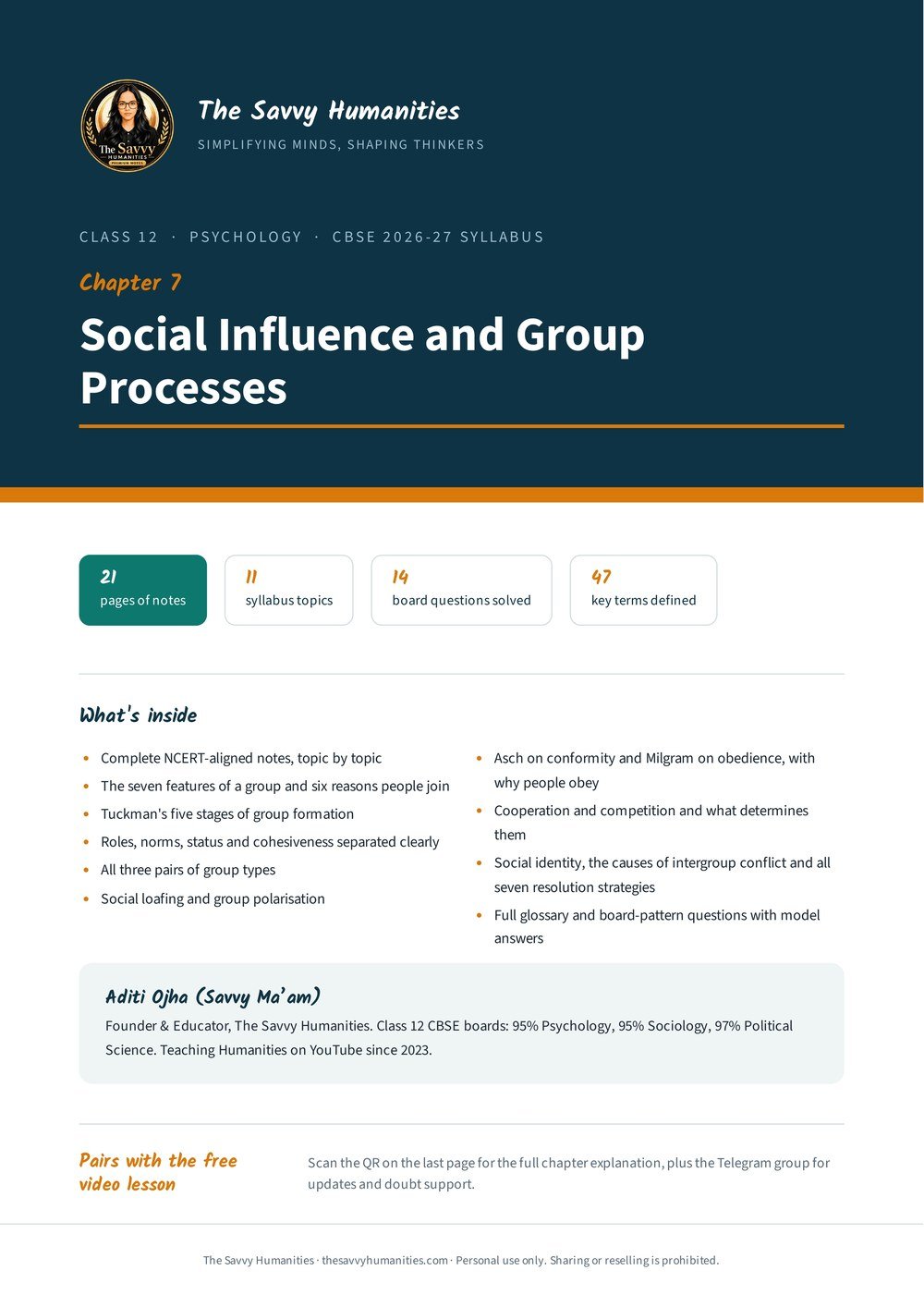
- The seven features of a group and the six reasons people join one — security, status, self-esteem, goals and the rest, given as named lists rather than prose
- Tuckman’s five stages of group formation: forming, storming, norming, performing and adjourning
- Roles, norms, status and cohesiveness separated clearly — role expectations, the unwritten rules, ascribed versus achieved status, and the “we feeling”
- All three pairs of group types: primary and secondary, formal and informal, ingroup and outgroup
- Social loafing and diffusion of responsibility, and group polarisation — why groups take more extreme decisions than individuals
- Asch’s line experiment on conformity and Milgram’s study on obedience, with compliance in between, and the reasons people obey
- Cooperation and competition, and what determines which one appears
- Tajfel’s social identity, the causes of intergroup conflict, Sherif’s superordinate goals, and all seven conflict-resolution strategies
- A 47-term glossary of every definition the paper can ask for
- 14 board-pattern questions with full model answers, written the way they should be written in the exam
- A revision tracker to tick off each topic as read, practised and revised
Written for the 2026-27 syllabus
Every topic in this file is on CBSE’s list for Chapter 7. Nothing more has been added to pad the page count. Psychology and Life and Developing Psychological Skills are not covered anywhere in these notes, because CBSE has removed both from the syllabus — you will not spend a minute on material the paper cannot ask.
Details
- Format: PDF, A4 — works on a phone and prints cleanly
- Length: 21 pages plus cover
- Delivery: instant download link after payment, plus a copy by email
- Free updates: if CBSE changes the syllabus or a correction goes in, the updated file is sent to you at no cost. You never pay twice for the same chapter.
By Aditi Ojha (Savvy Ma’am) — Founder and educator, The Savvy Humanities. Teaching Humanities on YouTube since 2023. These notes pair with the free chapter video; QR codes inside the file link to it.