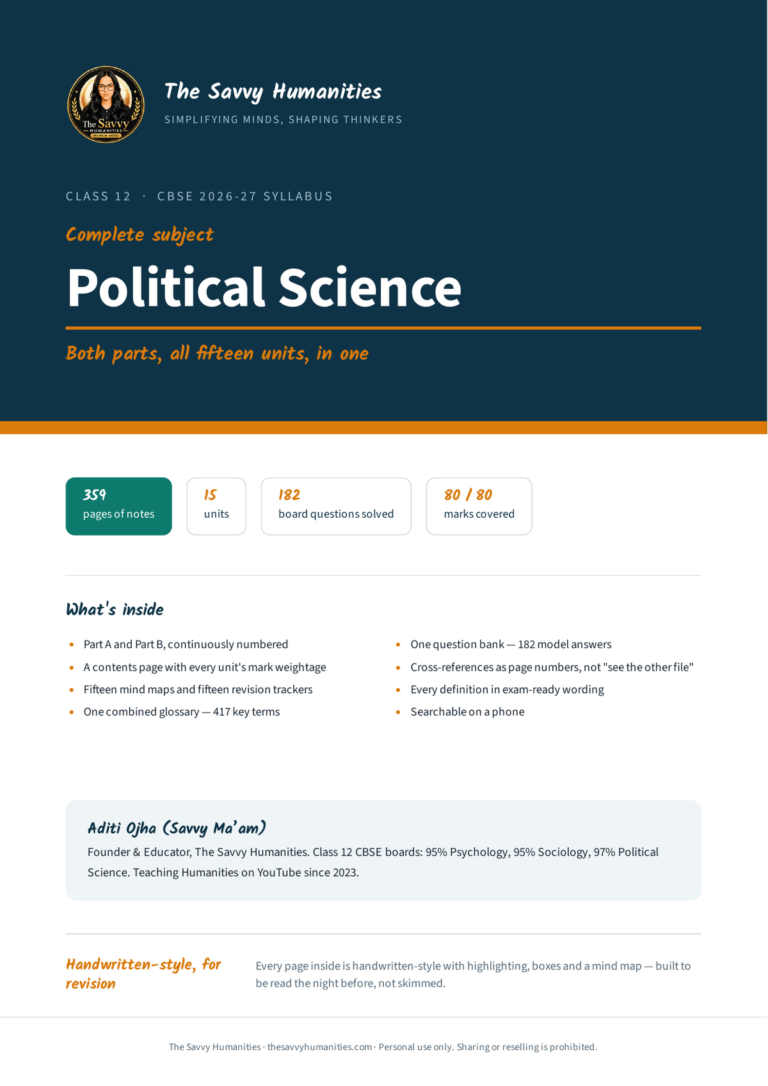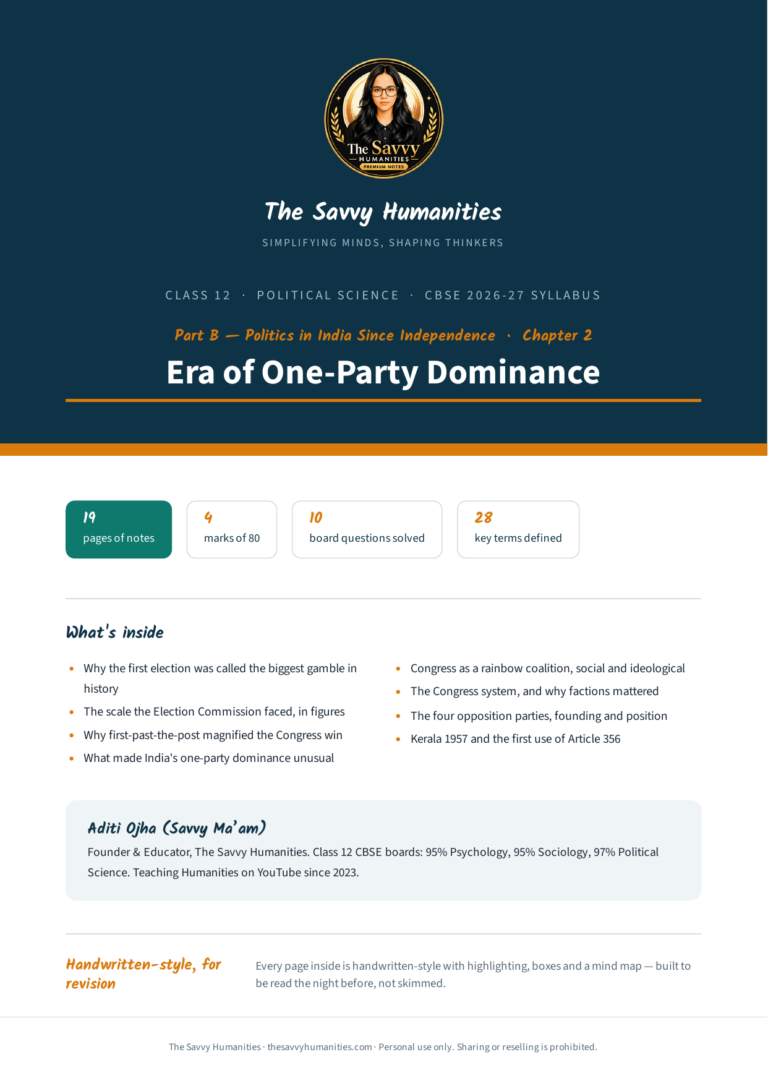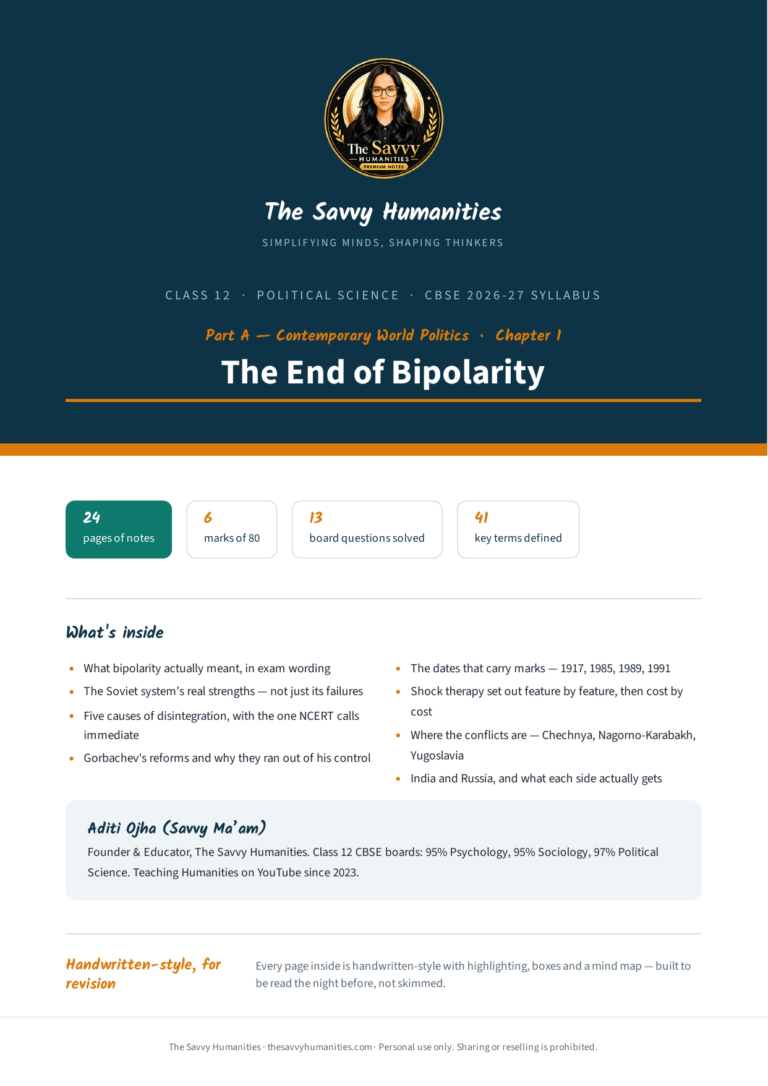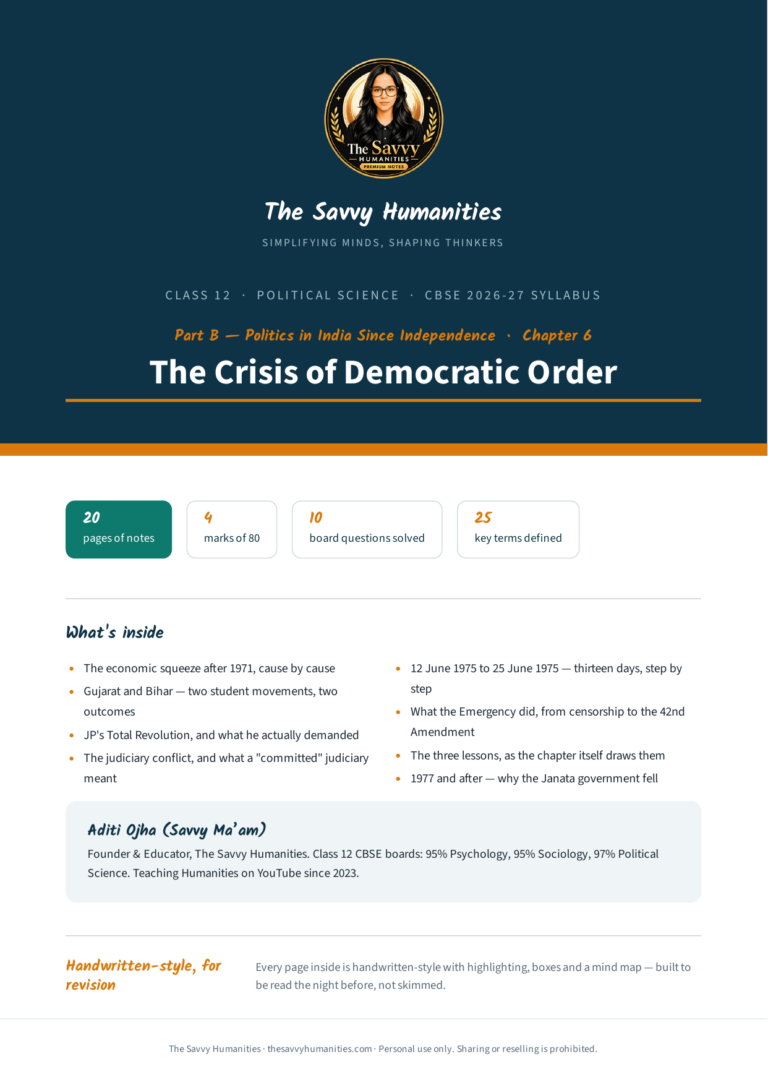
Exam-oriented handwritten-style notes — every page laid out like class notes, with highlighting, boxes and a mind map, built to be read the night before rather than skimmed.
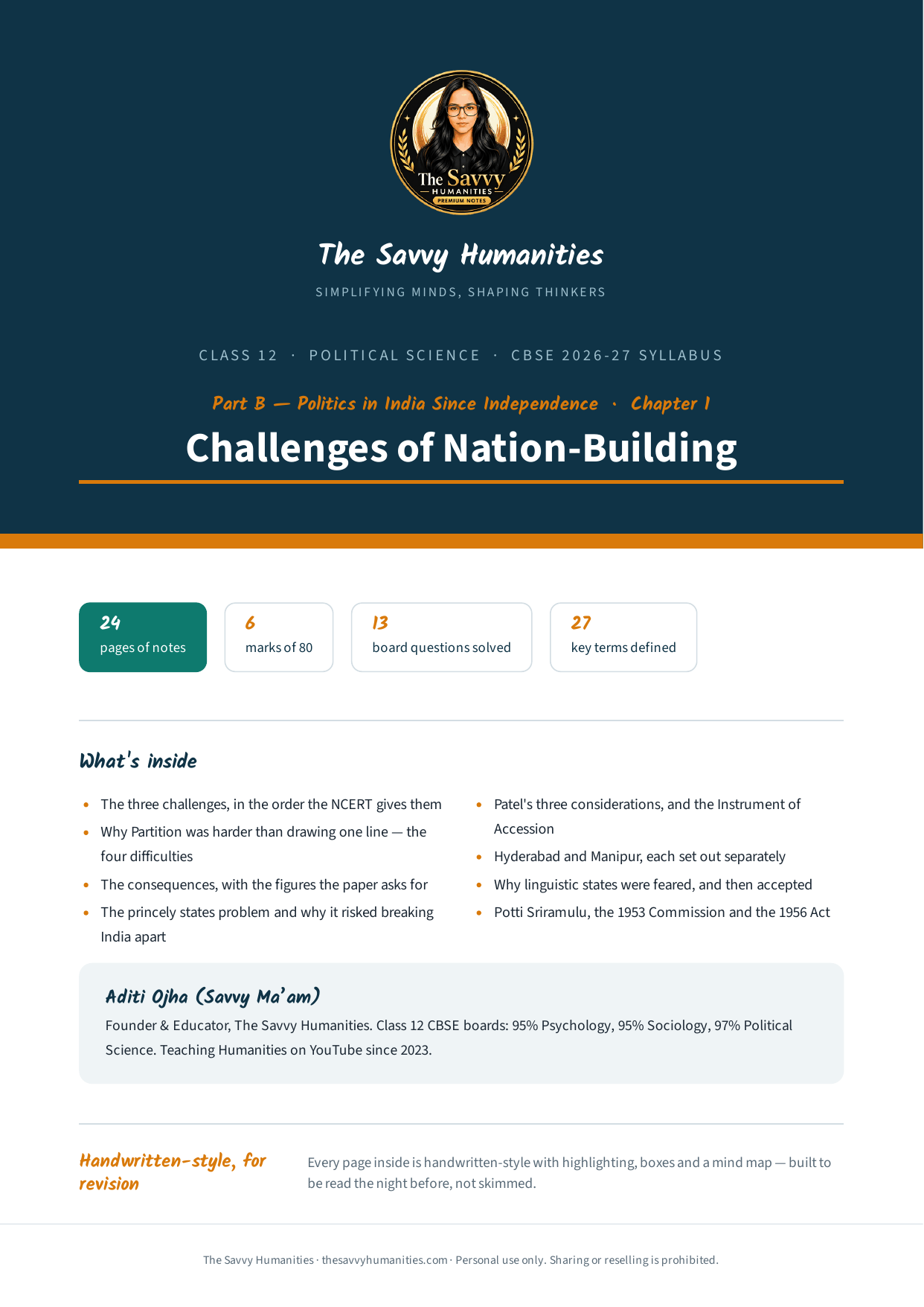
Unit 1 of Part B in the CBSE Class 12 Political Science paper carries 6 marks out of 80, checked against CBSE’s own 2026-27 curriculum document, which lists four sub-topics: the challenges for the new nation, Partition and its consequences, the integration of the princely states, and the reorganisation of states. It is the chapter that opens Part B — the country described in Units 2 to 8 is the country made here.
What are the three challenges of nation-building?
Unity in the face of diversity, establishing democracy, and development for the whole of society. The notes give all three in NCERT’s own order, which is the order the examiner expects, with the wording to write for each.
Why was Partition harder than drawing one line?
Because religious majorities did not map onto a single boundary. The notes set out the four difficulties — no single Muslim-majority belt, the bifurcation of Punjab and Bengal district by district, the position of minorities on both sides, and the choice forced on the North-West Frontier Province under Khan Abdul Ghaffar Khan. The consequences follow, with the figures the paper asks for and NCERT’s phrase division of hearts.
How were the princely states integrated?
565 princely states, with British paramountcy lapsing at independence rather than passing to India — which is why balkanisation was a real risk. The notes cover Sardar Patel’s three considerations, the Instrument of Accession, and the four states that did not accede in the first round, with Hyderabad and Manipur each set out separately: the Nizam, the Standstill Agreement, Telangana and the Razakars; then Bodhachandra Singh, the Merger Agreement of September 1949, and Manipur holding India’s first election on universal adult franchise in June 1948.
Why were linguistic states first feared and then accepted?
The fear was that language-based states would pull a new country apart. The notes trace the reversal through the Vishalandhra movement, Potti Sriramulu’s 56-day fast and his death in December 1952, the States Reorganisation Commission of 1953 and its 1955 report, and the States Reorganisation Act of 1956 — fourteen states and six union territories.
What else is in the file
- Chapter at a glance — a one-page mind map of the whole chapter
- Complete topic-by-topic notes, NCERT-aligned, in CBSE’s own topic order
- A 27-term glossary of every definition the paper can ask for
- 13 board-pattern questions with full model answers
- A revision tracker to tick off each topic as read, practised and revised
Written for the 2026-27 syllabus
Nothing from CBSE’s list for this unit is left out — all four sub-topics are covered. Rise of Popular Movements, which older editions printed in this book, is not covered anywhere in this set: CBSE removed it from the 2026-27 syllabus and the current NCERT edition no longer prints it. Chapter numbers in this set follow the current NCERT book, which matches CBSE’s units.
The file
- Format: PDF, A4 — works on a phone and prints cleanly
- Length: 24 pages plus cover
- Delivery: instant download link after payment, plus a copy by email
- Free updates: if CBSE changes the syllabus or a correction goes in, the updated file is sent to you at no cost. You never pay twice for the same chapter.
By Aditi Ojha (Savvy Ma’am) — Founder and educator, The Savvy Humanities. Teaching Humanities on YouTube since 2023. These notes pair with the free chapter video; QR codes inside the file link to it.