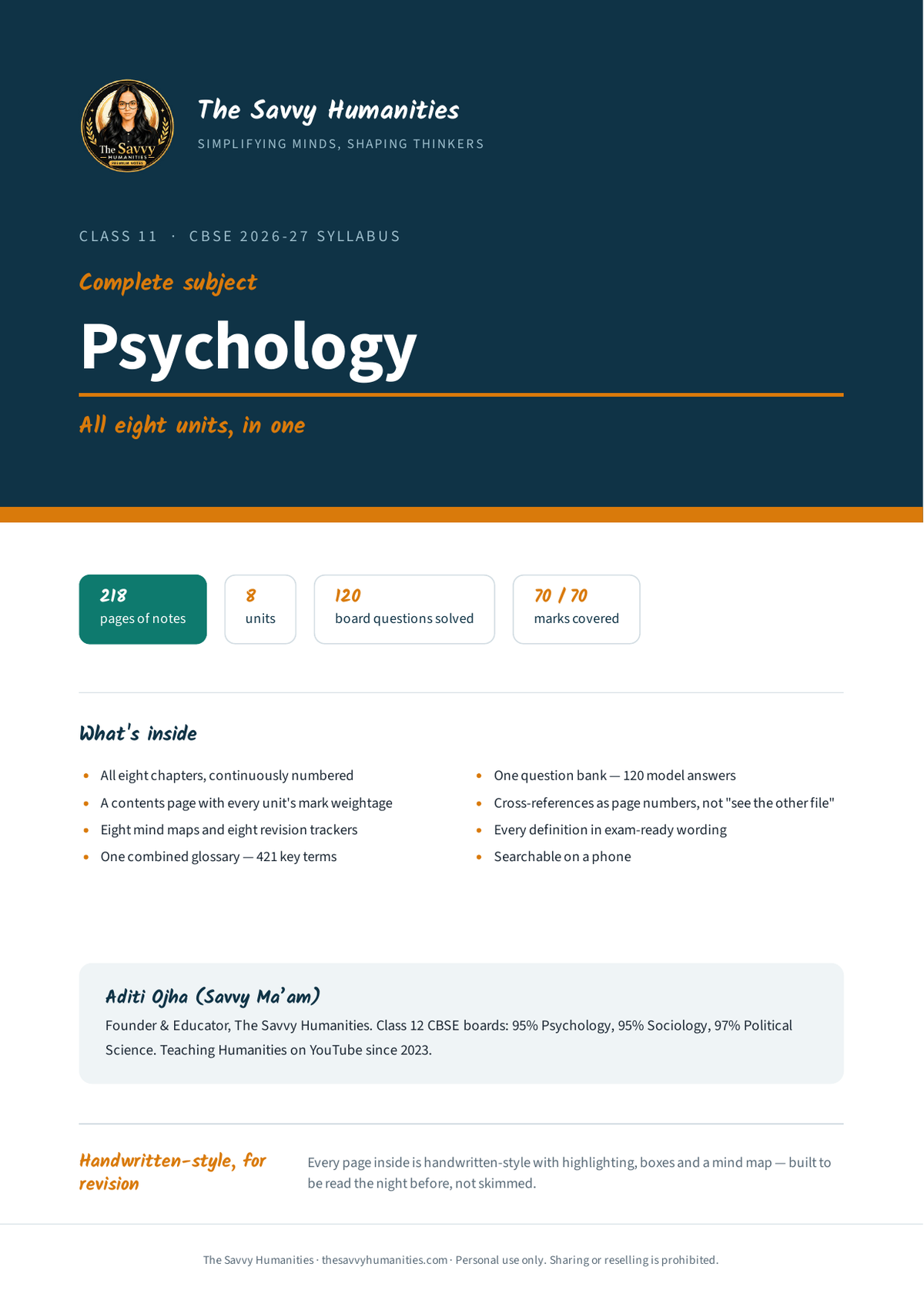
The complete CBSE Class 11 Psychology paper in one book — all eight units, all 70 marks. 218 pages, continuously numbered from Page 1 to Page 218, in the handwritten style the chapter files use: highlighting, boxes, and a mind map for every unit.
This is not eight PDFs in a folder. It is one file with one contents page, one glossary and one question bank, so nothing has to be looked up twice.
What does “all 70 marks” actually mean here?
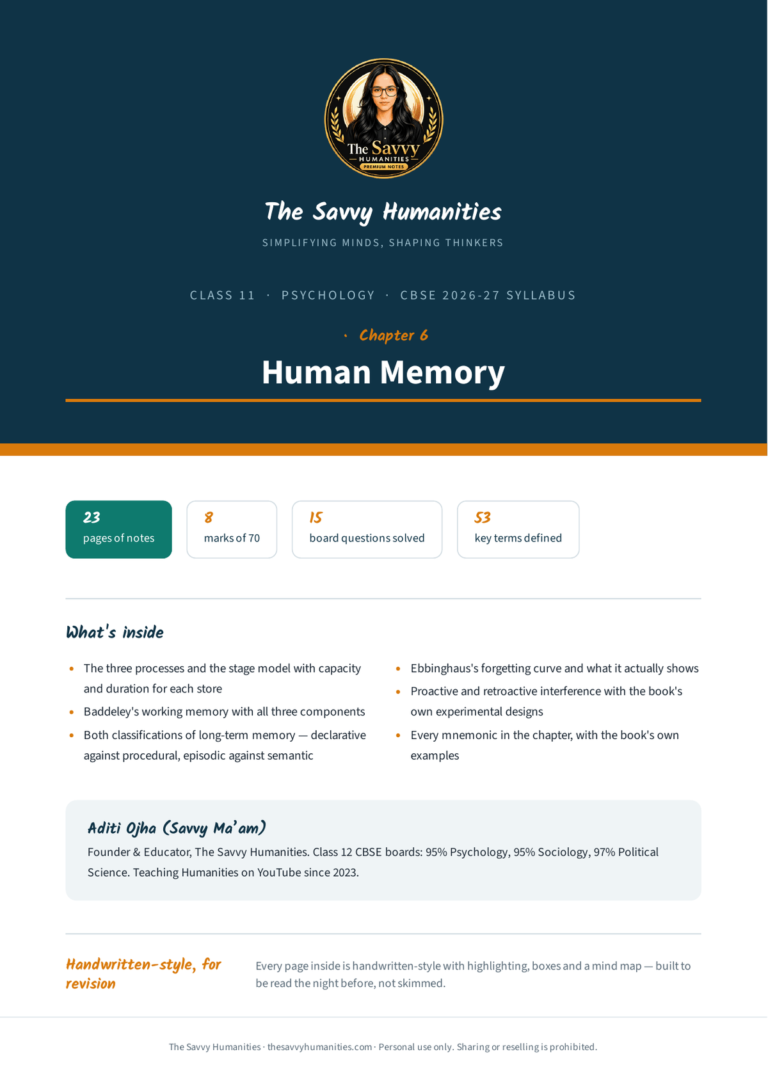
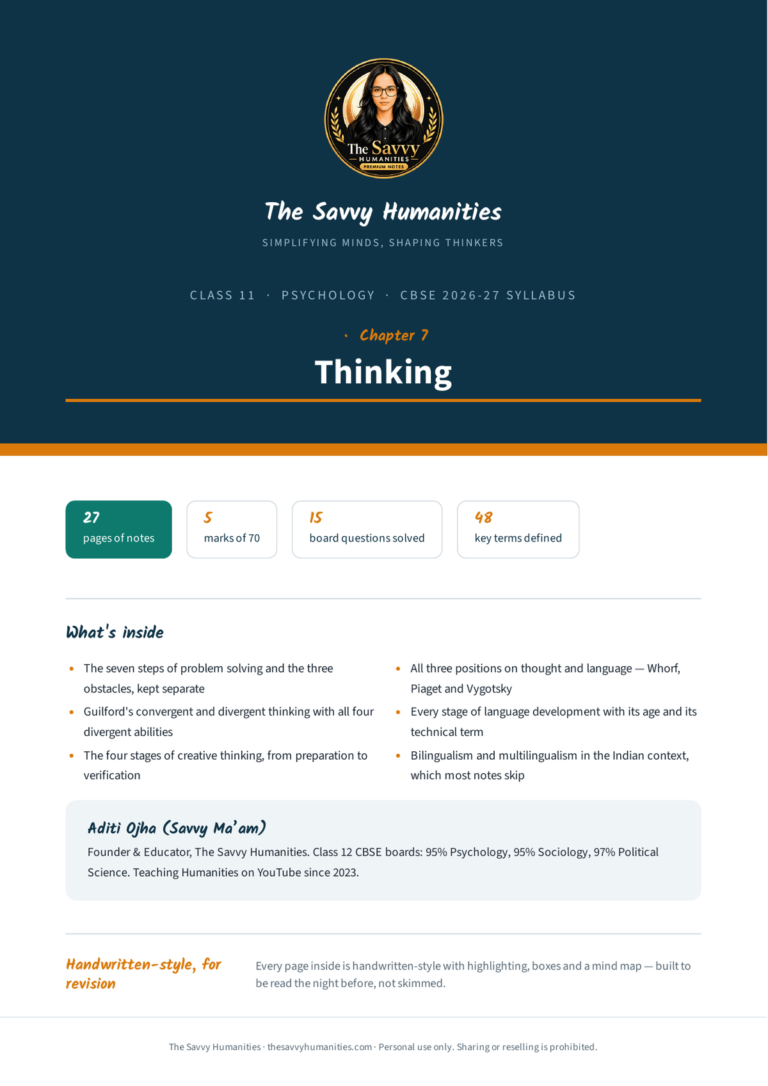
The eight units and what each one carries: Understanding Psychology (11), Methods of Enquiry in Psychology (13), Human Development (11), Sensory, Attentional and Perceptual Processes (8), Learning (9), Human Memory (8), Thinking (5) and Motivation and Emotion (5). Every weightage is checked against CBSE’s own 2026-27 curriculum document, and the contents page prints the mark column beside every unit.
Why does the mark column matter more than the chapter order?
Because the weightage is not even. Methods of Enquiry carries 13 marks and Thinking carries 5 — nearly three times the difference between two units that look the same on a syllabus list. The contents page puts that column in front of you before you plan a single revision session, which is the whole point of having one book rather than eight.
What is in the combined glossary?
421 key terms in one alphabetical list. Each term carries a chapter tag, so you can go straight back to the explanation. Where a term is taught in two chapters — Gestalt, Motivation, Selective attention, Free recall, Babbling and Learned helplessness — both chapters are shown and the definition covers both senses, instead of the term appearing twice with two half-answers.
How many board questions are solved, and how are they arranged?
120 board-pattern questions with full model answers, grouped by chapter: 40 one-markers, 35 two-markers, 32 four-markers and 13 six-markers — 316 marks of practice in a single question bank at the back. Each unit’s block states its own mark weightage and question count at the top.
What does “cross-references as page numbers” mean?
Psychology doubles back on itself constantly — attention returns in memory, conditioning returns in motivation. In separate chapter files a reference can only say “see the other file”. Here it gives a page number, and that page is where the unit actually is. The eight mind maps and eight revision trackers all live at page numbers the contents page can find.
Why is this cheaper than buying the chapters separately?
The eight chapters bought one at a time are ₹49 × 8 = ₹392. In this book they are ₹299 — the same material, ₹93 less, and easier to revise from because it is one file instead of eight.
What is in the file
- 218 pages, all eight chapters continuously numbered
- A contents page with every unit’s mark weightage and page number
- Eight mind maps and eight revision trackers, one per unit
- One combined 421-term glossary, alphabetical, chapter-tagged
- One question bank — 120 questions with model answers
- Every definition in exam-ready wording, and the whole file searchable on a phone
The file
- Format: PDF, A4 — works on a phone and prints cleanly
- Length: 218 pages plus cover
- Delivery: instant download link after payment, plus a copy by email
- Free updates: if CBSE changes the syllabus or a correction goes in, the updated file is sent to you at no cost. You never pay twice for the same book.
By Aditi Ojha (Savvy Ma’am) — Founder and educator, The Savvy Humanities. Teaching Humanities on YouTube since 2023. These notes pair with the free chapter videos; QR codes inside the file link to them.