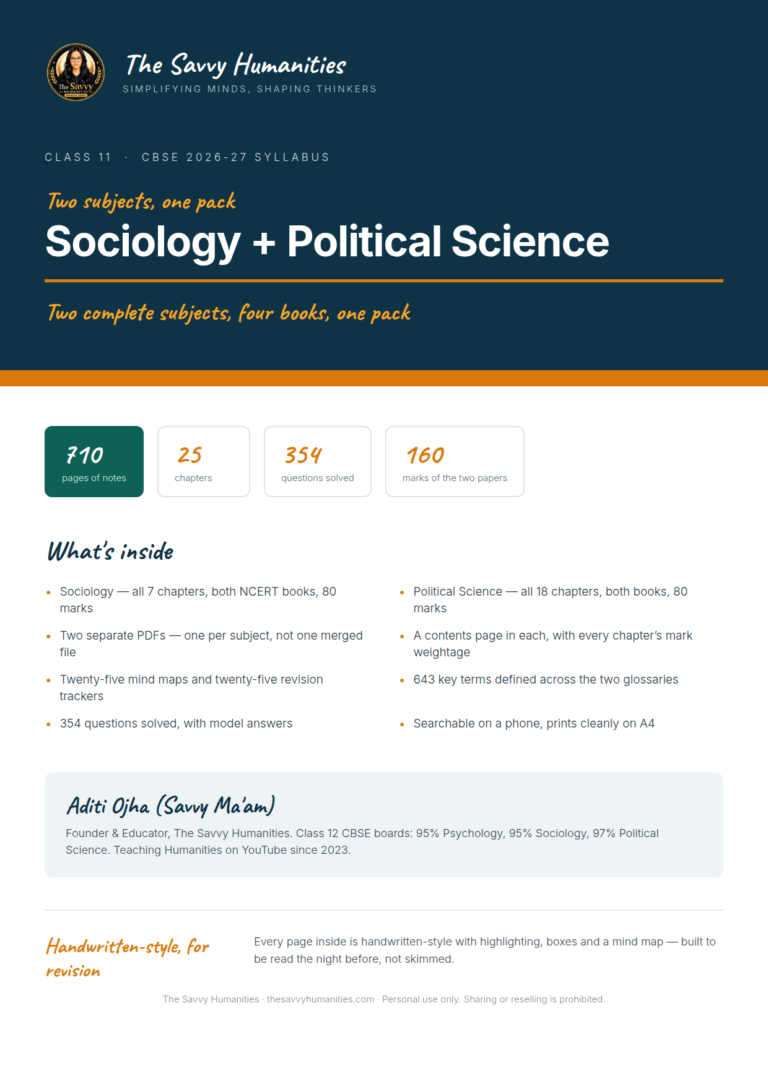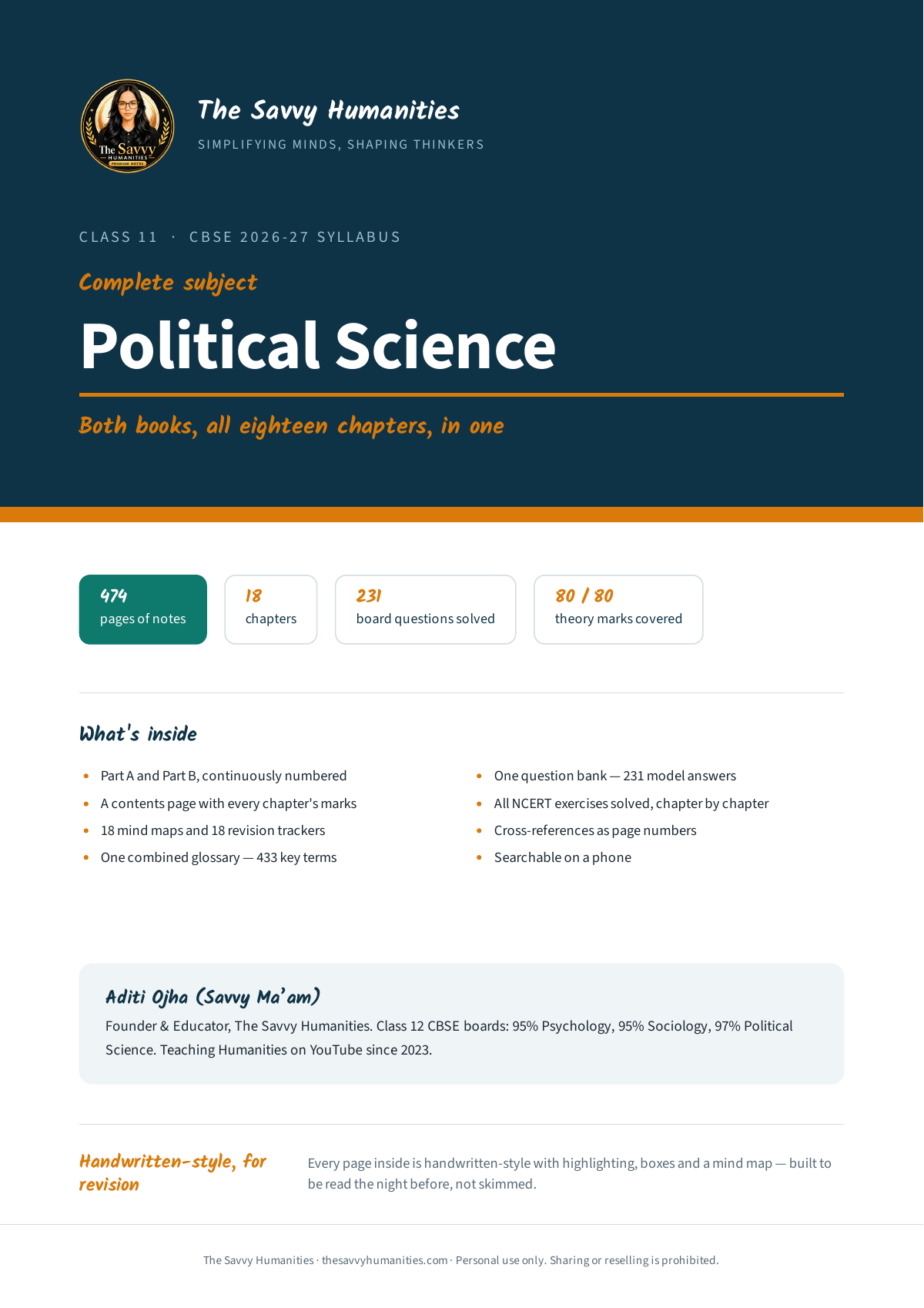
The complete CBSE Class 11 Political Science paper in one book — both NCERT books, all eighteen examined chapters, all 80 marks of the theory paper. 474 pages, continuously numbered from Page 1 to Page 474, in the handwritten style the chapter files use: highlighting, boxes, and a mind map for every chapter.
This is not eighteen PDFs in a folder. It is one file with one contents page, one glossary and one question bank, so nothing has to be looked up twice.
What does “all 80 marks” mean here?
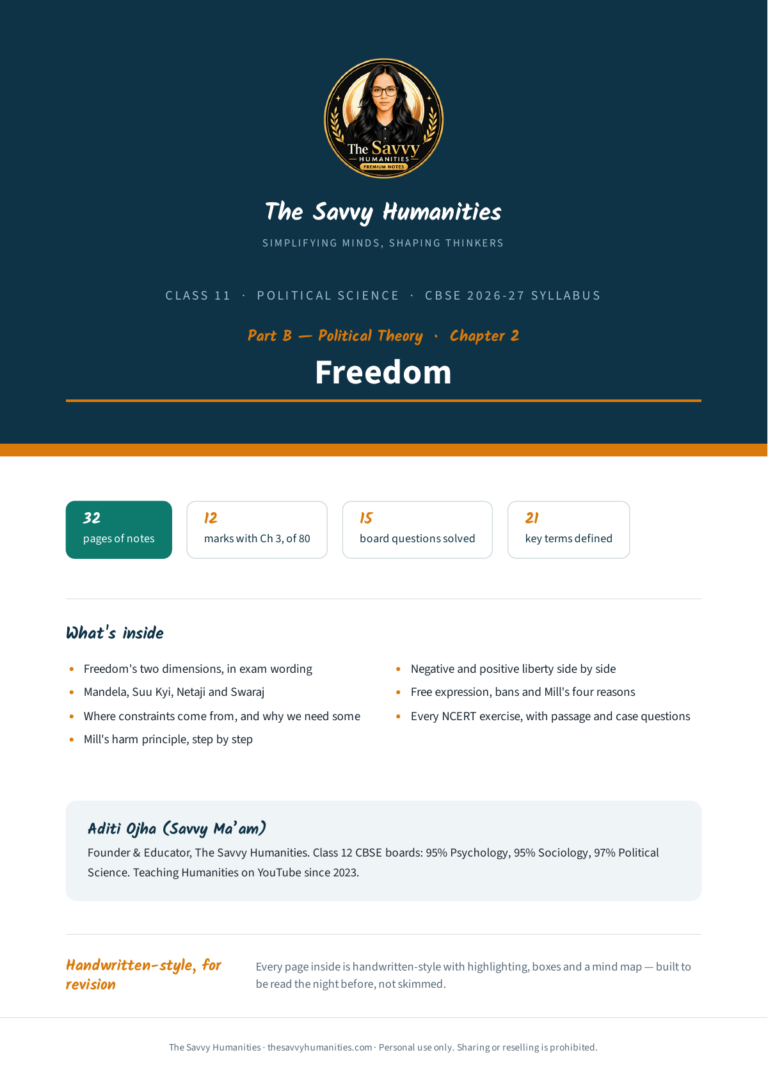
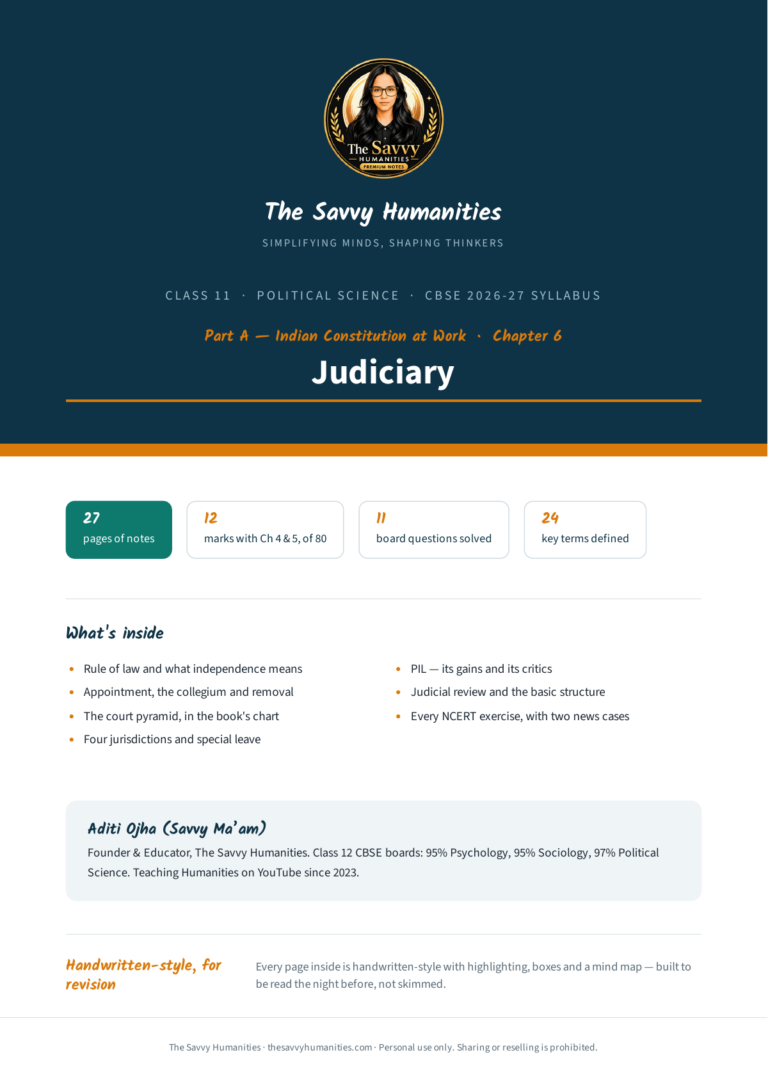
Part A, Indian Constitution at Work — 40 marks: Constitution: Why and How? and Rights in the Indian Constitution (8 together), Election and Representation (6), Executive, Legislature and Judiciary (12 together), Federalism (6), Local Governments (4), and Constitution as a Living Document and The Philosophy of the Constitution (4 together). Part B, Political Theory — 40 marks: Political Theory: An Introduction (4), Freedom and Equality (12 together), Social Justice (6), Rights (4), Citizenship and Nationalism (8 together) and Secularism (6). These match the unit weightage in CBSE’s 2026-27 curriculum, and the contents page prints the mark column beside every chapter.
Why are some chapters marked together?
Because CBSE groups them into one unit. Executive, Legislature and Judiciary share 12 marks; Freedom and Equality share 12; Citizenship and Nationalism share 8. A question on one can draw on the others, which is exactly why having them in one continuously numbered book helps.
Which NCERT chapters are left out, and why?
Part B’s Political Theory prints ten chapters; the CBSE 2026-27 course examines the first eight, so Peace and Development are not in this book. Leaving them out is deliberate — nothing here is time spent on material the paper cannot ask. The chapter numbers printed in your textbooks are kept.
How does one glossary cover both books?
One 433-term glossary, alphabetical, with a tag beside each term — A-1 to A-10 for Part A, B-1 to B-8 for Part B — so you can go straight back to the explanation. The eighteen chapter glossaries hold 459 entries between them; 24 terms are taught in more than one chapter — among them Basic structure, Judicial review, Rule of law, Principled distance, Special majority, Swaraj and Political rights — and each appears once, with every chapter shown, instead of several times with partial answers.
How many questions are solved, and how are they arranged?
231 questions with full model answers — 84 board-pattern questions (MCQs, passage-, case- and cartoon-based, and long answers) and 147 NCERT exercise questions. By marks: 48 one-markers, 55 two-markers, 89 four-markers and 39 six-markers — 748 marks of practice in a single question bank at the back, grouped by chapter.
What is in the file
- 474 pages, Part A and Part B continuously numbered
- A contents page with every chapter’s mark weightage and page number
- Eighteen mind maps and eighteen revision trackers, one per chapter
- One combined 433-term glossary, alphabetical, chapter-tagged
- One question bank — 231 questions with model answers
- Cross-references as page numbers, and the whole file searchable on a phone
The file
- Format: PDF, A4 — works on a phone and prints cleanly
- Length: 474 pages plus cover
- Delivery: instant download link after payment, plus a copy by email
- Free updates: if CBSE changes the syllabus or a correction goes in, the updated file is sent to you at no cost. You never pay twice for the same book.
By Aditi Ojha (Savvy Ma’am) — Founder and educator, The Savvy Humanities. Teaching Humanities on YouTube since 2023.