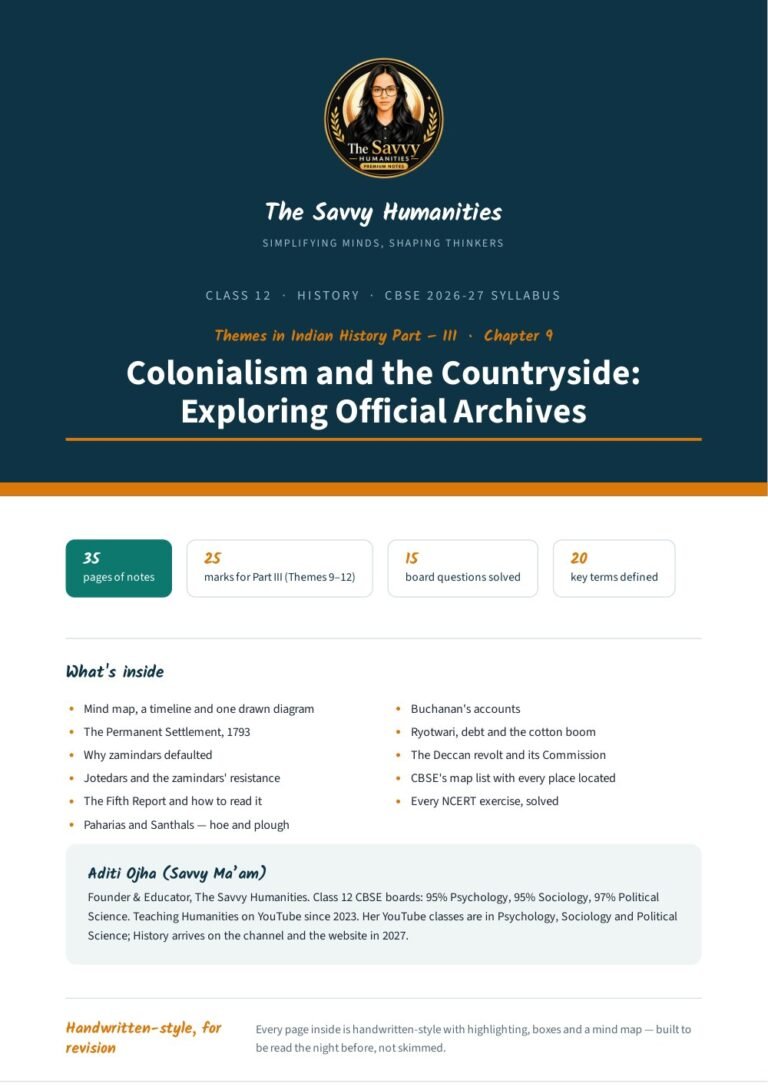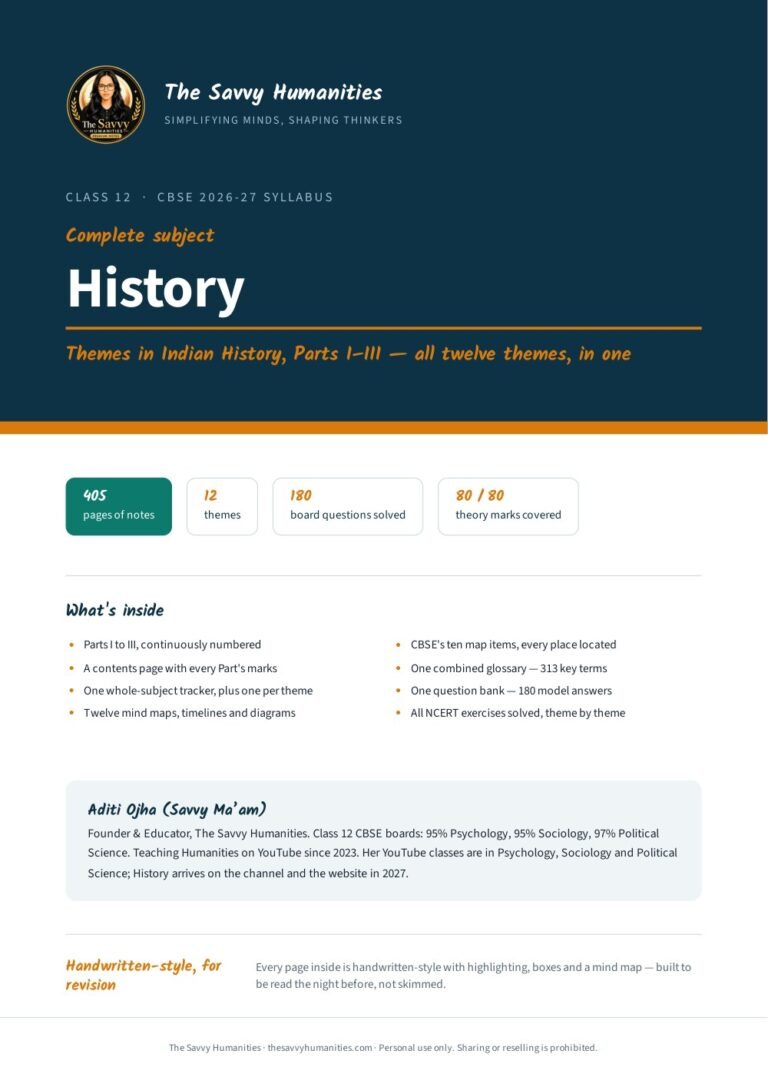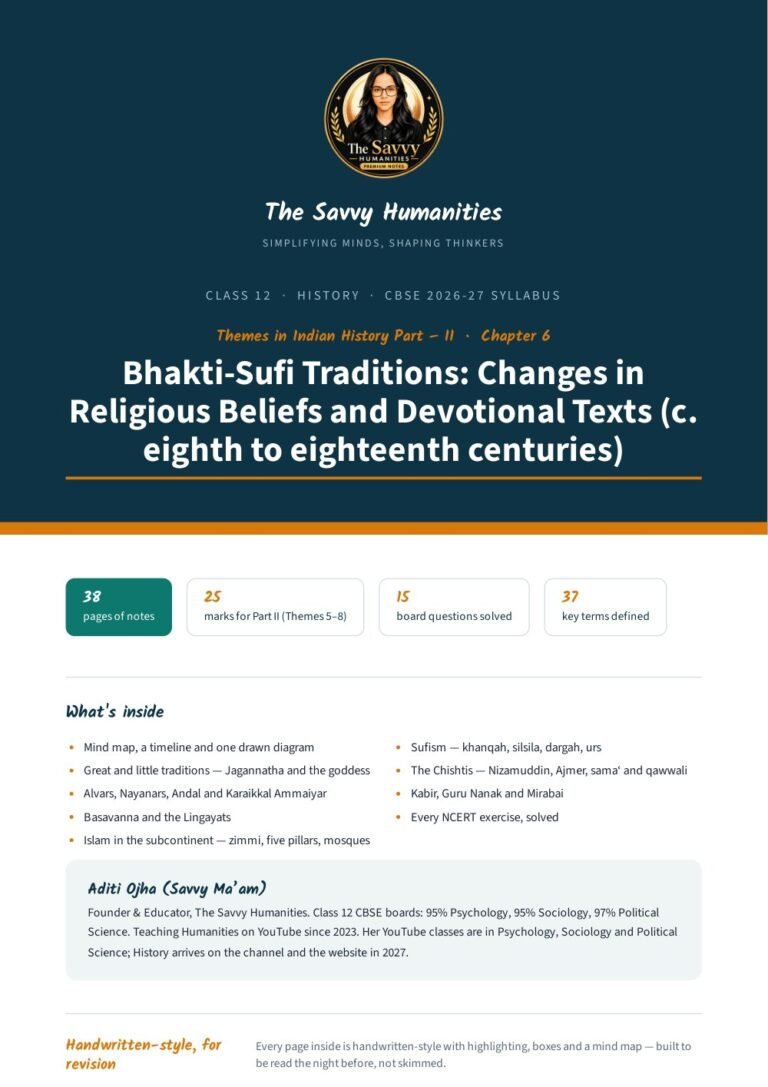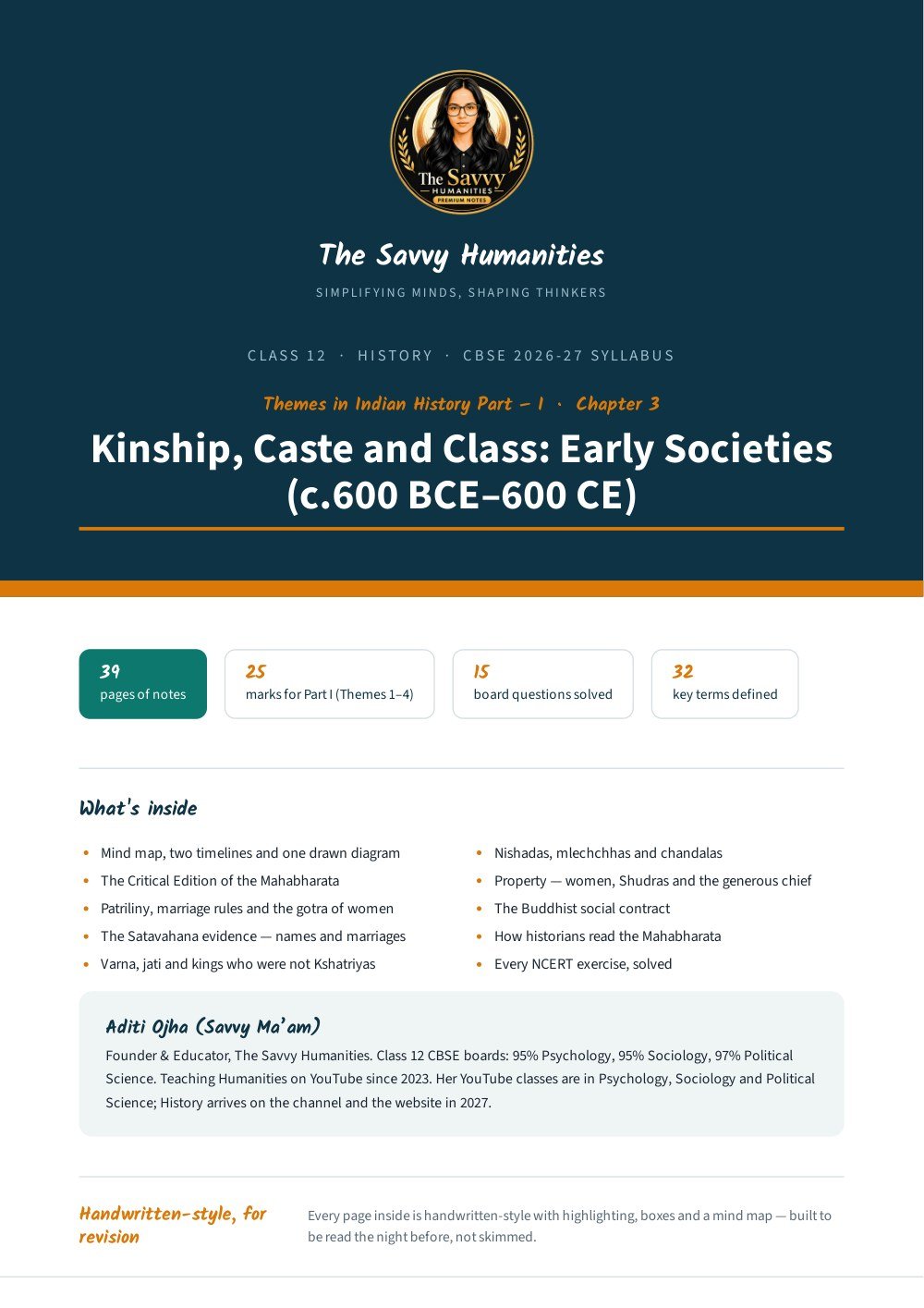
Exam-oriented handwritten-style notes — every page laid out like class notes, with highlighting, boxes and a mind map, built to be read the night before rather than skimmed.
Theme 3 of the CBSE Class 12 History paper sits in Part I (Themes 1–4), which carries 25 marks out of 80 — CBSE gives marks by Part, not by theme. It is one chapter of the NCERT book Themes in Indian History, Part I.
What does the Mahabharata tell us about family and marriage?
The Critical Edition prepared under V.S. Sukthankar, patriliny, the rules of marriage and the gotra of women, tested against the Satavahana evidence.
How did varna and jati work in practice?
The “right” occupation, kings who were not Kshatriyas, jatis and social mobility, and those placed beyond the four varnas — nishadas, mlechchhas and chandalas.
Who could own property — and how do historians read the epic?
Women’s and Shudras’ access to property, the Buddhist idea of a social contract, and how historians study the text’s language, authors and dates, with B.B. Lal‘s excavation at Hastinapura.
What else is in the file
- Chapter at a glance — a one-page mind map of the whole chapter, with two timelines and one hand-drawn diagram
- A 32-term glossary of every definition the paper can ask for
- 15 questions solved with full model answers — 9 NCERT exercises and 6 board-pattern questions
- NCERT’s map exercise worked out and both projects explained
- A revision tracker to tick off each topic as read, practised and revised
The file
- Format: PDF, A4 — works on a phone and prints cleanly
- Length: 39 pages of notes plus cover
- Delivery: instant download link after payment, plus a copy by email
- Free updates: if CBSE changes the syllabus or a correction goes in, the updated file is sent to you at no cost. You never pay twice for the same chapter.
By Aditi Ojha (Savvy Ma’am) — Founder and educator, The Savvy Humanities. Teaching Humanities on YouTube since 2023. These notes follow the NCERT book chapter by chapter.