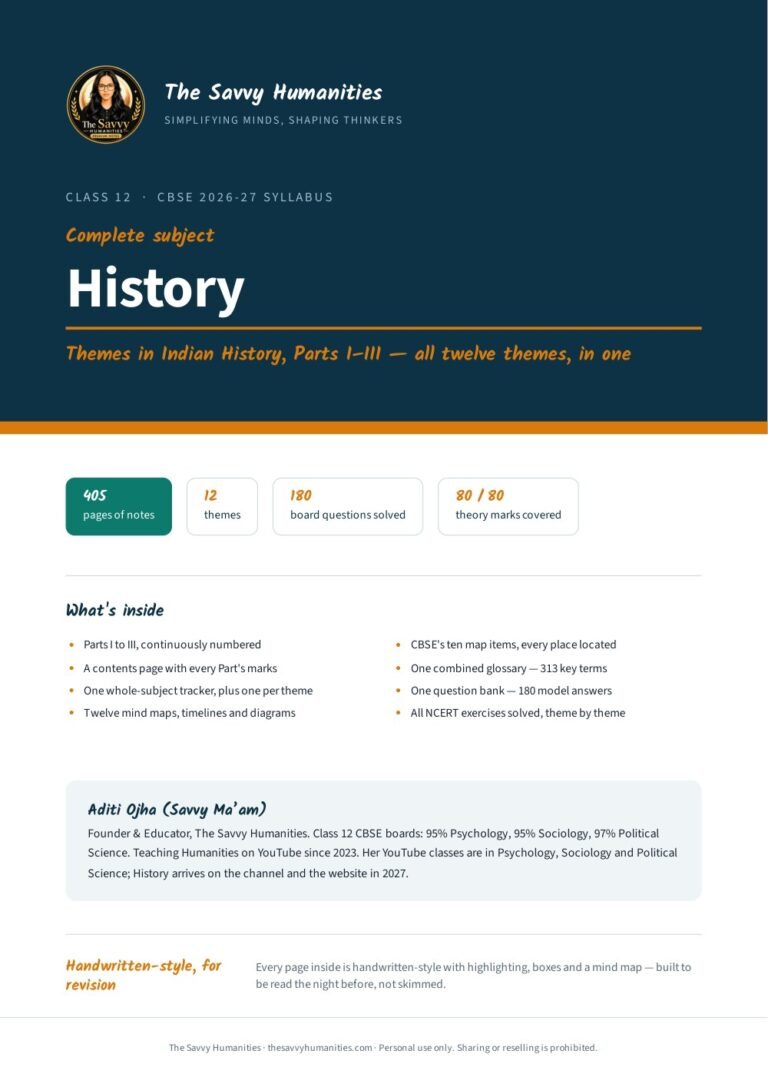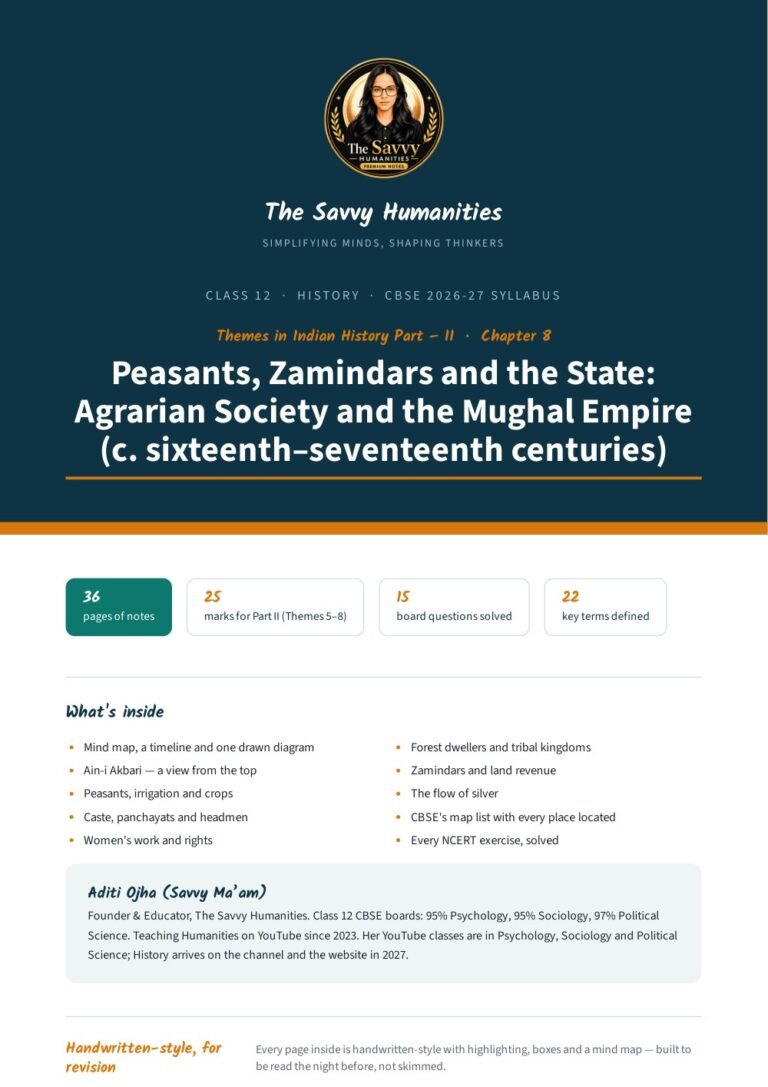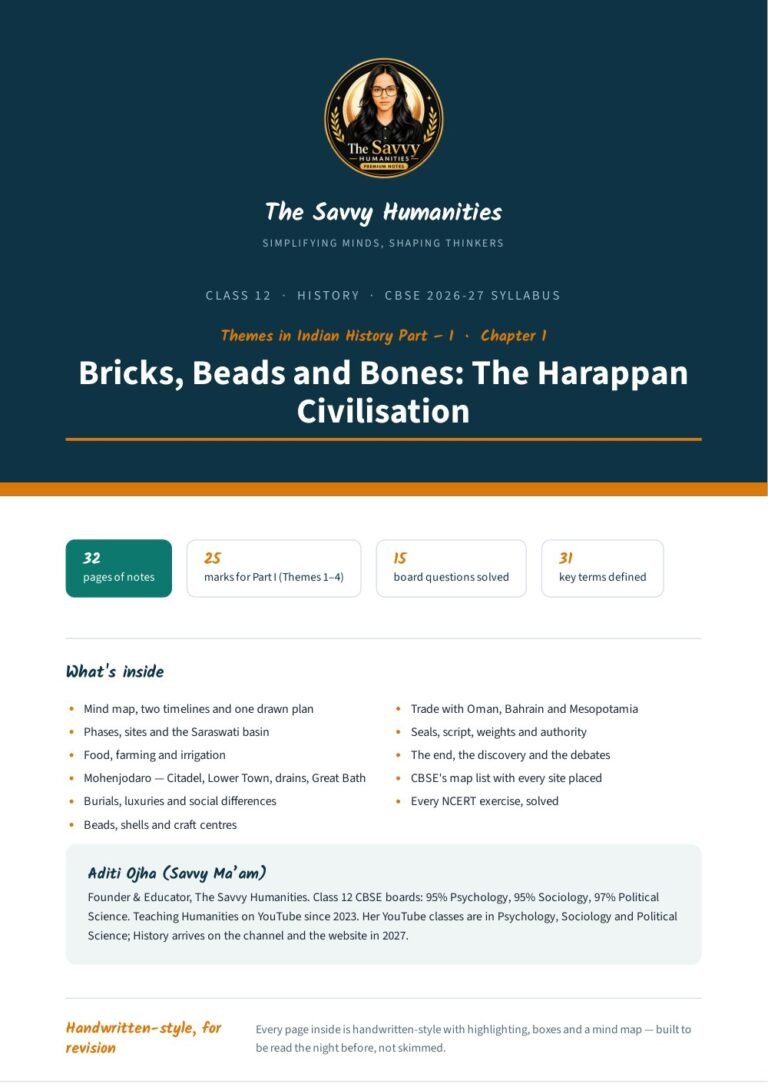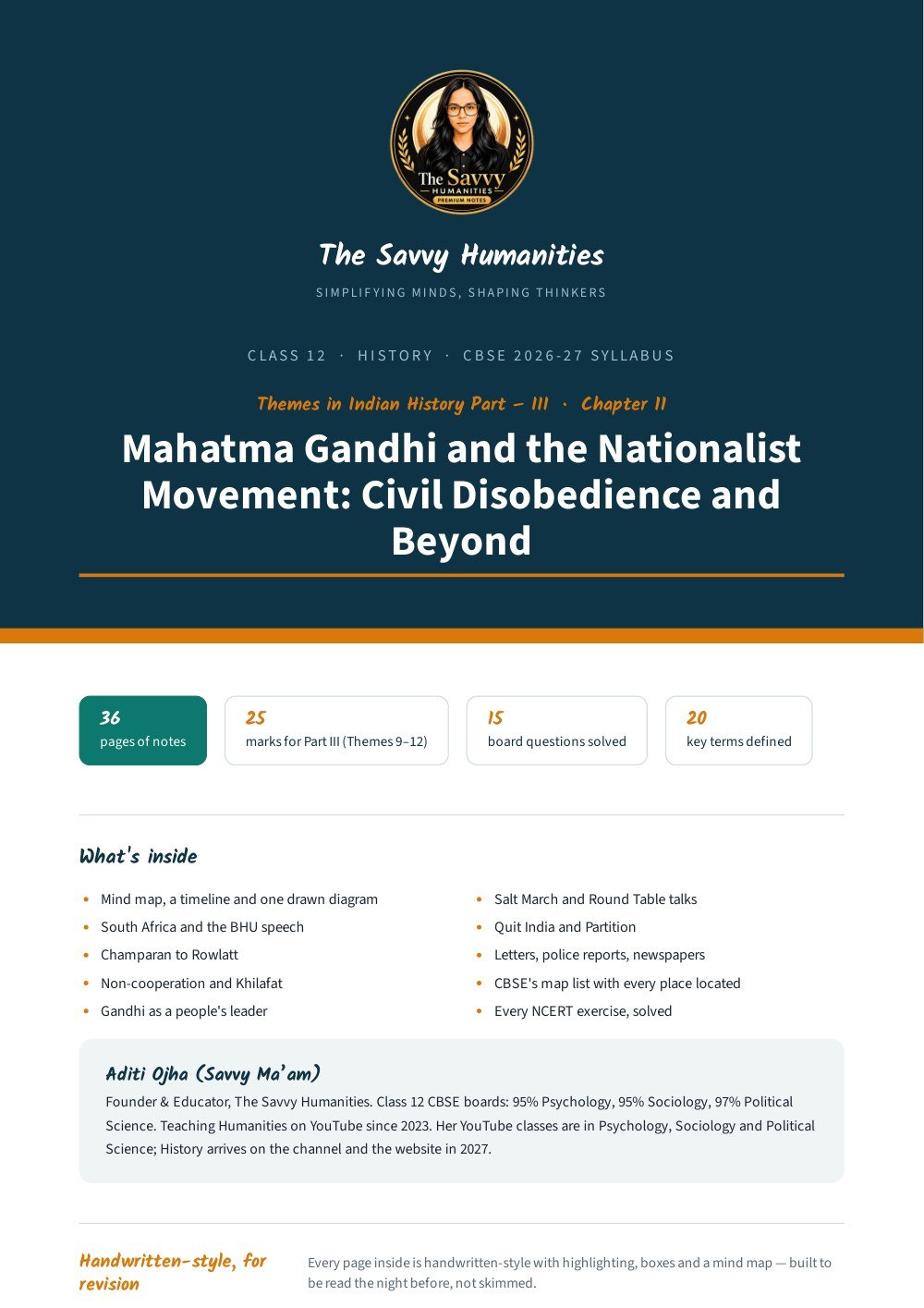
Exam-oriented handwritten-style notes — every page laid out like class notes, with highlighting, boxes and a mind map, built to be read the night before rather than skimmed.
Theme 11 of the CBSE Class 12 History paper sits in Part III (Themes 9–12), which carries 25 marks out of 80 — CBSE gives marks by Part, not by theme. It is one chapter of the NCERT book Themes in Indian History, Part III.
How did Gandhi become a people’s leader?
South Africa and the BHU speech, Champaran, Kheda and Ahmedabad, the Rowlatt satyagraha, then Non-cooperation and Khilafat.
What were the Salt March and Quit India?
The Salt March to Dandi, the Round Table talks and the Gandhi–Irwin Pact, Quit India in 1942, and the last months before Partition.
How do we know Gandhi?
His public voice and private letters, police reports and newspapers — and how each kind of source has to be read with care.
What else is in the file
- Chapter at a glance — a one-page mind map of the whole chapter, with a timeline and one hand-drawn diagram
- A 20-term glossary of every definition the paper can ask for
- 15 questions solved with full model answers — 9 NCERT exercises and 6 board-pattern questions
- CBSE’s map list for this theme with every place located, and NCERT’s map exercise worked out
- A revision tracker to tick off each topic as read, practised and revised
The file
- Format: PDF, A4 — works on a phone and prints cleanly
- Length: 36 pages of notes plus cover
- Delivery: instant download link after payment, plus a copy by email
- Free updates: if CBSE changes the syllabus or a correction goes in, the updated file is sent to you at no cost. You never pay twice for the same chapter.
By Aditi Ojha (Savvy Ma’am) — Founder and educator, The Savvy Humanities. Teaching Humanities on YouTube since 2023. These notes follow the NCERT book chapter by chapter.