Exam-oriented handwritten-style notes — every page laid out like class notes, with highlighting, boxes and mind maps, built to be read the night before rather than skimmed.
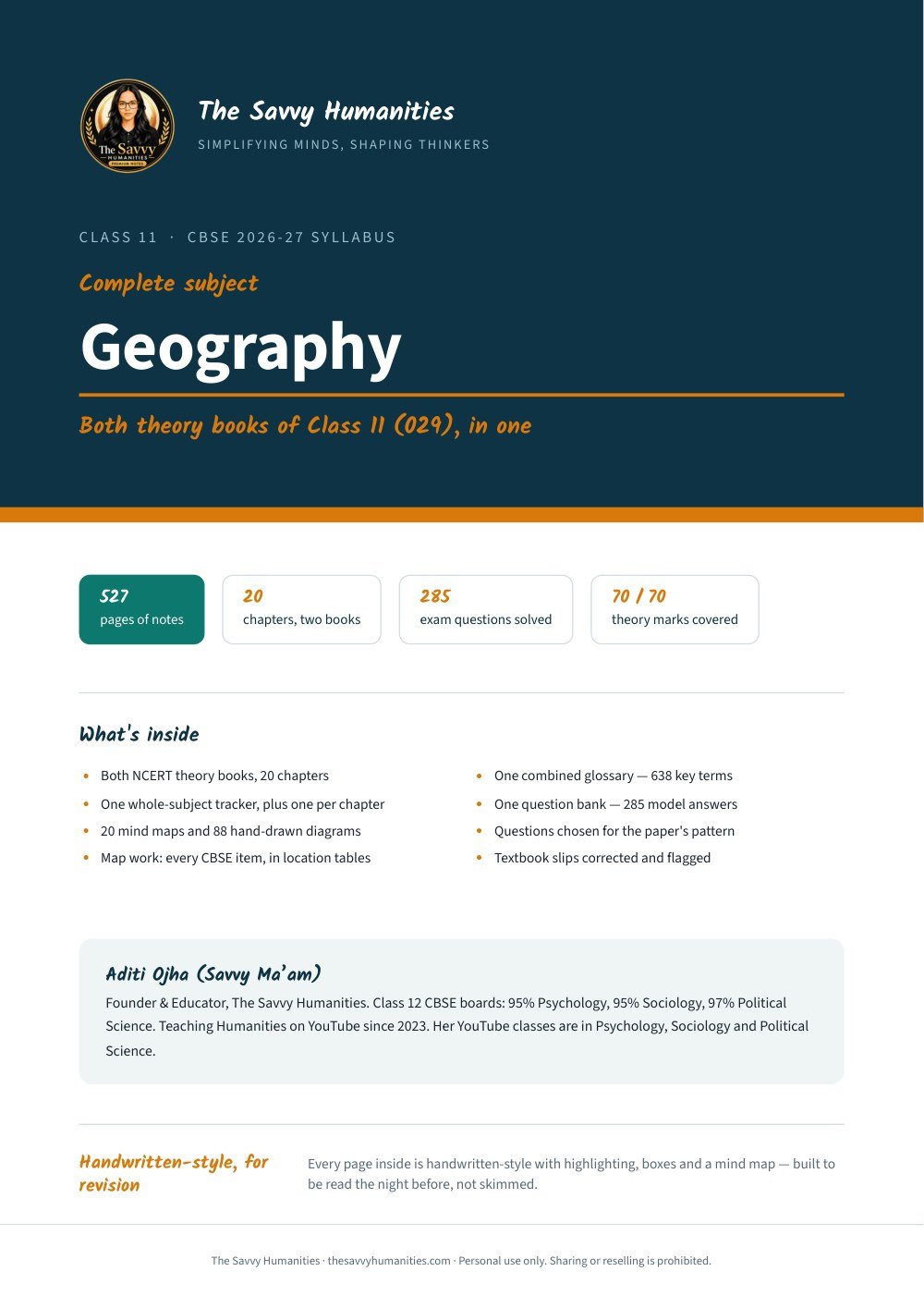
The whole of the CBSE Class 11 Geography theory paper (subject code 029, 70 marks) in one file: both NCERT books, all twenty chapters, continuously numbered and built from CBSE’s 2026-27 curriculum. Each book carries 35 marks — 30 for its units and 5 for map work. Class 11 is examined by your school, on the design CBSE uses for Class 12.
Which chapters of Fundamentals of Physical Geography are covered?
All fourteen — 35 marks. CBSE gives marks by unit, shared by the chapters of that unit.
- Chapter 1: Geography as a Discipline (Unit I · 3 marks)
- Chapter 2: The Origin and Evolution of the Earth (Unit II · 9 marks)
- Chapter 3: Interior of the Earth (Unit II)
- Chapter 4: Distribution of Oceans and Continents (Unit II)
- Chapter 5: Geomorphic Processes (Unit III · 6 marks)
- Chapter 6: Landforms and their Evolution (Unit III)
- Chapter 7: Composition and Structure of Atmosphere (Unit IV · 8 marks)
- Chapter 8: Solar Radiation, Heat Balance and Temperature (Unit IV)
- Chapter 9: Atmospheric Circulation and Weather Systems (Unit IV)
- Chapter 10: Water in the Atmosphere (Unit IV)
- Chapter 11: World Climate and Climate Change (Unit IV · project)
- Chapter 12: Water (Oceans) (Unit V · 4 marks)
- Chapter 13: Movements of Ocean Water (Unit V)
- Chapter 14: Biodiversity and Conservation (Unit VI · project)
Which chapters of India: Physical Environment are covered?
All six — 35 marks.
- Chapter 1: India – Location (Unit I · 5 marks)
- Chapter 2: Structure and Physiography (Unit II · 13 marks)
- Chapter 3: Drainage System (Unit II)
- Chapter 4: Climate (Unit III · 12 marks)
- Chapter 5: Natural Vegetation (Unit III)
- Chapter 6: Natural Hazards and Disasters (Unit IV · project)
The three chapters marked project are tested in school through a project and presentation, not in the written paper. They are here in full, with ten solved questions each and a page of project ideas.
How is each chapter laid out?
A divider page with the chapter’s unit and marks, what the paper wants from it and its revision tracker; then a one-page mind map; then the notes with the diagrams — the layers of the earth, the shadow zones, the heat budget, the pressure belts, the drainage patterns and the river systems of India are all drawn — and, at the end, a facts table and one-line answers. Where NCERT’s textbook slips, the book corrects it in a box and says so.
How is the map work taught?
Map work carries 5 marks in each book. Every item on CBSE’s map list — oceans, plates, currents and deserts of the world; ranges, peaks, passes, rivers, lakes and reserves of India — is given chapter by chapter in a location table that tells you in words where to mark it. Maps themselves are not printed (see below), so practise each item on the outline map in your NCERT book.
What do you get at the back for revision?
One combined glossary of 638 key terms, each tagged by book and chapter, and one question bank with 285 model answers, grouped by chapter — 184 from NCERT’s own exercises, 92 on CBSE’s paper pattern and 9 on the map list, from 1-mark MCQs to 5-mark long answers. There is also one whole-subject revision tracker, plus one for every chapter.
The file
- Format: PDF, A4 — works on a phone and prints cleanly
- Length: 527 pages plus cover
- Delivery: instant download link after payment, plus a copy by email
- Free updates: if CBSE changes the syllabus or a correction goes in, the updated file is sent to you at no cost. You never pay twice for the same book.
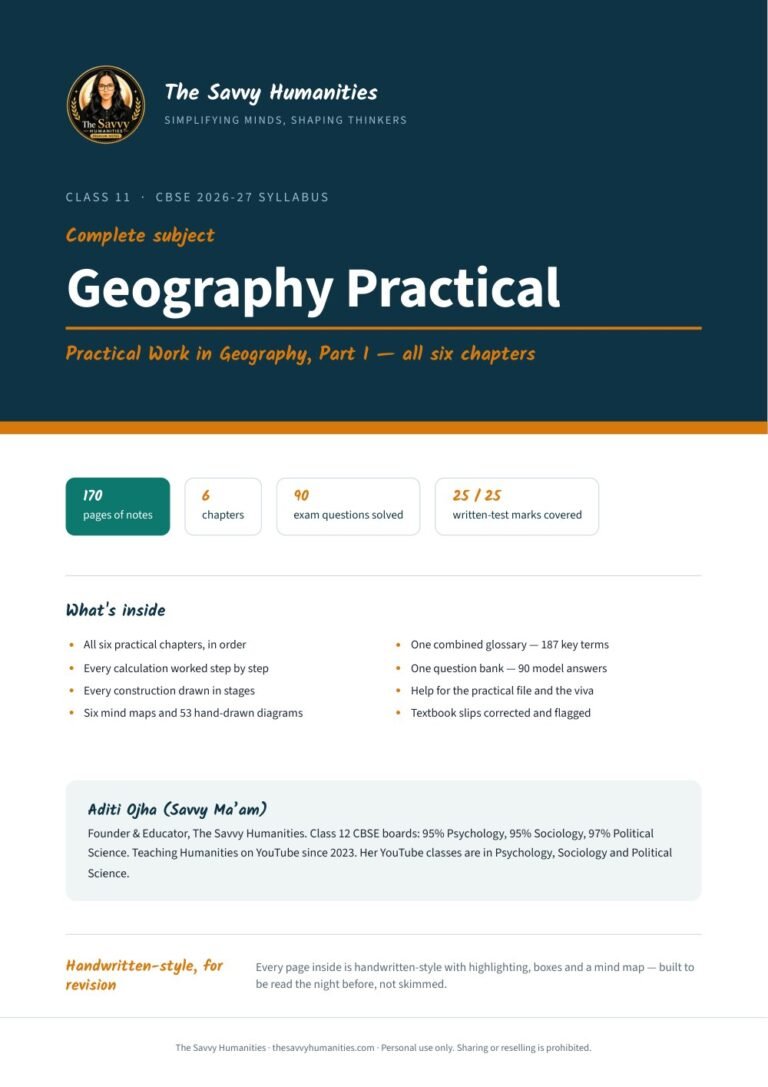
- Not included: maps of India and of the world are not printed — a map showing India’s boundaries has to be the official one. The 30-mark practical (Practical Work in Geography, Part I) is a separate book: Class 11 Geography Practical complete notes.
From The Savvy Humanities by Aditi Ojha (Savvy Ma’am). These Geography notes are built from CBSE’s own 2026-27 curriculum and NCERT’s 2026-27 reprint of the two Class XI textbooks; where the textbook itself slips, the notes say so and give the correct version. Savvy Ma’am’s YouTube classes are in Psychology, Sociology and Political Science; there are no video lessons for Geography.