Exam-oriented handwritten-style notes — every page laid out like class notes, with highlighting, boxes and mind maps, built to be read the night before rather than skimmed.
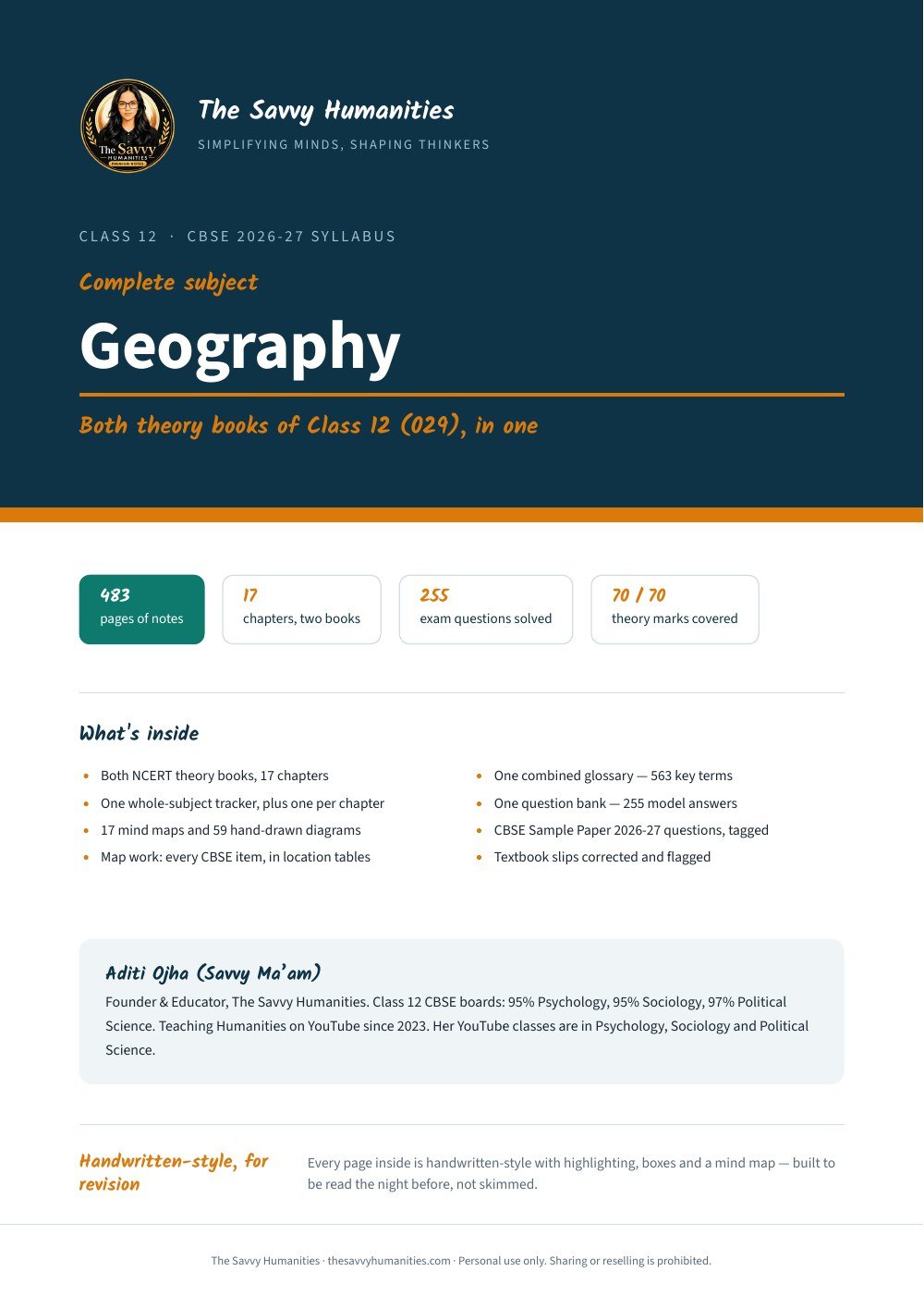
The whole of the CBSE Class 12 Geography theory board paper (subject code 029, 70 marks in 3 hours) in one file: both NCERT books, all seventeen chapters, continuously numbered and built from CBSE’s 2026-27 curriculum. Each book carries 35 marks — 30 for its units and 5 for map work.
Which chapters of Fundamentals of Human Geography are covered?
All eight — 35 marks. CBSE gives marks by unit, shared by the chapters of that unit.
- Chapter 1: Human Geography: Nature and Scope (Unit I · 3 marks)
- Chapter 2: The World Population Distribution, Density and Growth (Unit II · 8 marks)
- Chapter 3: Human Development (Unit II)
- Chapter 4: Primary Activities (Unit III · 19 marks)
- Chapter 5: Secondary Activities (Unit III)
- Chapter 6: Tertiary and Quaternary Activities (Unit III)
- Chapter 7: Transport and Communication (Unit III)
- Chapter 8: International Trade (Unit III)
Which chapters of India: People and Economy are covered?
All nine — 35 marks.
- Chapter 1: Population Distribution, Density, Growth and Composition (Unit I · 5 marks)
- Chapter 2: Human Settlements (Unit II · 3 marks)
- Chapter 3: Land Resources and Agriculture (Unit III · 10 marks)
- Chapter 4: Water Resources (Unit III)
- Chapter 5: Mineral and Energy Resources (Unit III)
- Chapter 6: Planning and Sustainable Development in Indian Context (Unit III)
- Chapter 7: Transport and Communication (Unit IV · 7 marks)
- Chapter 8: International Trade (Unit IV)
- Chapter 9: Geographical Perspective on Selected Issues and Problems (Unit V · 5 marks)
How is each chapter laid out?
A divider page with the chapter’s unit and marks, what the paper wants from it and its revision tracker; then a one-page mind map; then the notes with the diagrams, the map-work table, a facts table and one-line answers. Where NCERT’s textbook slips, the book corrects it in a box and says so. Every diagram is drawn in black and white so that it prints anywhere and can be copied by hand.
How is the map work taught?
Map work carries 5 marks in each book: on the world map you identify five of seven marked features, and on the map of India you locate and label five of seven. Every item on CBSE’s list is given chapter by chapter in a location table that tells you in words where to mark it. Maps themselves are not printed (see below), so practise each item on the outline map in your NCERT book.
What do you get at the back for revision?
One combined glossary of 563 key terms, each tagged by book and chapter, and one question bank with 255 model answers, grouped by chapter — from NCERT’s own exercises and CBSE’s paper pattern, from 1-mark MCQs to 5-mark long answers, with the questions from CBSE’s 2026-27 sample paper tagged. There is also one whole-subject revision tracker, plus one for every chapter.
The file
- Format: PDF, A4 — works on a phone and prints cleanly
- Length: 483 pages plus cover
- Delivery: instant download link after payment, plus a copy by email
- Free updates: if CBSE changes the syllabus or a correction goes in, the updated file is sent to you at no cost. You never pay twice for the same book.
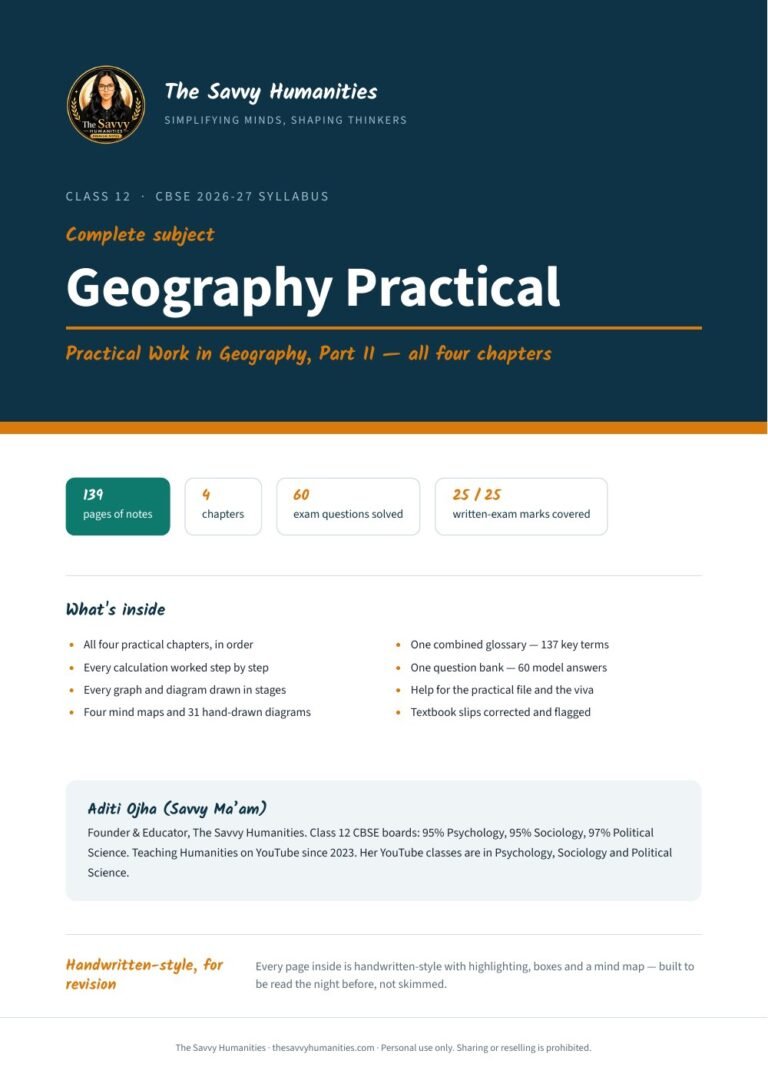
- Not included: maps of India and of the world are not printed — a map showing India’s boundaries has to be the official one. The 30-mark practical (Practical Work in Geography, Part II) is a separate book: Class 12 Geography Practical complete notes.
From The Savvy Humanities by Aditi Ojha (Savvy Ma’am). These Geography notes are built from CBSE’s own 2026-27 curriculum and NCERT’s 2026-27 reprint of the two Class XII textbooks; where the textbook itself slips, the notes say so and give the correct version. Savvy Ma’am’s YouTube classes are in Psychology, Sociology and Political Science; there are no video lessons for Geography.