Exam-oriented handwritten-style notes — every page laid out like class notes, with highlighting, boxes and mind maps, built to be read the night before rather than skimmed.
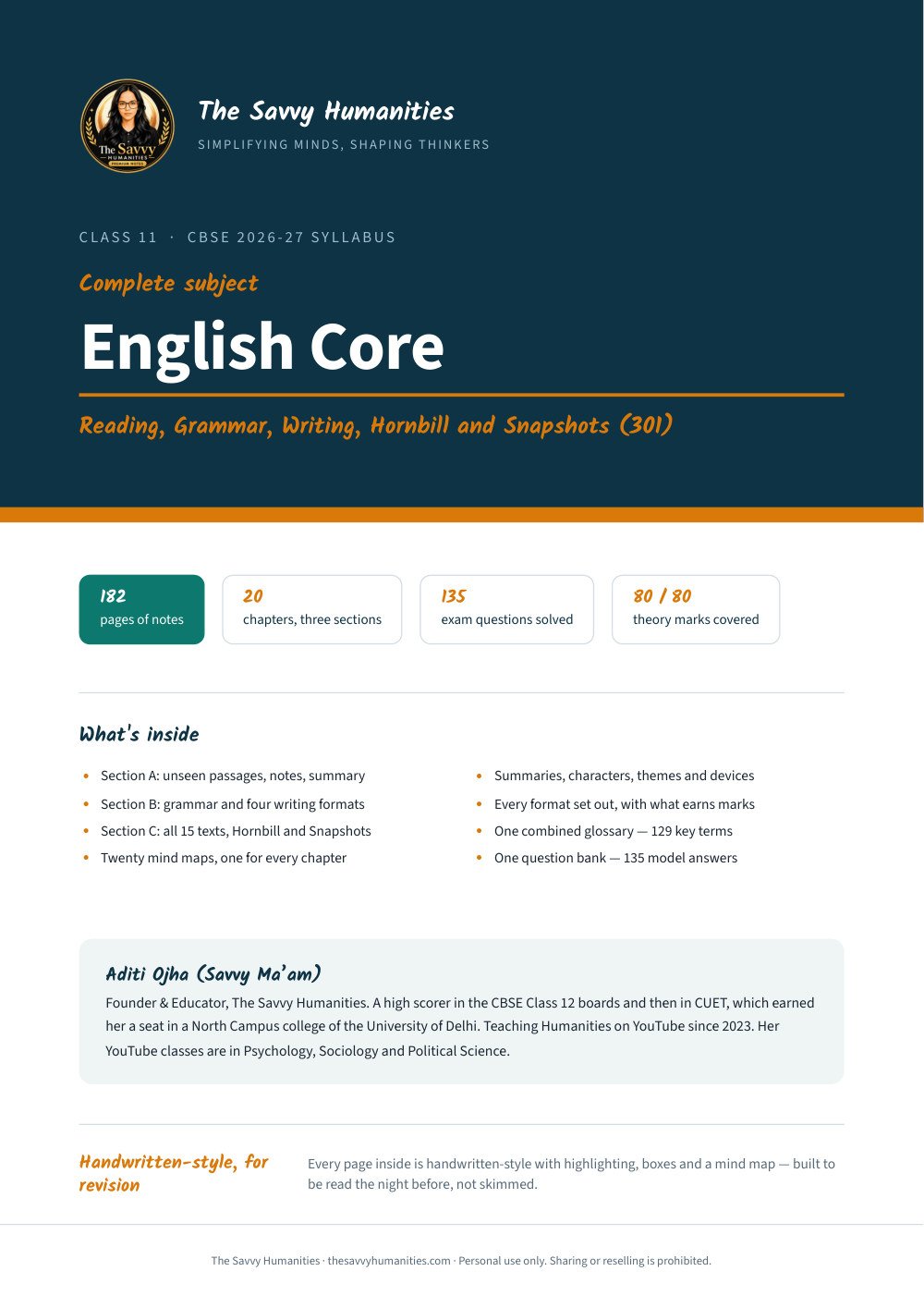
The whole of the CBSE Class 11 English Core theory paper (subject code 301, 80 marks in 3 hours) in one file, in the order of CBSE’s paper: Section A, Reading Skills (26 marks); Section B, Grammar and Creative Writing Skills (23 marks); and Section C, Literature (31 marks) — Hornbill 18 and Snapshots 13. Built from CBSE’s 2026-27 curriculum and NCERT’s 2026-27 reprints of Hornbill and Snapshots. Listening, speaking and project work carry 20 more marks and are assessed in school. Class 11 has no board examination: your school sets the paper.
Which chapters of Class 11 English Core are covered?
All twenty — five skill chapters for Sections A and B, and one chapter for each of the fifteen texts CBSE prescribes for 2026-27.
Section A — Reading Skills
- Chapter 1: Reading Comprehension through Unseen Passages
- Chapter 2: Note Making and Summarization
Section B — Grammar and Creative Writing Skills
- Chapter 3: Grammar
- Chapter 4: Short Writing Tasks: Classified Advertisements and Poster
- Chapter 5: Long Writing Tasks: Speech and Debate
Section C — Hornbill
- Chapter 6: The Portrait of a Lady (prose, Khushwant Singh)
- Chapter 7: A Photograph (poem, Shirley Toulson)
- Chapter 8: We’re Not Afraid to Die… if We Can All Be Together (prose, Gordon Cook and Alan East)
- Chapter 9: Discovering Tut: The Saga Continues (prose, A. R. Williams)
- Chapter 10: The Laburnum Top (poem, Ted Hughes)
- Chapter 11: The Voice of the Rain (poem, Walt Whitman)
- Chapter 12: Childhood (poem, Markus Natten)
- Chapter 13: The Adventure (prose, Jayant Narlikar)
- Chapter 14: Silk Road (prose, Nick Middleton)
- Chapter 15: Father to Son (poem, Elizabeth Jennings)
Section C — Snapshots
- Chapter 16: The Summer of the Beautiful White Horse (prose, William Saroyan)
- Chapter 17: The Address (prose, Marga Minco)
- Chapter 18: Mother’s Day (play, J. B. Priestley)
- Chapter 19: Birth (prose, A. J. Cronin)
- Chapter 20: The Tale of Melon City (poem, Vikram Seth)
How is each chapter laid out?
Each chapter opens with one page: what the paper wants from it, what is left out, and its mind map. Then come the notes, an “At a Glance” table and one-line answers. For a lesson or a poem the notes give the summary, the characters, the themes and the poetic devices in their own words, and point to the lines in your textbook; read the text itself in the textbook first.
How are reading, grammar and writing taught?
As methods, not as lists. Section A gives a step-by-step method for unseen passages, the ten kinds of question CBSE asks, reading tables and charts, and note making with abbreviations, a key and a 50-word summary. Section B covers grammar and the four writing formats the paper asks for — classified advertisement, poster, speech and debate — each set out in full, with what earns marks. Every passage, advertisement, poster, speech and debate was written for this book.
What do you get at the back for revision?
One combined glossary of 129 key terms, tagged by chapter, and one question bank with 135 model answers, grouped by chapter: 68 NCERT exercise questions and 67 questions set on CBSE’s paper pattern, from extract-based questions to 6-mark long answers inside CBSE’s word limits. There is also one revision tracker for all twenty chapters.
The file
- Format: PDF, A4 — works on a phone and prints cleanly
- Length: 182 pages plus cover
- Delivery: instant download link after payment, plus a copy by email
- Free updates: if CBSE changes the syllabus or a correction goes in, the updated file is sent to you at no cost. You never pay twice for the same book.
- Not included: the lessons and poems themselves (read them in the textbook); “The Ailing Planet”, which is printed in Hornbill but not prescribed by CBSE for 2026-27; Hornbill’s sub-titling, essay, letter and creative-writing sections, which the Class 11 paper does not ask; listening, speaking and project work (20 marks, assessed in school).
From The Savvy Humanities by Aditi Ojha (Savvy Ma’am). These English Core notes are built from CBSE’s own 2026-27 curriculum and NCERT’s 2026-27 reprints of Hornbill and Snapshots. Savvy Ma’am’s YouTube classes are in Psychology, Sociology and Political Science; there are no video lessons for English.