Exam-oriented handwritten-style notes — every page laid out like class notes, with highlighting, boxes and mind maps, built to be read the night before the board paper rather than skimmed.
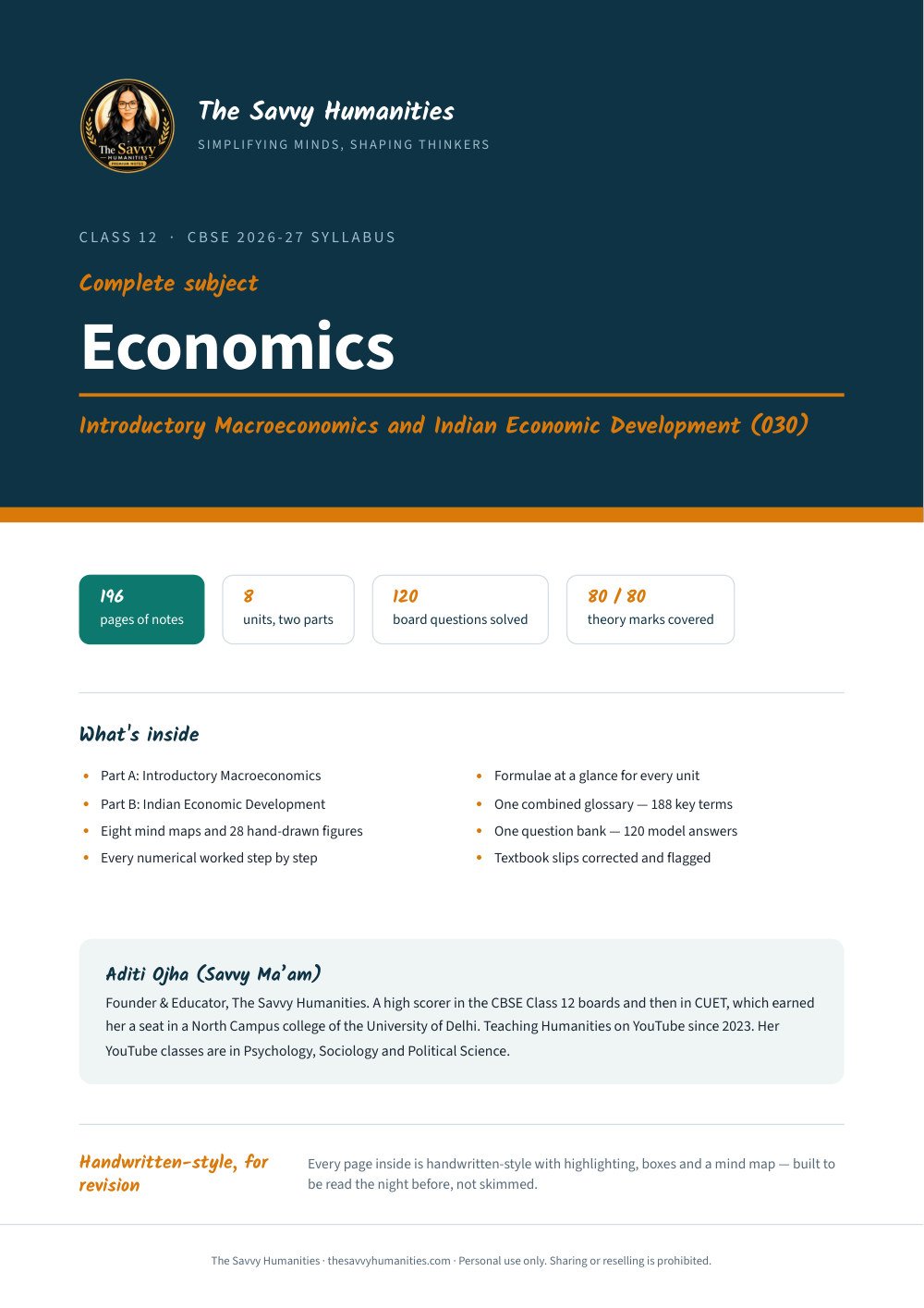
The whole of the CBSE Class 12 Economics board paper (subject code 030, 80 marks in 3 hours) in one file: Part A, Introductory Macroeconomics, and Part B, Indian Economic Development, all eight units in CBSE’s order, built from CBSE’s 2026-27 curriculum and sample paper and NCERT’s 2026-27 reprint of the two textbooks. Each part carries 40 marks; project work carries 20 more and is done in school.
Which units of Class 12 Economics are covered?
All eight, with CBSE’s marks for each.
- Unit 1: National Income and Related Aggregates (Part A · 10 marks)
- Unit 2: Money and Banking (Part A · 6 marks)
- Unit 3: Determination of Income and Employment (Part A · 12 marks)
- Unit 4: Government Budget and the Economy (Part A · 6 marks)
- Unit 5: Balance of Payments (Part A · 6 marks)
- Unit 6: Development Experience (1947-90) and Economic Reforms since 1991 (Part B · 12 marks)
- Unit 7: Current Challenges facing Indian Economy (Part B · 20 marks)
- Unit 8: Development Experience of India – A Comparison with Neighbours (Part B · 8 marks)
How is each unit laid out?
A divider page with the unit’s marks, what the board paper wants from it and its revision tracker; then a one-page mind map; then the notes with worked examples and graphs; then a table of formulae and facts and one-line answers. Where CBSE’s course content needs something the textbook does not explain, it is given in a box headed “Not in the textbook”. Where NCERT’s textbook slips, the book points it out and gives the correct version. Every graph is drawn in black and white so that it prints anywhere and can be copied by hand.
How are the numericals taught?
Step by step: formula first, then the substitution, then the answer. This covers national income by the value added, income and expenditure methods, the money multiplier, the investment multiplier and equilibrium output, and budget deficits. Every worked example and numerical answer was calculated again and checked before it was printed.
What do you get at the back for revision?
One combined glossary of 188 key terms, tagged by unit, and one question bank with 120 model answers, fifteen a unit: all 34 questions of CBSE’s 2026-27 sample paper answered on its marking scheme, NCERT exercise questions and questions set on the board paper’s pattern — from 1-mark MCQs to 6-mark long answers inside CBSE’s word limits. There is also one revision tracker for all eight units.
The file
- Format: PDF, A4 — works on a phone and prints cleanly
- Length: 196 pages plus cover
- Delivery: instant download link after payment, plus a copy by email
- Free updates: if CBSE changes the syllabus or a correction goes in, the updated file is sent to you at no cost. You never pay twice for the same book.
- Not included: project work (20 marks) is done and assessed in school. The demand for money, the government spending and tax multipliers and the open-economy multiplier are outside CBSE’s 2026-27 course content and get only a few lines, clearly marked. Budget figures and survey data stay as NCERT’s 2026-27 reprint gives them, because schools mark against the textbook.
From The Savvy Humanities by Aditi Ojha (Savvy Ma’am). These Economics notes are built from CBSE’s own 2026-27 curriculum and sample paper and NCERT’s 2026-27 reprint of the two Class XII textbooks. Savvy Ma’am’s YouTube classes are in Psychology, Sociology and Political Science; there are no video lessons for Economics.