Exam-oriented handwritten-style notes — every page laid out like class notes, with highlighting, boxes and mind maps, built to be read the night before the board paper rather than skimmed.
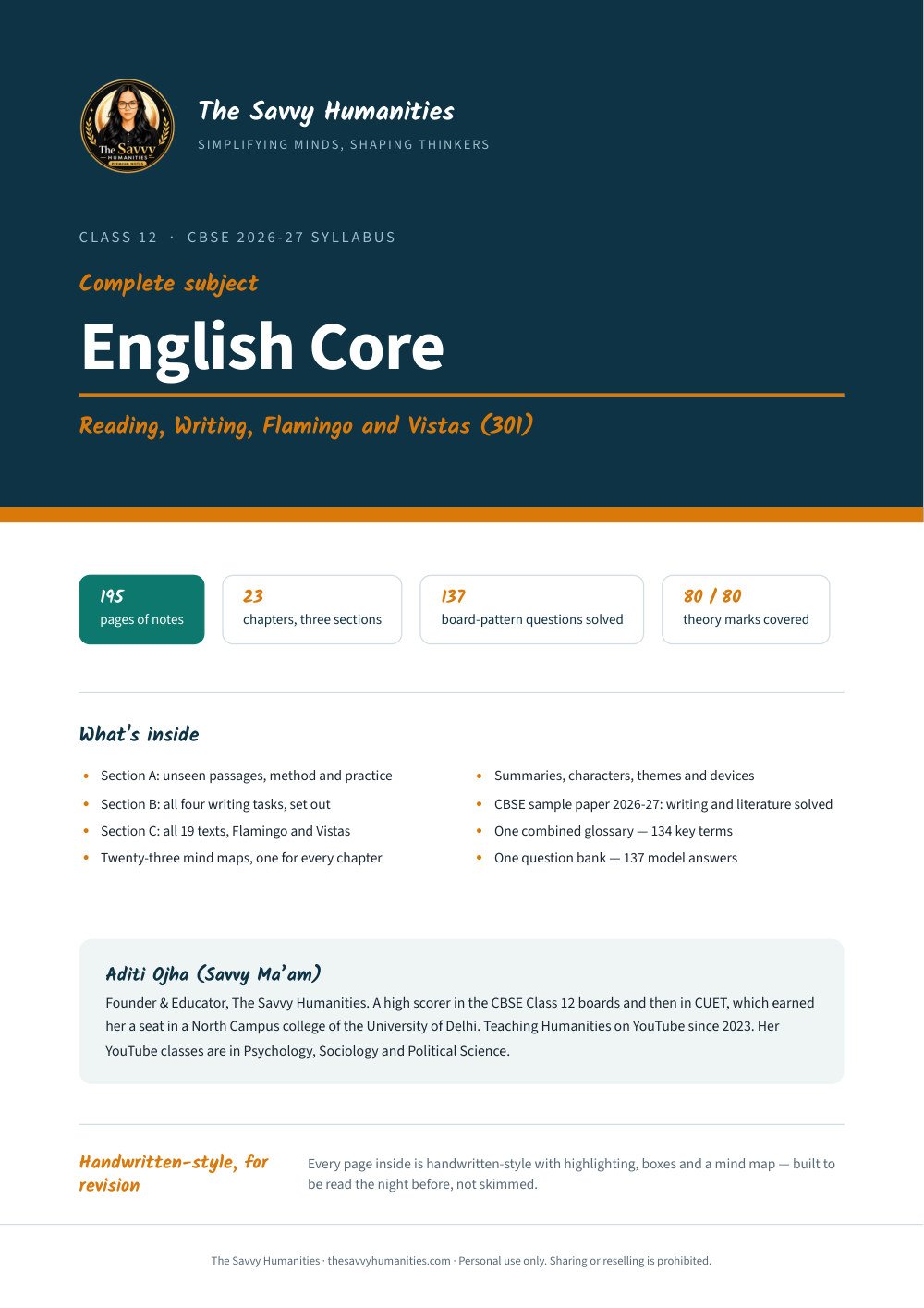
The whole of the CBSE Class 12 English Core board paper (subject code 301, 80 marks in 3 hours) in one file, in the order of CBSE’s paper: Section A, Reading Skills (22 marks); Section B, Creative Writing Skills (18 marks); and Section C, Literature (40 marks) — Flamingo 27 and Vistas 13. Built from CBSE’s 2026-27 curriculum, sample paper and marking scheme and NCERT’s 2026-27 reprints of Flamingo and Vistas. Listening, speaking and project work carry 20 more marks and are assessed in school.
Which chapters of Class 12 English Core are covered?
All twenty-three — four skill chapters for Sections A and B, and one chapter for each of the nineteen texts CBSE prescribes for 2026-27.
Section A — Reading Skills
- Chapter 1: Reading Comprehension through Unseen Passages
Section B — Creative Writing Skills
- Chapter 2: Notice, Invitations and Replies
- Chapter 3: Letters
- Chapter 4: Article and Report Writing
Section C — Flamingo
- Chapter 5: The Last Lesson (prose, Alphonse Daudet)
- Chapter 6: Lost Spring (prose, Anees Jung)
- Chapter 7: Deep Water (prose, William Douglas)
- Chapter 8: The Rattrap (prose, Selma Lagerlöf)
- Chapter 9: Indigo (prose, Louis Fischer)
- Chapter 10: Poets and Pancakes (prose, Asokamitran)
- Chapter 11: The Interview (prose, Christopher Silvester)
- Chapter 12: Going Places (prose, A. R. Barton)
- Chapter 13: My Mother at Sixty-Six (poem, Kamala Das)
- Chapter 14: Keeping Quiet (poem, Pablo Neruda)
- Chapter 15: A Thing of Beauty (poem, John Keats)
- Chapter 16: A Roadside Stand (poem, Robert Frost)
- Chapter 17: Aunt Jennifer’s Tigers (poem, Adrienne Rich)
Section C — Vistas
- Chapter 18: The Third Level (prose, Jack Finney)
- Chapter 19: The Tiger King (prose, Kalki)
- Chapter 20: Journey to the End of the Earth (prose, Tishani Doshi)
- Chapter 21: The Enemy (prose, Pearl S. Buck)
- Chapter 22: On the Face of It (play, Susan Hill)
- Chapter 23: Memories of Childhood (prose, Zitkala-Sa and Bama)
How is each chapter laid out?
Each chapter opens with one page: what the paper wants from it, what is left out, and its mind map. Then come the notes, an “At a Glance” table and one-line answers. For a lesson or a poem the notes give the summary, the characters, the themes and the poetic devices in their own words, and point to the lines in your textbook; read the text itself in the textbook first.
How are reading and writing taught?
As methods and formats. Section A gives a step-by-step method for the two unseen passages, practised on passages written for this book. Section B sets out all four writing tasks the board paper asks for — notice, invitation and reply, letter, and article or report — each in full, with what earns marks on CBSE’s marking scheme.
What do you get at the back for revision?
One combined glossary of 134 key terms, tagged by chapter, and one question bank with 137 model answers, grouped by chapter: 27 questions of CBSE’s own 2026-27 sample paper answered on its marking scheme, 85 NCERT exercise questions and 25 questions set on the board paper’s pattern, inside CBSE’s word limits. There is also one revision tracker for all twenty-three chapters.
The file
- Format: PDF, A4 — works on a phone and prints cleanly
- Length: 195 pages plus cover
- Delivery: instant download link after payment, plus a copy by email
- Free updates: if CBSE changes the syllabus or a correction goes in, the updated file is sent to you at no cost. You never pay twice for the same book.
- Not included: the lessons and poems themselves (read them in the textbook); the sample paper’s two reading passages, which come from outside sources (Chapter 1 teaches the method on passages of the same kind); listening, speaking and project work (20 marks, assessed in school).
From The Savvy Humanities by Aditi Ojha (Savvy Ma’am). These English Core notes are built from CBSE’s own 2026-27 curriculum and sample paper and NCERT’s 2026-27 reprints of Flamingo and Vistas. Savvy Ma’am’s YouTube classes are in Psychology, Sociology and Political Science; there are no video lessons for English.