Exam-oriented handwritten-style notes, in Hindi — every page laid out like class notes, with highlighting, boxes and mind maps, built to be read the night before rather than skimmed.
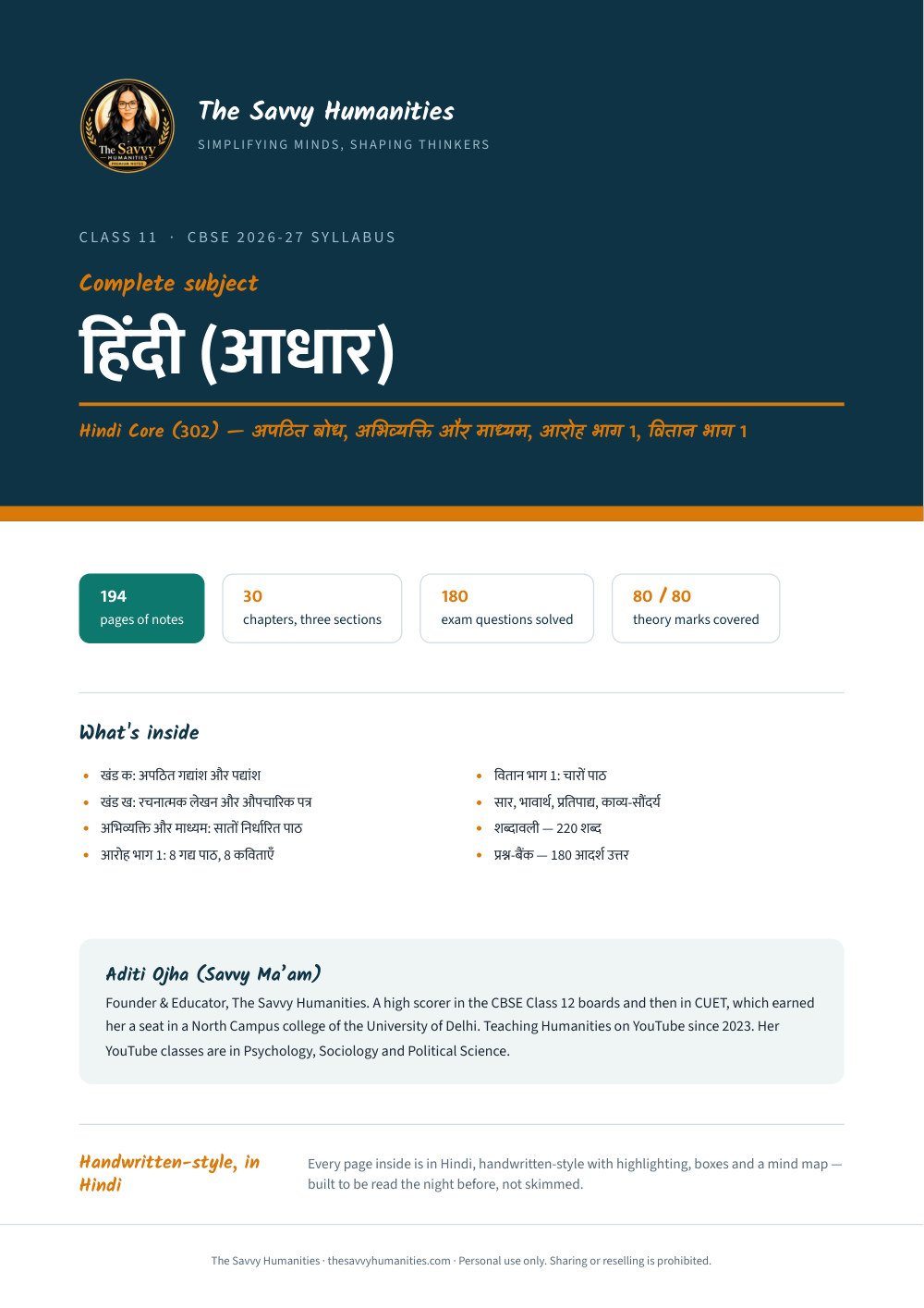
The whole of the CBSE Class 11 Hindi Core (हिंदी आधार) theory paper (subject code 302, 80 marks in 3 hours) in one file, in the order of CBSE’s paper: खंड क — अपठित बोध (18 marks); खंड ख — अभिव्यक्ति और माध्यम (22 marks); and खंड ग — आरोह भाग 1 and वितान भाग 1 (40 marks). Built from CBSE’s 2026-27 curriculum and NCERT’s 2026-27 textbooks. Class 11 has no board examination: your school sets the paper.
Which chapters of Class 11 Hindi Core are covered?
All thirty, in CBSE’s order.
खंड क — अपठित बोध
- Chapter 1: अपठित बोध: गद्यांश और पद्यांश
खंड ख — अभिव्यक्ति और माध्यम (लेखन and पाठ 1, 2, 9, 10, 14, 15, 16)
- Chapter 2: रचनात्मक लेखन
- Chapter 3: औपचारिक पत्र लेखन
- Chapter 4: जनसंचार माध्यम
- Chapter 5: पत्रकारिता के विविध आयाम
- Chapter 6: डायरी लिखने की कला
- Chapter 7: कथा-पटकथा
- Chapter 8: कार्यालयी लेखन और प्रक्रिया
- Chapter 9: स्ववृत्त (बायोडेटा) लेखन और रोज़गार संबंधी आवेदन पत्र
- Chapter 10: कोश–एक परिचय
खंड ग — आरोह भाग 1, गद्य खंड
- Chapter 11: नमक का दारोगा — प्रेमचंद
- Chapter 12: मियाँ नसीरुद्दीन — कृष्णा सोबती
- Chapter 13: अपू के साथ ढाई साल — सत्यजित राय
- Chapter 14: विदाई-संभाषण — बालमुकुंद गुप्त
- Chapter 15: गलता लोहा — शेखर जोशी
- Chapter 16: रजनी — मन्नू भंडारी
- Chapter 17: जामुन का पेड़ — कृश्नचंदर
- Chapter 18: भारत माता — जवाहरलाल नेहरू
खंड ग — आरोह भाग 1, काव्य खंड
- Chapter 19: हम तौ एक एक करि जांनां — कबीर
- Chapter 20: मेरे तो गिरधर गोपाल, दूसरो न कोई — मीरा
- Chapter 21: घर की याद — भवानी प्रसाद मिश्र
- Chapter 22: चंपा काले काले अच्छर नहीं चीन्हती — त्रिलोचन
- Chapter 23: ग़ज़ल — दुष्यंत कुमार
- Chapter 24: हे भूख! मत मचल; हे मेरे जूही के फूल जैसे ईश्वर — अक्कमहादेवी
- Chapter 25: सबसे खतरनाक — अवतार सिंह पाश
- Chapter 26: आओ, मिलकर बचाएँ — निर्मला पुतुल
खंड ग — वितान भाग 1
- Chapter 27: भारतीय गायिकाओं में बेजोड़: लता मंगेशकर — कुमार गंधर्व
- Chapter 28: राजस्थान की रजत बूँदें — अनुपम मिश्र
- Chapter 29: आलो-आँधारि — बेबी हालदार
- Chapter 30: भारतीय कलाएँ
How is each chapter laid out?
Each chapter opens with one page: what the paper wants from it, what is left out, and its mind map. For a lesson or a poem the notes give the सार, भावार्थ, प्रतिपाद्य and काव्य-सौंदर्य in their own words and point to the lines in your textbook — read the text itself in the textbook first. अपठित बोध, रचनात्मक लेखन and औपचारिक पत्र are taught as methods and formats, with what earns marks.
What do you get at the back for revision?
One combined glossary (शब्दावली) of 220 terms, tagged by chapter, and one question bank (प्रश्न-बैंक) with 180 model answers, in chapter order, inside CBSE’s word limits. There is also one revision tracker for all thirty chapters.
The file
- Language: Hindi (Devanagari)
- Format: PDF, A4 — works on a phone and prints cleanly
- Length: 194 pages plus cover
- Delivery: instant download link after payment, plus a copy by email
- Free updates: if CBSE changes the syllabus or a correction goes in, the updated file is sent to you at no cost. You never pay twice for the same book.
- Not included: the lessons and poems themselves (read them in the textbook); listening, speaking and project work, which are assessed in school.
From The Savvy Humanities by Aditi Ojha (Savvy Ma’am). These Hindi Core notes are built from CBSE’s own 2026-27 curriculum and NCERT’s 2026-27 textbooks. Savvy Ma’am’s YouTube classes are in Psychology, Sociology and Political Science; there are no video lessons for Hindi.