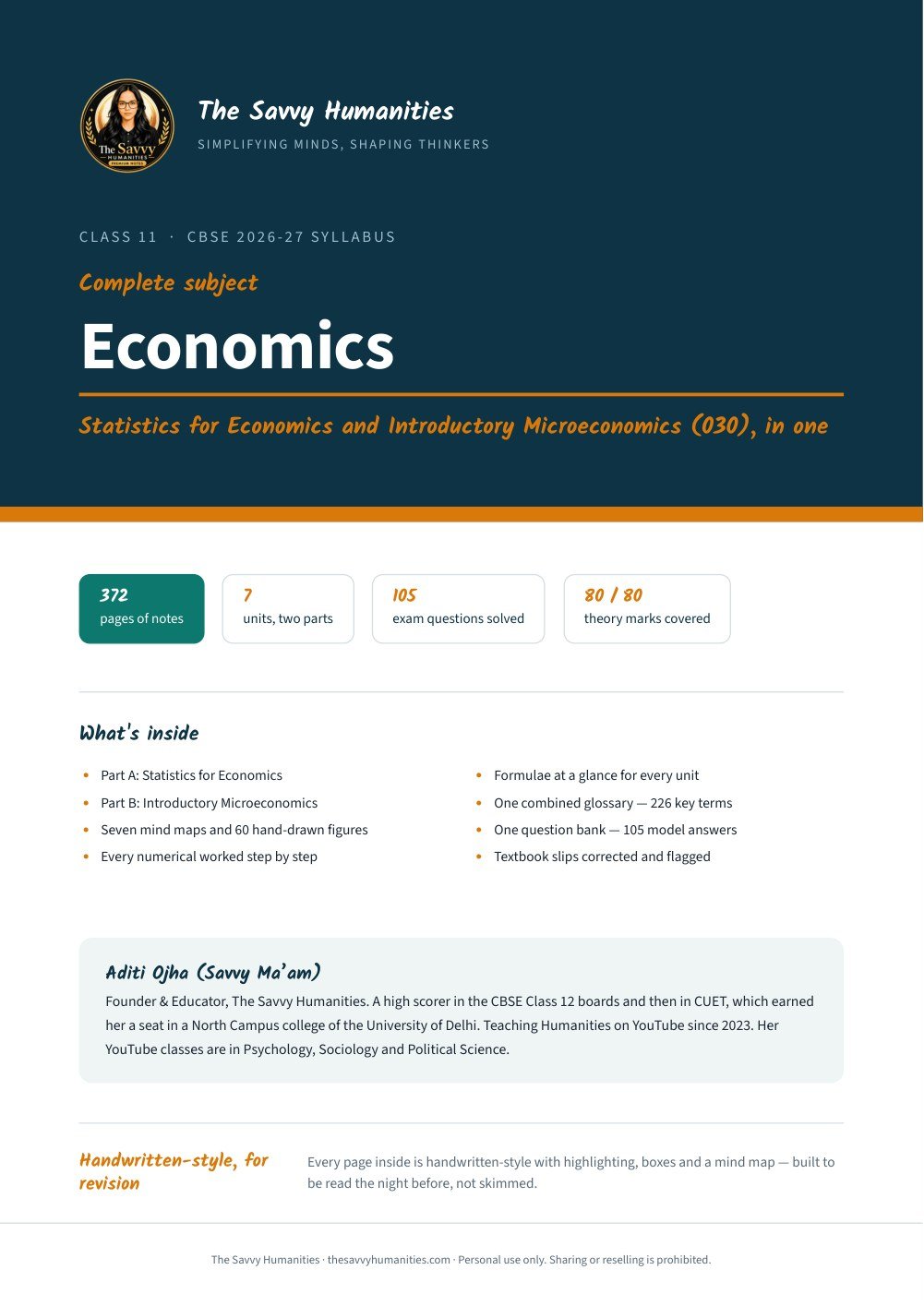
Exam-oriented handwritten-style notes — every page laid out like class notes, with highlighting, boxes and mind maps, built to be read the night before rather than skimmed.
The whole of the CBSE Class 11 Economics theory paper (subject code 030, 80 marks in 3 hours) in one file: Part A, Statistics for Economics, and Part B, Introductory Microeconomics, all seven units in CBSE’s order and built from CBSE’s 2026-27 curriculum and NCERT’s 2026-27 reprint of the two textbooks. Each part carries 40 marks; project work carries 20 more and is done in school. Class 11 has no board examination: your school sets the paper on the design CBSE uses for Class 12.
Which units of Class 11 Economics are covered?
All seven. CBSE gives marks by unit, and Units 1 and 2 share 15 marks.
- Unit 1: Introduction (Part A · Units 1 and 2 share 15 marks)
- Unit 2: Collection, Organisation and Presentation of Data (Part A · Units 1 and 2 share 15 marks)
- Unit 3: Statistical Tools and Interpretation (Part A · 25 marks)
- Unit 4: Introduction (Part B · 4 marks)
- Unit 5: Consumer’s Equilibrium and Demand (Part B · 14 marks)
- Unit 6: Producer Behaviour and Supply (Part B · 14 marks)
- Unit 7: Perfect Competition – Price Determination and Simple Applications (Part B · 8 marks)
How is each unit laid out?
A divider page with the unit’s marks, what the paper wants from it and its revision tracker; then a one-page mind map; then the notes with worked examples and graphs; then a table of formulae and facts and one-line answers. Where NCERT’s textbook slips, the book corrects it in a box and says so. Every graph is drawn in black and white so that it prints anywhere and can be copied by hand.
How are the numericals taught?
Step by step, formula first, then the table or substitution, then the answer with one line on what it means — because CBSE asks for the interpretation. This covers the mean by the direct, assumed mean and step deviation methods, the median and the mode, Karl Pearson’s coefficient of correlation, Spearman’s rank correlation and index numbers in Unit 3, and elasticity, cost schedules and equilibrium price in Part B. Every worked example and numerical answer was calculated again and checked before it was printed.
What do you get at the back for revision?
One combined glossary of 226 key terms, tagged by unit, and one question bank with 105 model answers, fifteen a unit, from 1-mark MCQs to 6-mark long answers on CBSE’s paper pattern. There is also one revision tracker for all seven units, and a tracker page on every unit.
The file
- Format: PDF, A4 — works on a phone and prints cleanly
- Length: 372 pages plus cover
- Delivery: instant download link after payment, plus a copy by email
- Free updates: if CBSE changes the syllabus or a correction goes in, the updated file is sent to you at no cost. You never pay twice for the same book.
- Not included: project work (20 marks) is done and assessed in school; NCERT’s Chapter 8 is a guide to it and is not part of the written paper. Measures of dispersion, monopoly and other forms of market are outside CBSE’s 2026-27 course content, and the long run gets only a few lines, clearly marked.
From The Savvy Humanities by Aditi Ojha (Savvy Ma’am). These Economics notes are built from CBSE’s own 2026-27 curriculum and NCERT’s 2026-27 reprint of the two Class XI textbooks; where the textbook itself slips, the notes say so and give the correct version. Savvy Ma’am’s YouTube classes are in Psychology, Sociology and Political Science; there are no video lessons for Economics.