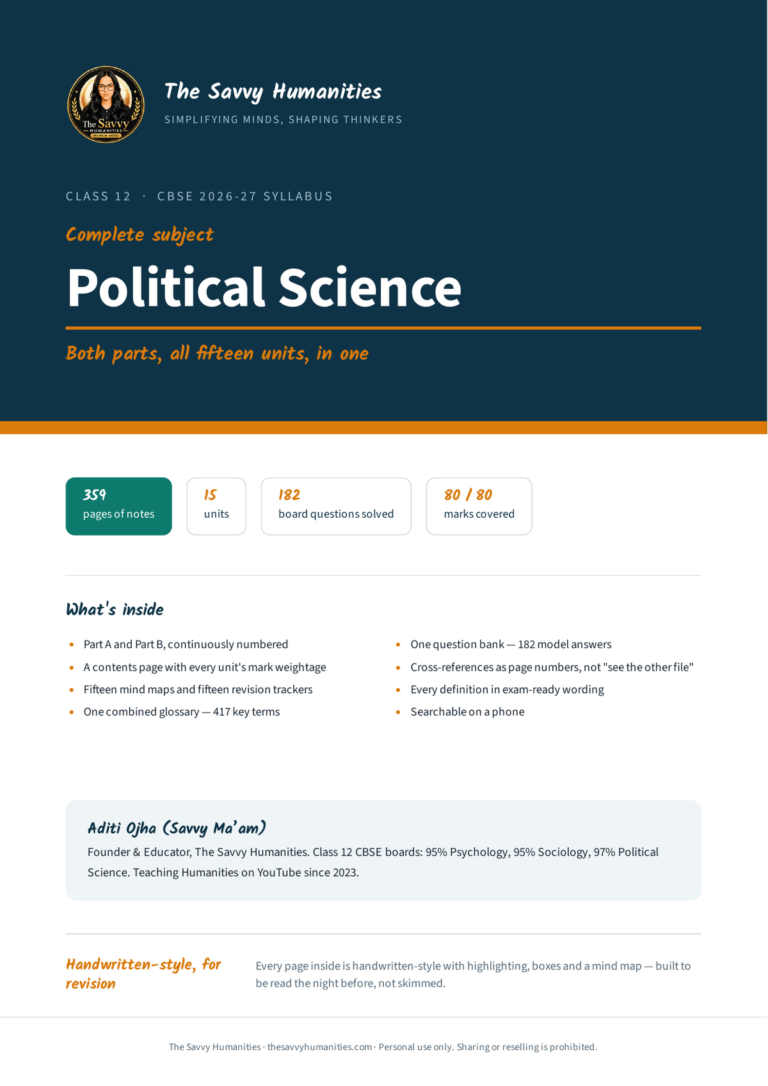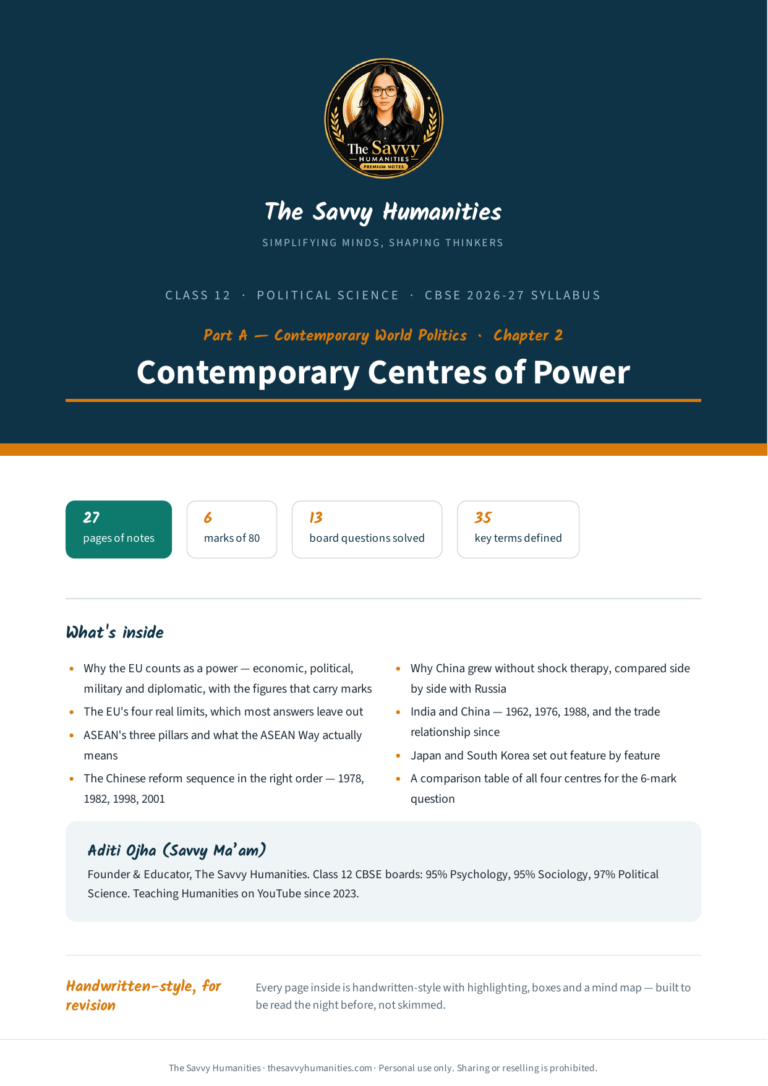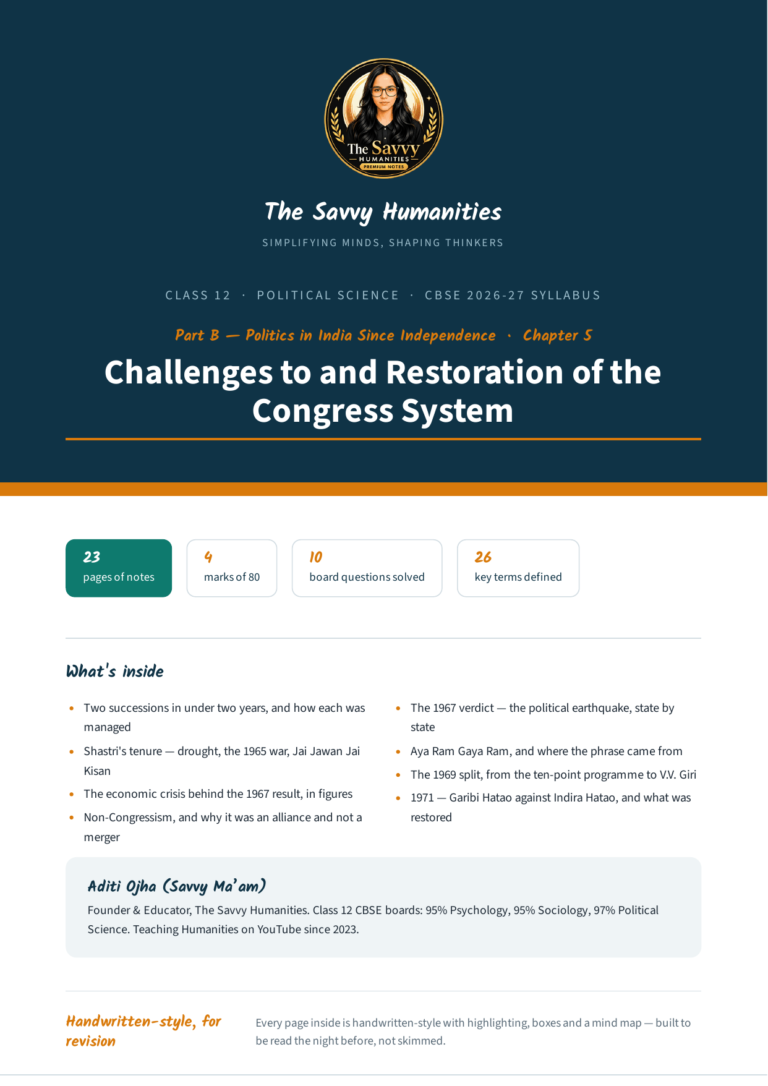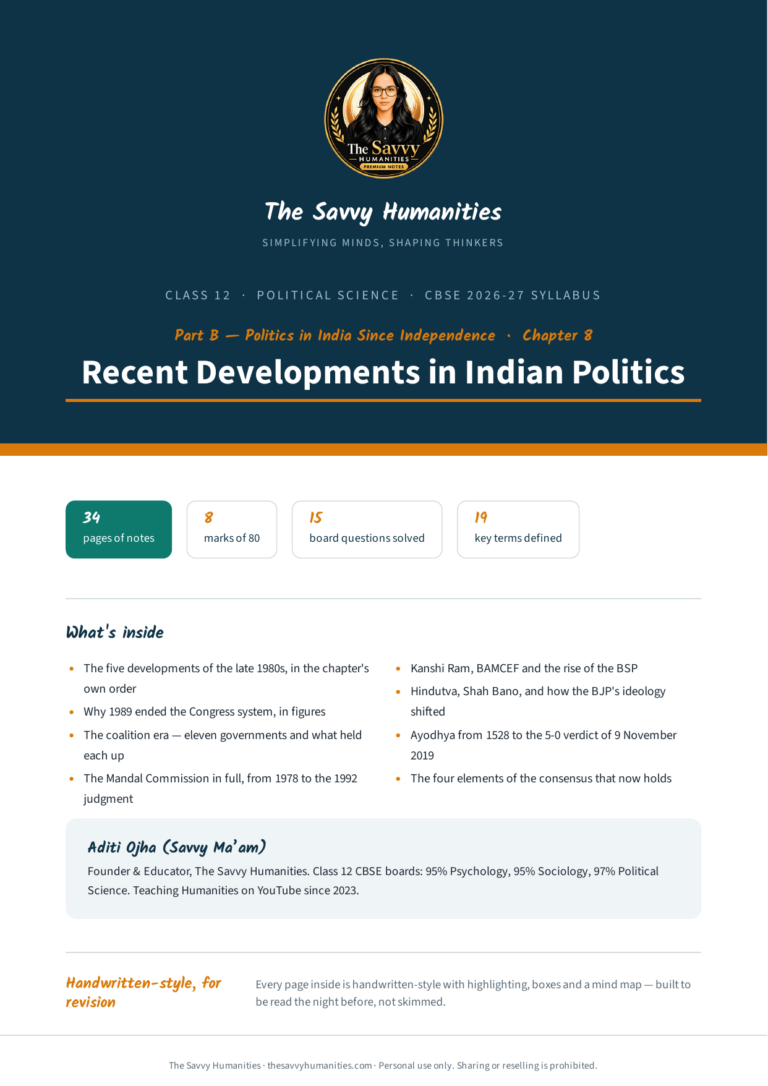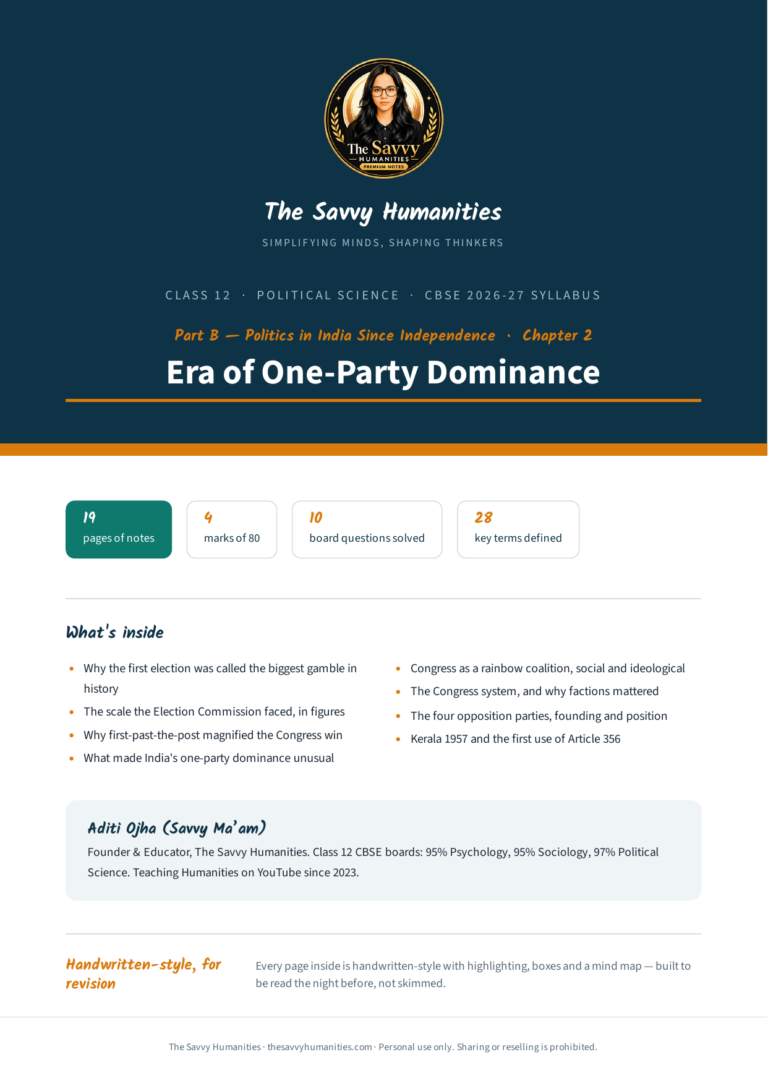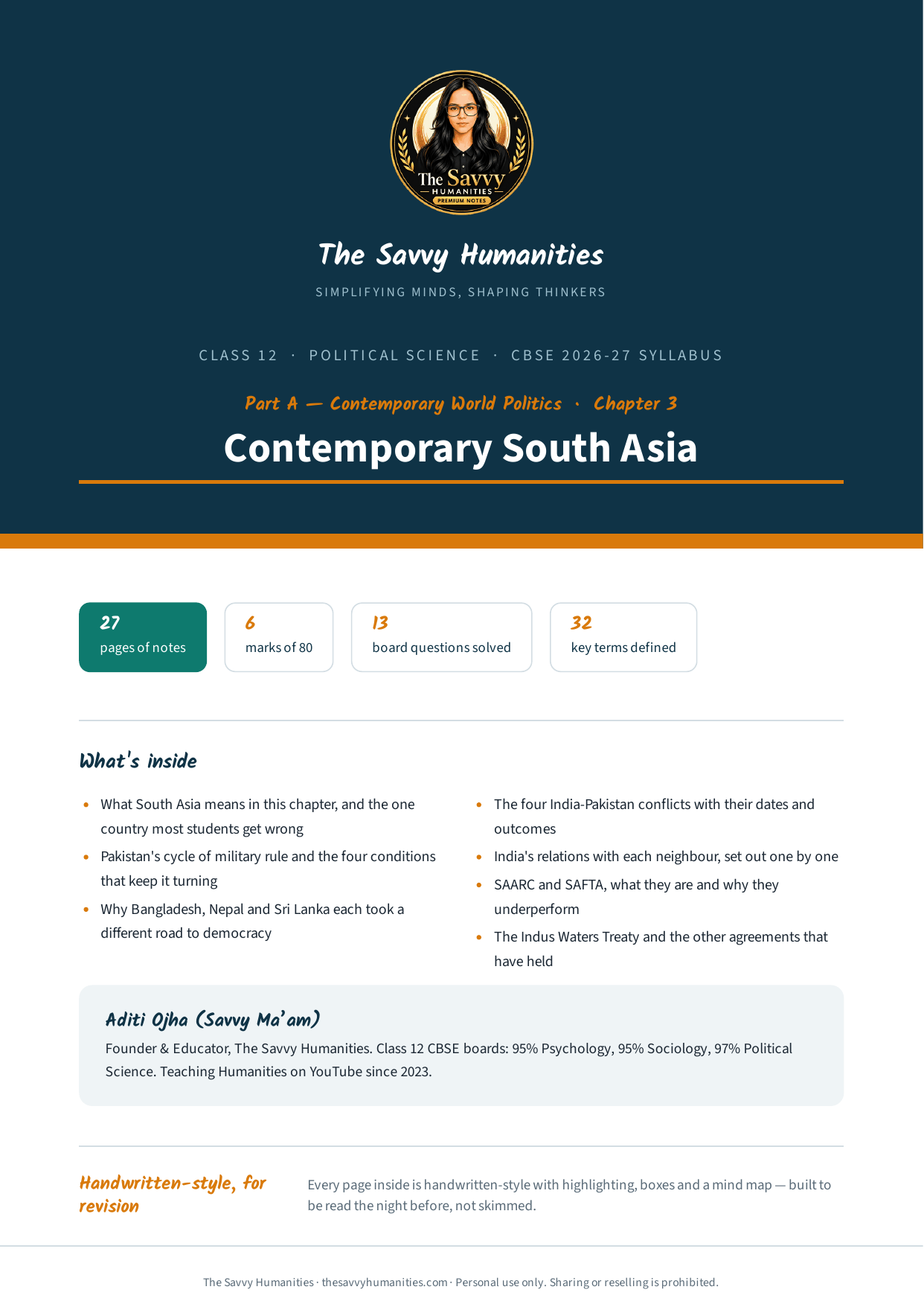
Exam-oriented handwritten-style notes — every page laid out like class notes, with highlighting, boxes and a mind map, built to be read the night before rather than skimmed.
Unit 3 of the CBSE Class 12 Political Science paper carries 6 marks out of 80, checked against CBSE’s own 2026-27 curriculum document. It is the unit with the most names and dates in it, and the one where an answer either has the sequence right or does not.
What is inside
- Chapter at a glance — a one-page mind map of the whole chapter
- Complete topic-by-topic notes, NCERT-aligned, in CBSE’s own topic order
- What South Asia means in this chapter, and the one country most students get wrong — the seven states of the region, and why Afghanistan is counted in
- Pakistan’s cycle of military rule and the four conditions that keep it turning — Ayub Khan, Yahya Khan, Zia-ul-Haq and Musharraf in order, with the democratic periods between them under Zulfikar Ali Bhutto, Benazir Bhutto and Nawaz Sharif
- Why Bangladesh, Nepal and Sri Lanka each took a different road to democracy — Bangladesh from 1971 through military rule to elected government; Nepal from constitutional monarchy to a federal democratic republic in 2008; Sri Lanka’s long ethnic conflict between the Sinhala majority and Tamil minority, the LTTE’s demand for Tamil Eelam, and the 1987 accord under which the IPKF was sent and withdrew in 1989
- The four India-Pakistan conflicts with their dates and outcomes — 1947-48, 1965 and the Tashkent Agreement, 1971 and the Shimla Agreement of 1972, and Kargil 1999, fought on the Indian side of the Line of Control and the first between two nuclear-armed neighbours
- India’s relations with each neighbour, set out one by one — Pakistan, Bangladesh, Nepal, Sri Lanka, Bhutan, the Maldives and Afghanistan, so a question on any one of them has its own answer ready
- SAARC and SAFTA, what they are and why they underperform — 1985 and 2006, and the bilateralism India has generally preferred
- The Indus Waters Treaty and the other agreements that have held — the 1960 treaty that has survived every conflict between the two countries, which is the point the examiner wants made
- A 32-term glossary of every definition the paper can ask for
- 13 board-pattern questions with full model answers
- A revision tracker to tick off each topic as read, practised and revised
Written for the 2026-27 syllabus
Nothing from CBSE’s list for this unit is left out — all six sub-topics are covered in full. Afghanistan, Bhutan and the Maldives are included because NCERT treats them as part of the region, although the paper asks about them far less often than Pakistan, Bangladesh, Nepal and Sri Lanka — and the notes say so, rather than giving every country equal weight.
The Cold War Era and US Hegemony in World Politics are not covered anywhere in this set, because CBSE removed them from the 2026-27 syllabus.
The file
- Format: PDF, A4 — works on a phone and prints cleanly
- Length: 27 pages plus cover
- Delivery: instant download link after payment, plus a copy by email
- Free updates: if CBSE changes the syllabus or a correction goes in, the updated file is sent to you at no cost. You never pay twice for the same chapter.
By Aditi Ojha (Savvy Ma’am) — Founder and educator, The Savvy Humanities. Teaching Humanities on YouTube since 2023. These notes pair with the free chapter video; QR codes inside the file link to it.