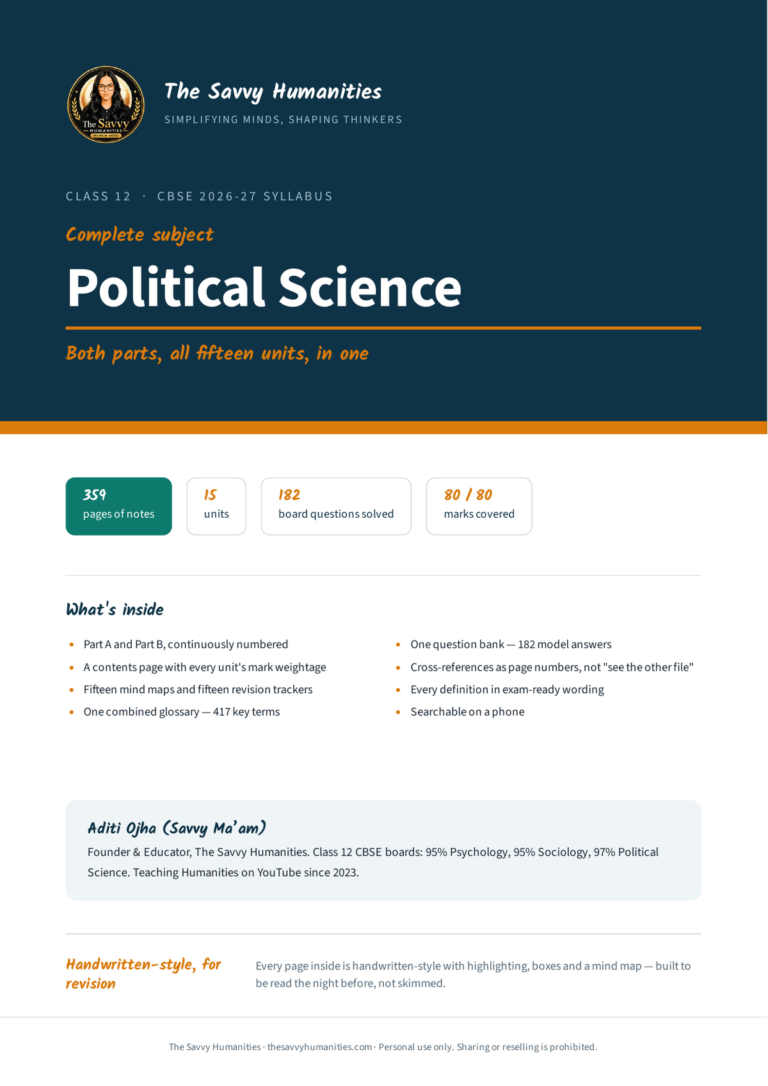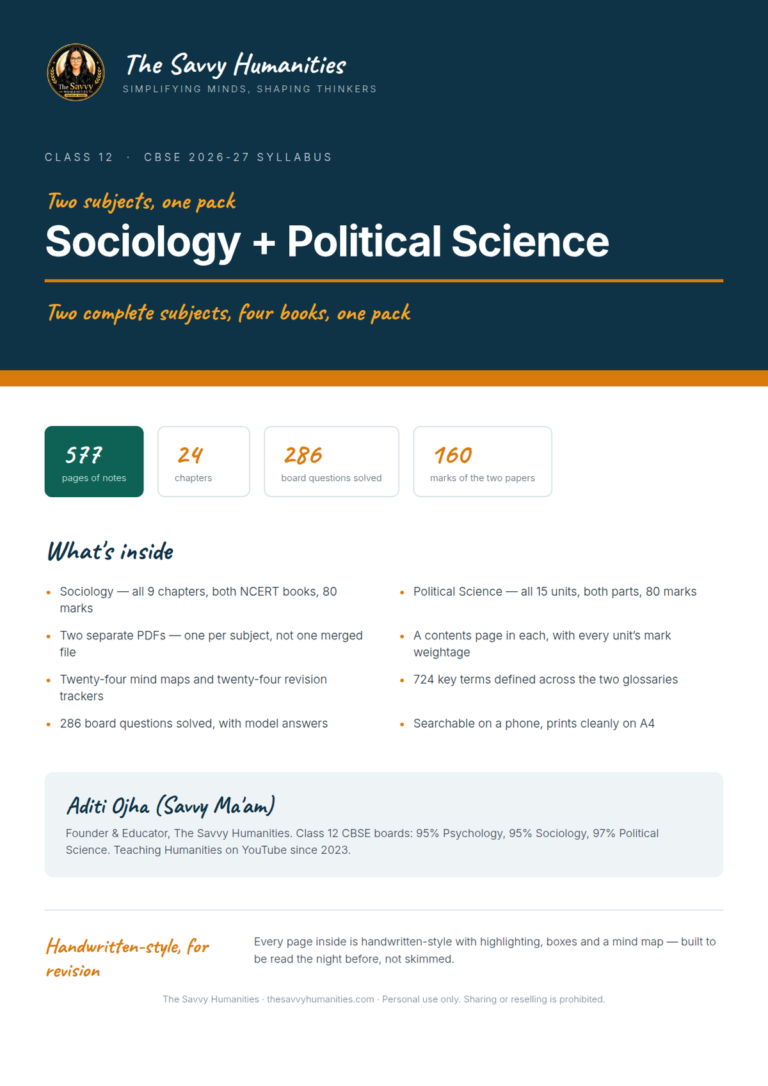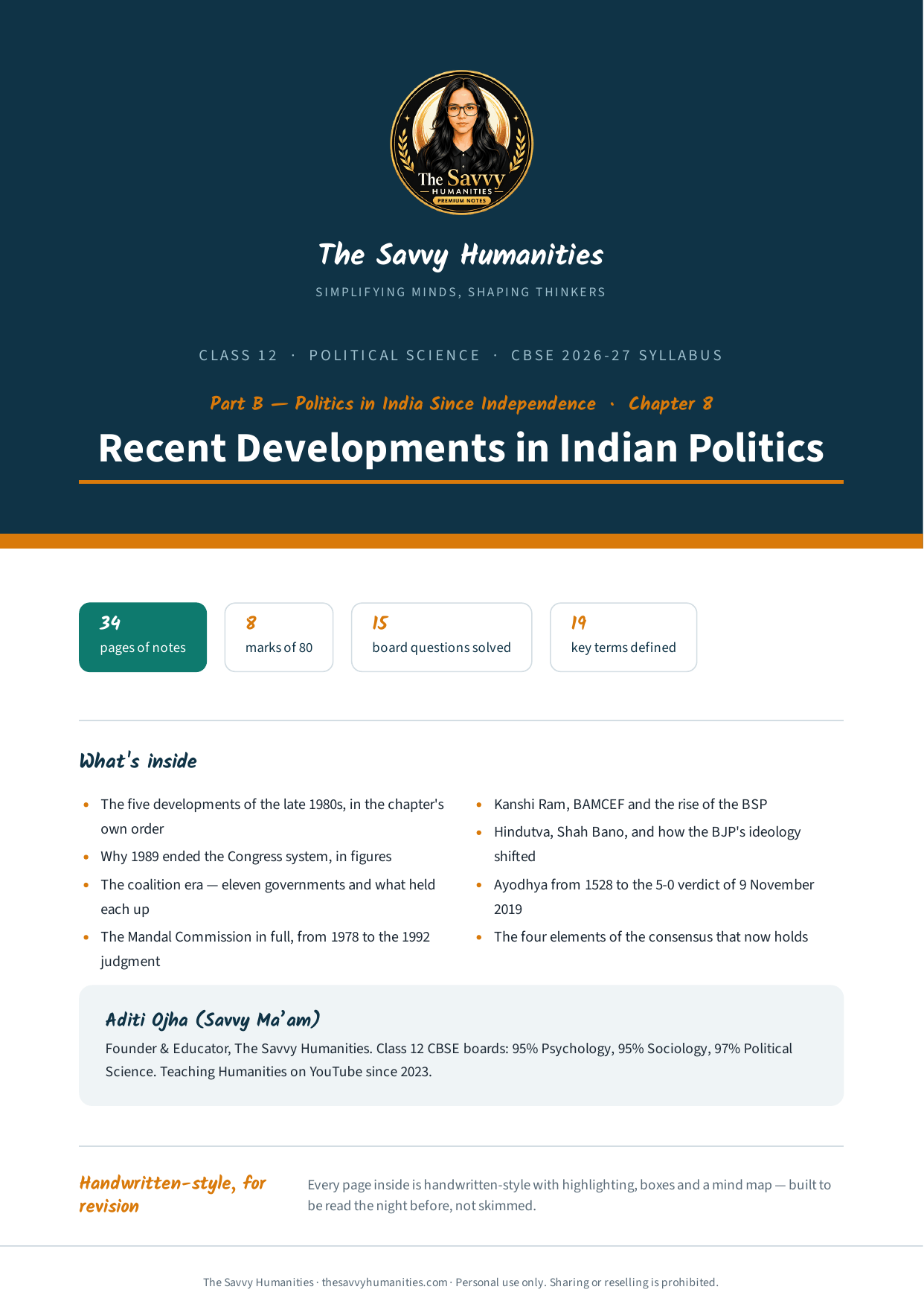
Exam-oriented handwritten-style notes — every page laid out like class notes, with highlighting, boxes and a mind map, built to be read the night before rather than skimmed.
Unit 8 of Part B in the CBSE Class 12 Political Science paper carries 8 marks out of 80 — the single largest unit in the whole paper. Checked against CBSE’s own 2026-27 curriculum document, which lists seven sub-topics for this unit; every one of the seven is a printed heading in the chapter and every one is covered here.
What are the five developments that shaped the 1990s?
The chapter opens with five, and a question on “the context of the 1990s” is answered by naming all five in order: the defeat of the Congress in 1989 (415 seats in 1984 down to 197); the rise of the Mandal issue after the National Front’s 1990 decision; the turn in economic policy known as the new economic reforms, begun under Rajiv Gandhi and visible from 1991; the entry of the Ayodhya dispute into national politics; and the assassination of Rajiv Gandhi in May 1991, after which the Congress chose Narasimha Rao as Prime Minister.
Why did the era of coalitions begin in 1989?
Because the 1989 election defeated the Congress without giving any other party a majority. The National Front formed a government supported from outside by two groups that agreed on almost nothing — the BJP and the Left Front — each wanting to keep the Congress out. The notes set out the rule of the period plainly: no single party won a clear majority in any Lok Sabha election from 1989 till 2014, and the BJP won one on its own in 2014 and again in 2019. The eleven governments since 1989, the United Front of 1996 and how its support was arranged differently, and the long view — that the coalition did not appear in the 1990s but moved outside the Congress — are all here.
What did the Mandal Commission recommend, and what happened to it?
The sequence the paper draws its 1- and 2-markers from, learnt as a sequence: reservations for OBCs already operating in southern States from the 1960s; the demand raised in north India under the Janata Party government of 1977-79; Karpoori Thakur as Chief Minister of Bihar; the Commission appointed in 1978 — officially the Second Backward Classes Commission, popularly named after its Chairperson Bindeshwari Prasad Mandal; its report in 1980, recommending 27 per cent reservation in educational institutions and government jobs along with measures such as land reform; the National Front’s decision of August 1990 to implement the jobs recommendation; the agitations that followed; and the Indira Sawhney case, in which the Supreme Court upheld the decision in November 1992.
How did Dalit politics rise — BAMCEF, Kanshi Ram and the BSP
BAMCEF, the Backward and Minority Communities Employees Federation, was formed in 1978 and took a position in favour of political power for the bahujan — SC, ST, OBC and minorities. Out of it came the Dalit Shoshit Samaj Sangharsh Samiti and then the Bahujan Samaj Party in 1984 under Kanshi Ram, with its breakthrough in Uttar Pradesh in the 1989 and 1991 elections. The notes carry his strategy — political power as the master key to social equality, resting on the arithmetic that the Bahujans are a majority — and the chapter’s own observation that Dalit politics and OBC politics have often developed in competition with each other.
Hindutva, the Shah Bano case, and the BJP’s shift after 1986
The BJP was formed in 1980 by supporters of the erstwhile Jana Sangh after the Janata Party broke up, at first on a broader platform of “Gandhian Socialism” with cultural nationalism; after 1986 it emphasised nationalism as the core of its ideology and pursued the politics of Hindutva, a term popularised by Vinayak Damodar Savarkar and defined in the notes exactly as the chapter defines it. On the Shah Bano case of 1985 the notes are careful about the direction of events, which is where most answers go wrong: the Supreme Court ruled in her favour, and it was the Muslim Women (Protection of Rights on Divorce) Act, 1986 that nullified the judgement — an Act opposed by many women’s organisations, many Muslim groups and most intellectuals, and criticised by the BJP as appeasement.
The Ayodhya issue from 1528 to the verdict of 9 November 2019
The dispute is set out with its dates and its legal steps: the three-dome structure built in 1528 and the five centuries of conflict documented in the Lucknow, Barabanki and Faizabad district Gazetteers; the site sealed in 1949 once court proceedings began; the Faizabad district court’s order unlocking it in 1986; the demolition of 1992, which some critics contended was a substantial challenge to the principles of Indian democracy; and the resolution through court hearings, mediation attempts and popular movements in the 5-0 verdict of a constitutional bench of the Supreme Court on 9 November 2019, which allotted the disputed site to the Shri Ram Janmabhoomi Teertha Kshetra Trust and directed the government to allot an appropriate site for a Mosque to the Sunni Central Waqf Board. From Legal Proceedings to Amicable Acceptance is a printed section heading with its own CBSE sub-topic, so a question from it should be expected.
The Lok Sabha elections 2004 to 2019, in figures
2004 — the NDA defeated and the UPA formed with Left support, the Congress increasing its seats for the first time since 1991. July 2008 — the Left withdraws support over the Indo-US nuclear deal. 2009 — the Congress rises from 145 to 206 seats and Dr Manmohan Singh takes a second term. September 2013 — Narendra Modi declared the BJP’s Prime Ministerial candidate. 2014 — the BJP wins 282 seats, the first single-party majority in thirty years, and forms the NDA government anyway. 2019 — 303 seats. The two seat figures are the ones most likely to be asked directly.
What are the four elements of the growing consensus?
Agreement on the new economic policies; acceptance of the political and social claims of the backward castes; acceptance of the role of State level parties in governing the country; and an emphasis on pragmatic considerations rather than ideological positions. The notes teach them in that fixed order for a reason — each element settles a conflict described earlier in the same chapter, so an answer that shows the structure is doing more than listing.
What else is in the file
- Chapter at a glance — a one-page mind map of the whole chapter
- A 19-term glossary of every definition the paper can ask for
- 15 board-pattern questions with full model answers — 1, 2, 4 and 6 markers
- A revision tracker to tick off each topic as read, practised and revised
The file
- Format: PDF, A4 — works on a phone and prints cleanly
- Length: 34 pages plus cover
- Delivery: instant download link after payment, plus a copy by email
- Free updates: if CBSE changes the syllabus or a correction goes in, the updated file is sent to you at no cost. You never pay twice for the same chapter.
By Aditi Ojha (Savvy Ma’am) — Founder and educator, The Savvy Humanities. Teaching Humanities on YouTube since 2023. These notes pair with the free chapter video; QR codes inside the file link to it.