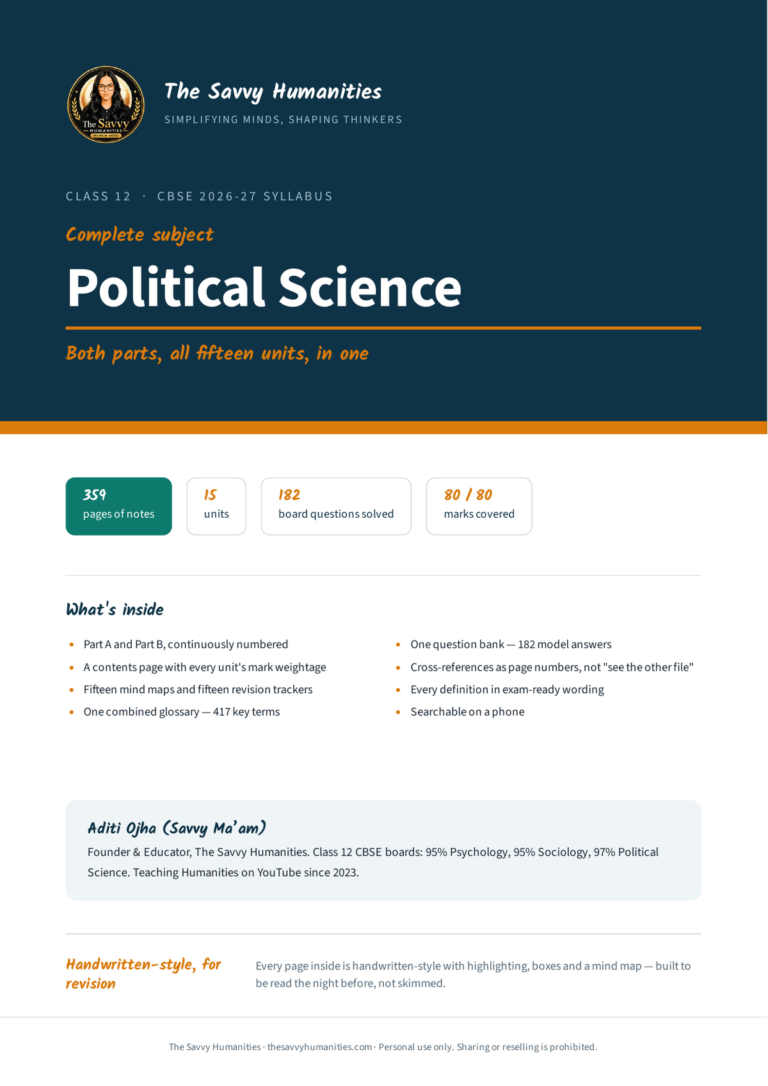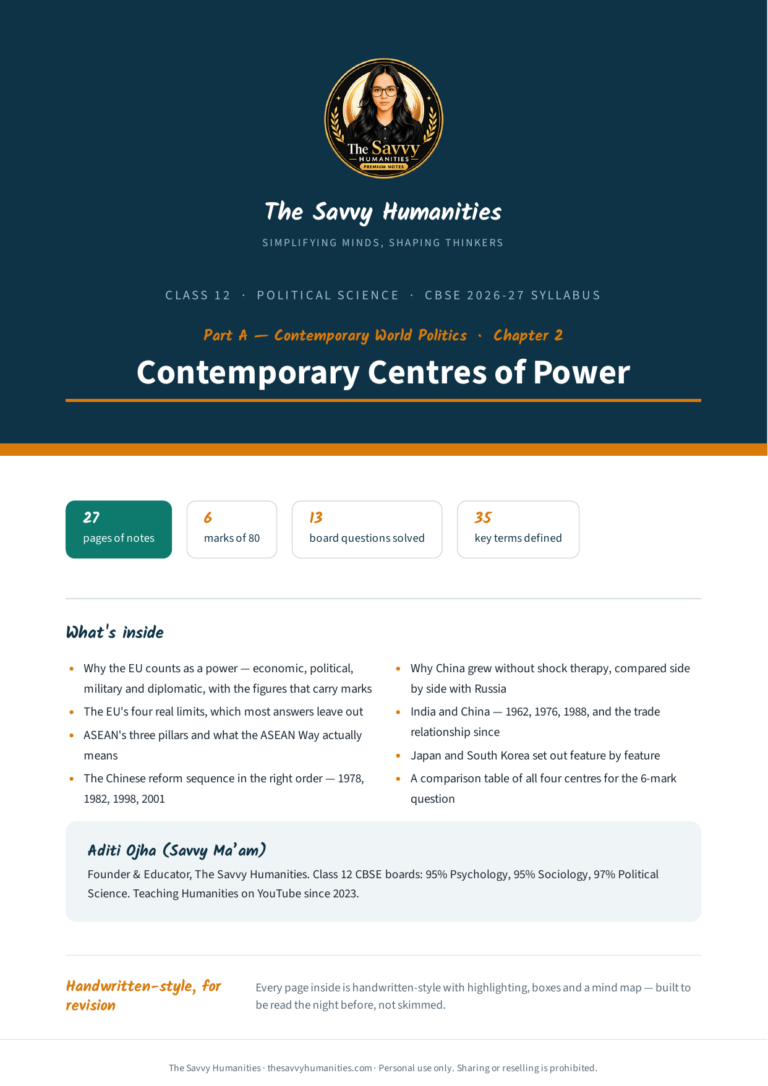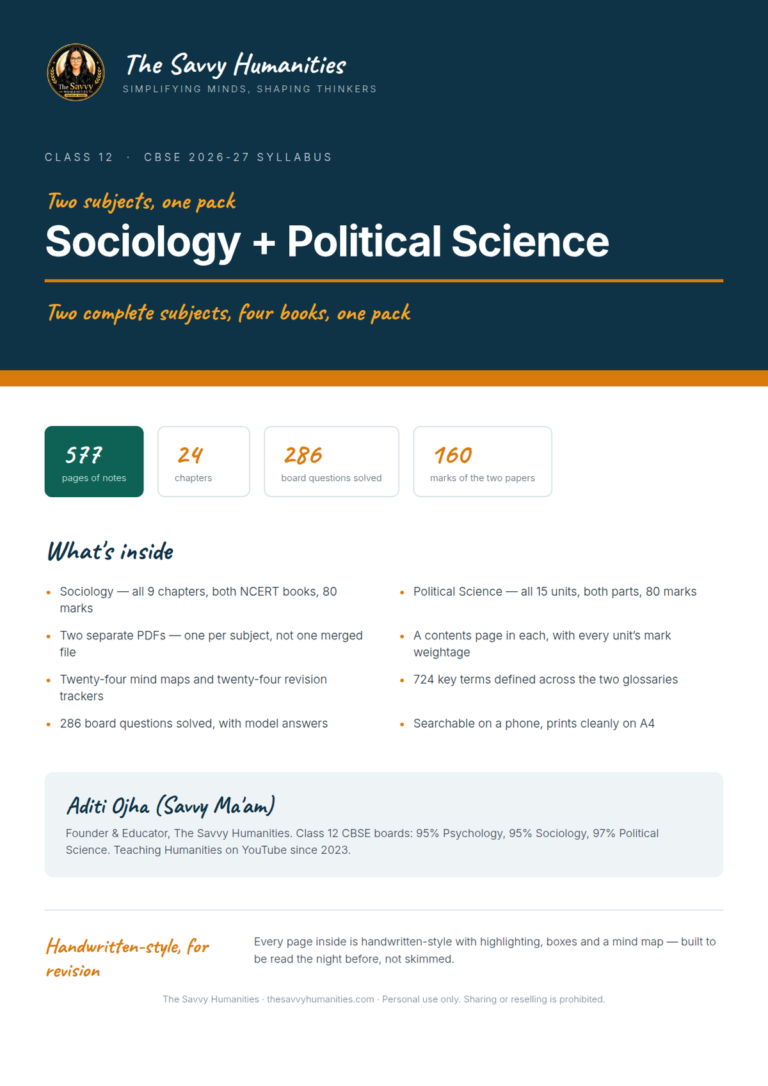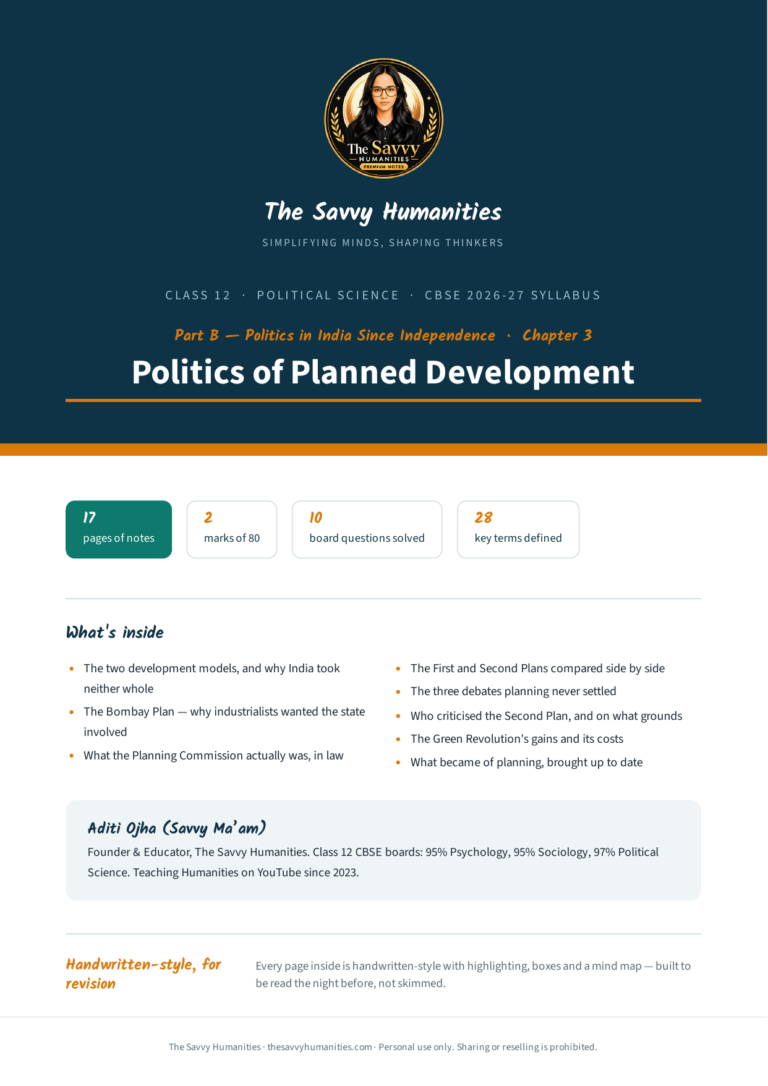
Exam-oriented handwritten-style notes — every page laid out like class notes, with highlighting, boxes and a mind map, built to be read the night before rather than skimmed.
Unit 6 of the CBSE Class 12 Political Science paper carries 6 marks out of 80, checked against CBSE’s own 2026-27 curriculum document. The trap in this unit is answering it as science. The paper is not asking what global warming is; it is asking who should pay to stop it, and why the answer is disputed.
What is inside
- Chapter at a glance — a one-page mind map of the whole chapter
- Complete topic-by-topic notes, NCERT-aligned, in CBSE’s own topic order
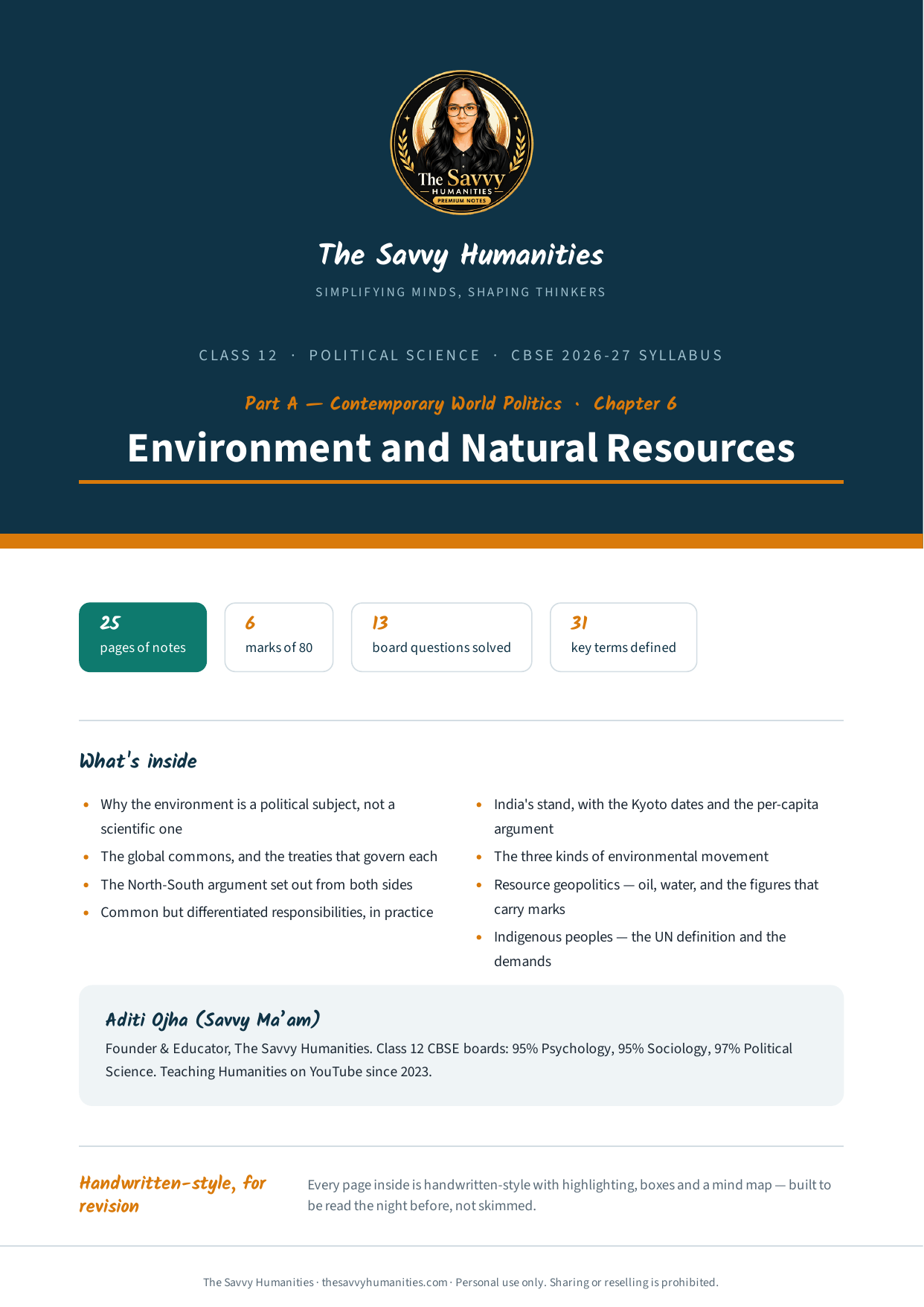
- Why the environment is a political subject, not a scientific one — the argument the whole unit rests on
- The global commons, and the treaties that govern each — Antarctica, the ocean floor, outer space and the atmosphere, with the Antarctic Treaty of 1959, the Montreal Protocol of 1987 and the Antarctic Environmental Protocol of 1991
- The North-South argument set out from both sides — the developed world’s case and the developing world’s case, each given fairly, because a question asking you to evaluate needs both
- Common but differentiated responsibilities, in practice — not just the phrase, but what it actually obliges whom to do
- The Rio Earth Summit and Agenda 21 — 1992, 170 states, and what came out of it
- India’s stand, with the Kyoto dates and the per-capita argument — the 1997 Protocol, and why India measures emissions per person rather than per country
- India’s own environmental programmes — the National Auto-fuel Policy, the Energy Conservation Act 2001, the Electricity Act 2003 and the National Mission on Biodiesel
- The three kinds of environmental movement — forests, mega-dams and mining — with the Narmada Bachao Andolan and the World Commission on Dams
- Resource geopolitics — oil, water, and the figures that carry marks — the Gulf region, and the upstream-downstream problem in river disputes
- Indigenous peoples — the UN definition and the demands — the Working Group on Indigenous Populations, the World Council of Indigenous Peoples, and where India’s tribal population fits
- A 31-term glossary of every definition the paper can ask for
- 13 board-pattern questions with full model answers
- A revision tracker to tick off each topic as read, practised and revised
Written for the 2026-27 syllabus
Nothing from CBSE’s list for this unit is left out — all seven sub-topics are covered. The Cold War Era and US Hegemony in World Politics were removed from the 2026-27 syllabus and appear nowhere in this set.
Figures that change year to year — current emission totals, or the present state of a particular negotiation — are deliberately kept out. The dates and proportions here are the ones NCERT itself uses and the ones the paper asks for, so the file does not go stale between the day you buy it and the day you sit the exam.
The file
- Format: PDF, A4 — works on a phone and prints cleanly
- Length: 25 pages plus cover
- Delivery: instant download link after payment, plus a copy by email
- Free updates: if CBSE changes the syllabus or a correction goes in, the updated file is sent to you at no cost. You never pay twice for the same chapter.
By Aditi Ojha (Savvy Ma’am) — Founder and educator, The Savvy Humanities. Teaching Humanities on YouTube since 2023. These notes pair with the free chapter video; QR codes inside the file link to it.