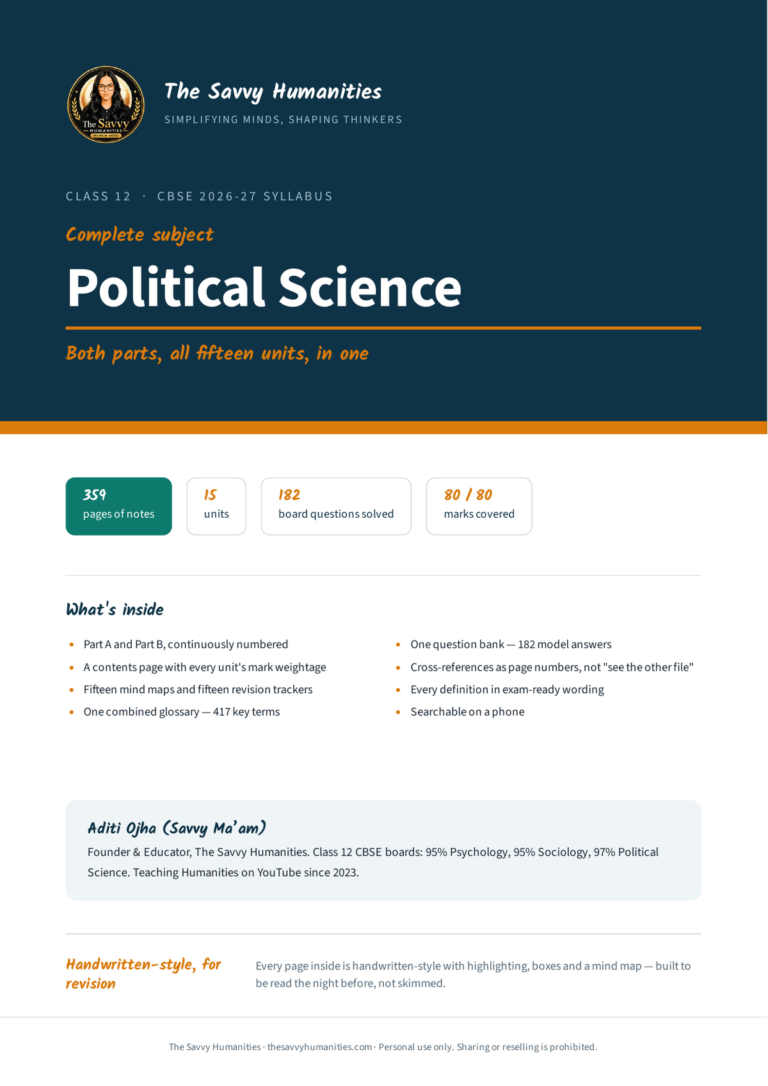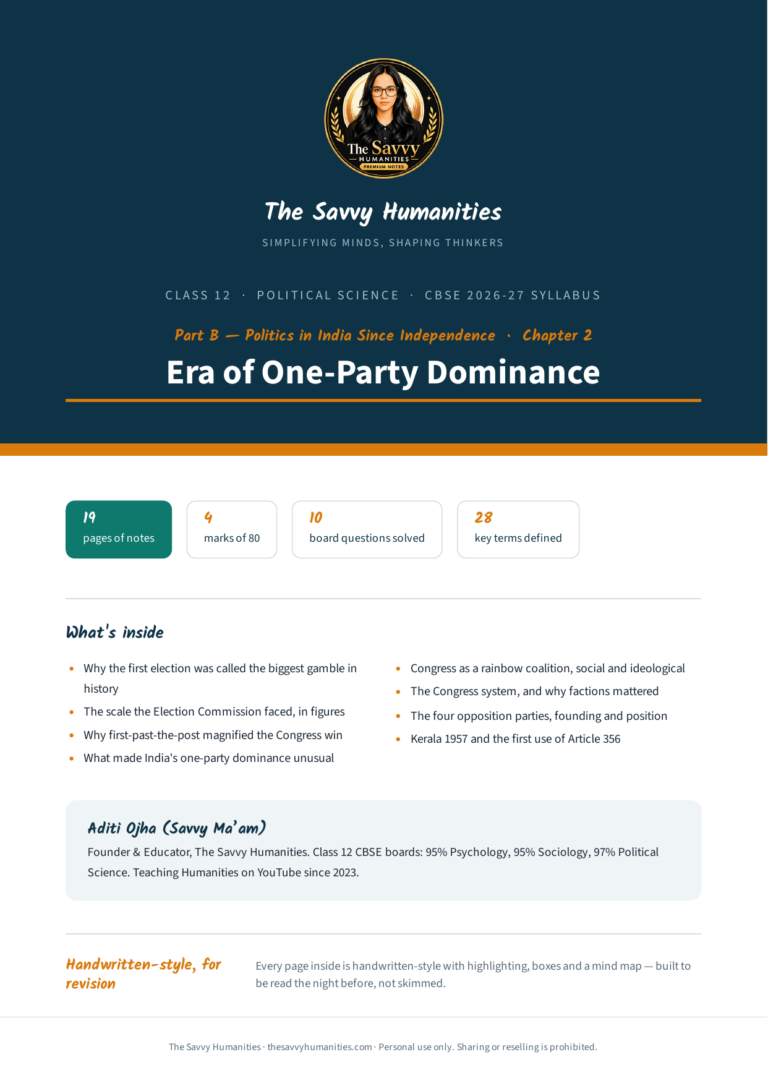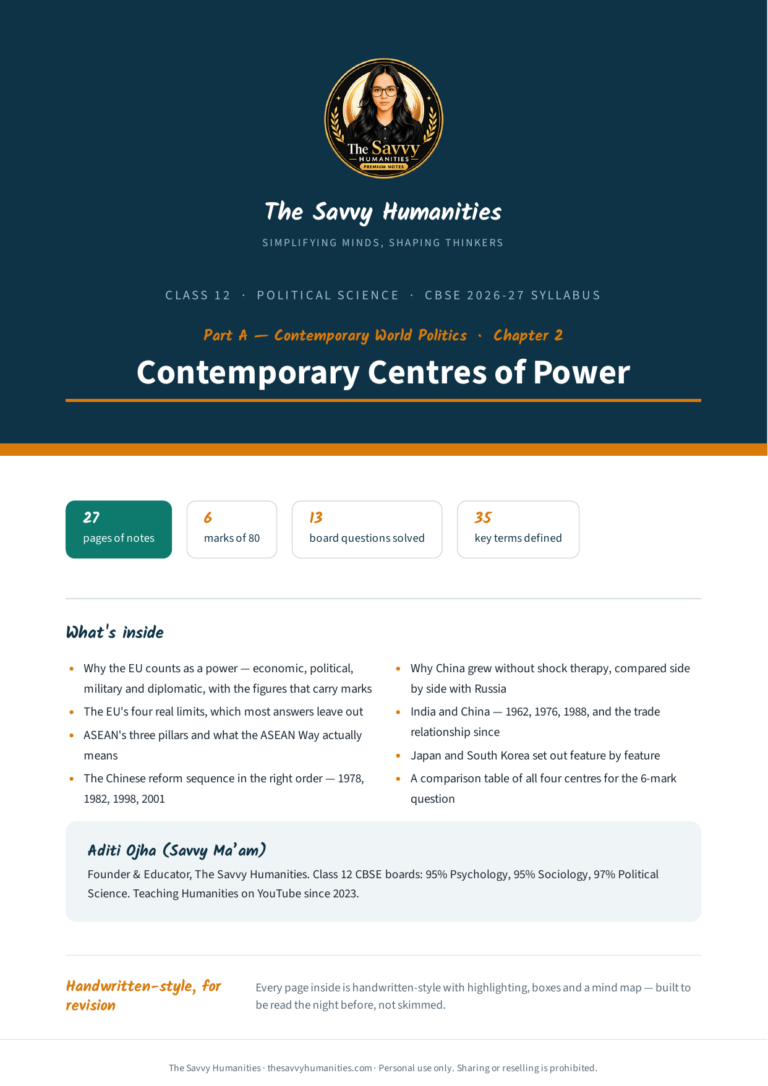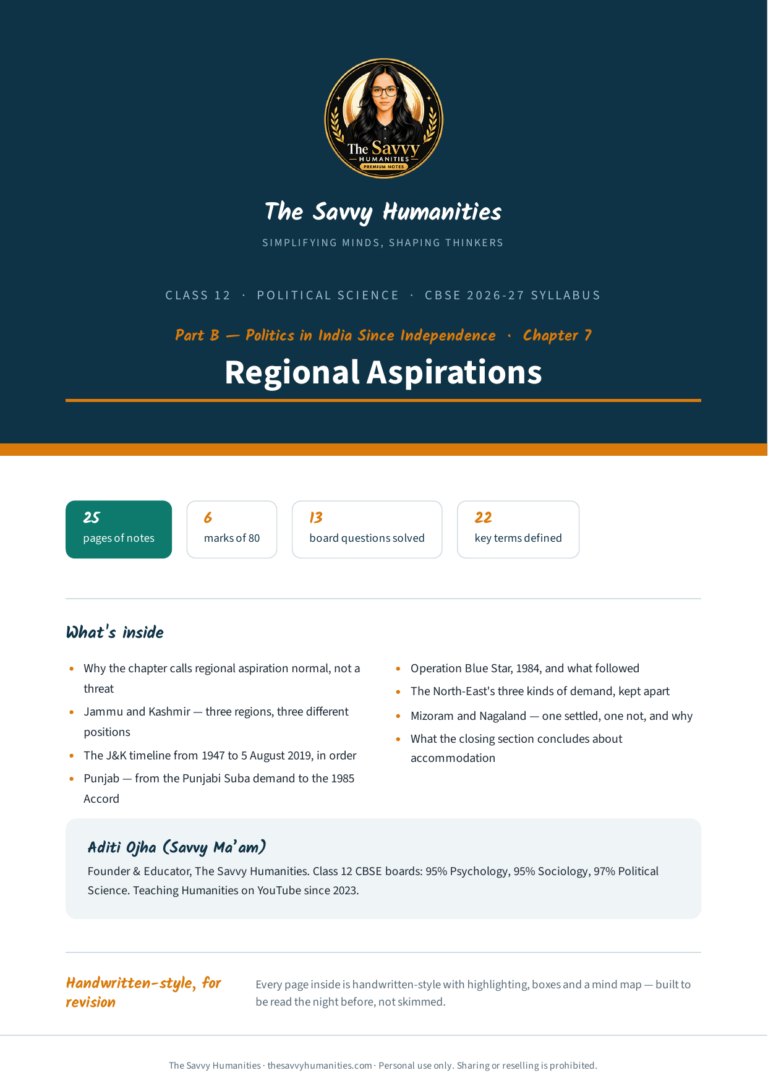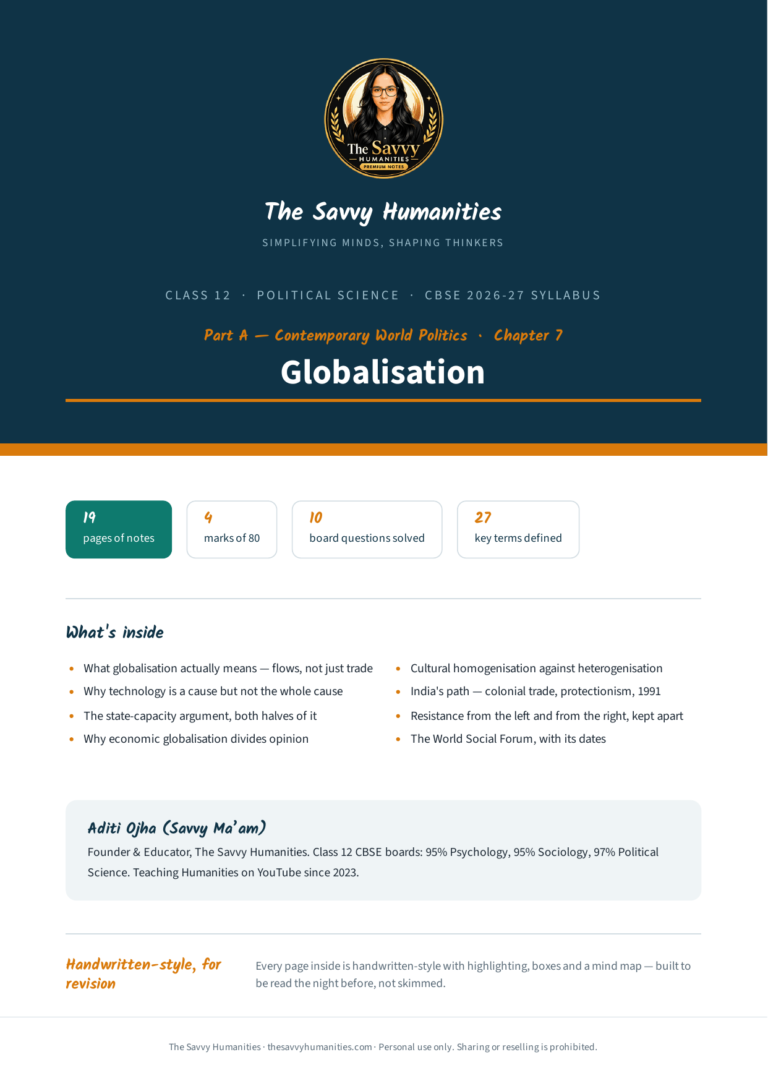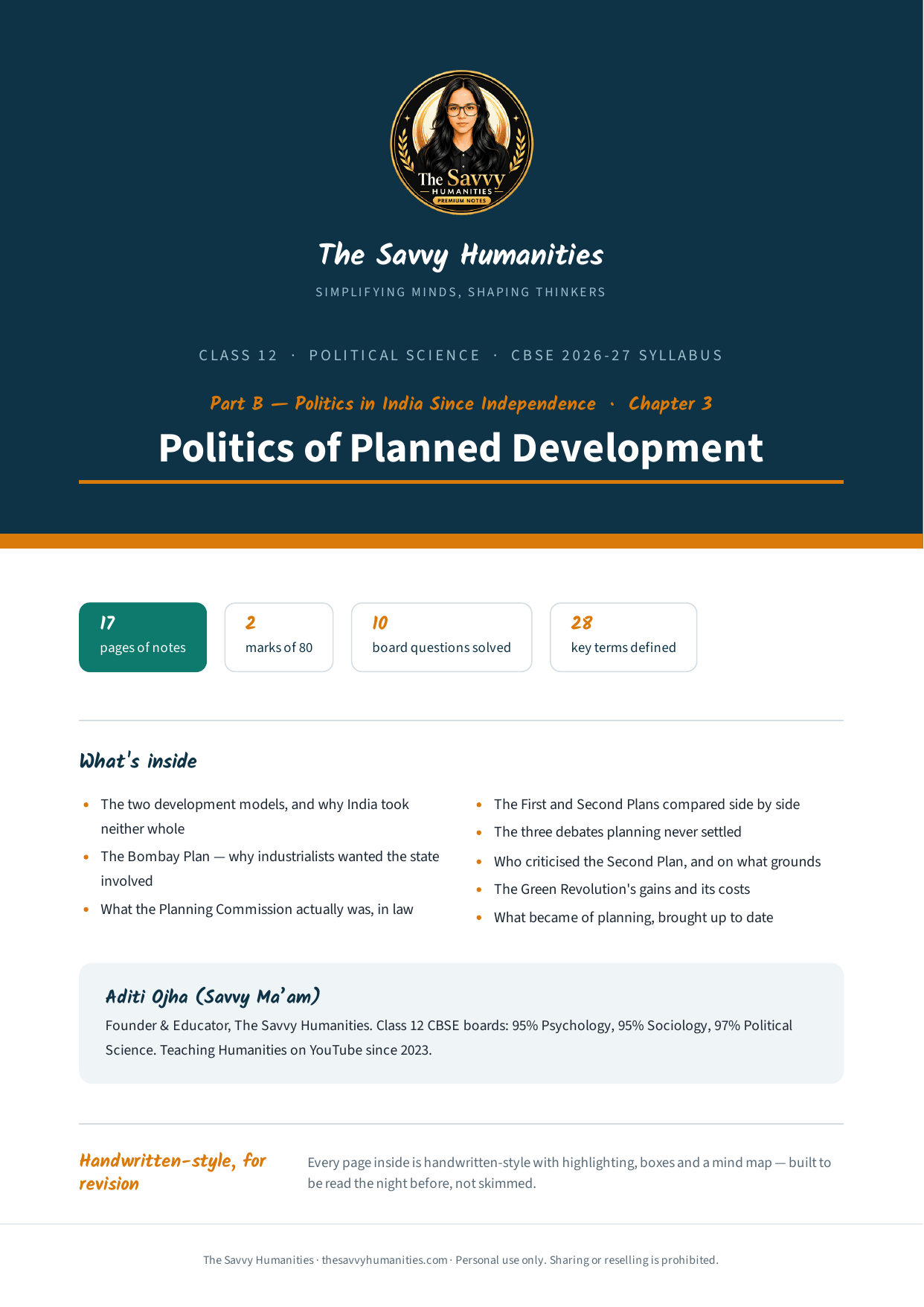
Exam-oriented handwritten-style notes — every page laid out like class notes, with highlighting, boxes and a mind map, built to be read the night before rather than skimmed.
Unit 3 of Part B in the CBSE Class 12 Political Science paper carries 2 marks out of 80 — the smallest unit in the whole paper. Checked against CBSE’s own 2026-27 curriculum document, which lists two sub-topics: political contestation over development, and planning.
What were the two development models, and which did India choose?
The liberal-capitalist model of the United States and Western Europe, where the market allocates resources and industry is privately owned, and the socialist model of the Soviet Union and Eastern Europe, where the state allocates through central planning and owns the means of production. India took neither whole and chose a mixed economy, with public and private sectors side by side — and the notes explain what that compromise cost and won.
Why did industrialists ask for a state-led plan?
The Bombay Plan of 1944 was a joint proposal by leading Indian industrialists asking the state to make the major investments in industry. It is the detail that surprises students, and it is exactly why the exam likes it: planning in India was not imposed on business against its will.
What was the Planning Commission, in law?
Set up in March 1950 by a resolution of the Government of India — an advisory body, neither constitutional nor statutory, chaired by the Prime Minister. That distinction is a definition question waiting to be asked. The notes also carry the National Planning Committee of 1938 under Nehru, and NITI Aayog, which replaced the Planning Commission on 1 January 2015.
First Plan against Second Plan, side by side
- First Five Year Plan, 1951-1956 — drafted by K.N. Raj; agriculture, dams and irrigation, Bhakra Nangal, land reform as the key to productivity; and the argument to “hasten slowly”, that development too rapid in the first two decades might endanger democracy
- Second Five Year Plan, 1956-1961 — drafted by a team under P.C. Mahalanobis; heavy industry with the public sector leading, on the reasoning that a country that can make machines can make everything else, with substantial tariffs producing in effect a closed economy
Who criticised the Second Plan, and on what grounds?
Both criticisms are given as their authors made them. J.C. Kumarappa argued for a Gandhian alternative built on agriculture and small-scale, cottage and village industry. Chaudhary Charan Singh argued that planning had created an unnecessary tension between agriculture and industry, and that industrialisation should rest on agricultural prosperity instead. The notes also set out the three debates planning never settled.
The Green Revolution’s gains and its costs
High-yielding variety seeds with fertilisers, pesticides and assured irrigation from the mid-1960s, which raised food grain production and wheat in particular. The notes give the gains and what followed: the rise of a prosperous, politically confident middle peasantry that became a major force in Indian politics. The White Revolution is set beside it — Operation Flood, Verghese Kurien and Amul at Anand, and why a dairy cooperative network raised rural incomes more broadly.
What else is in the file
- Chapter at a glance — a one-page mind map of the whole chapter
- A 28-term glossary of every definition the paper can ask for
- 10 board-pattern questions with full model answers
- A revision tracker to tick off each topic as read, practised and revised
A 2-mark unit, covered properly
This is the lightest unit in the paper, and the notes do not pad it to look bigger — 17 pages, no 6-markers in the question bank. But it is not skipped either: the definitions here (mixed economy, Planning Commission, Green Revolution) turn up in answers across other units, which is why the glossary is as full as a heavier chapter’s.
The file
- Format: PDF, A4 — works on a phone and prints cleanly
- Length: 17 pages plus cover
- Delivery: instant download link after payment, plus a copy by email
- Free updates: if CBSE changes the syllabus or a correction goes in, the updated file is sent to you at no cost. You never pay twice for the same chapter.
By Aditi Ojha (Savvy Ma’am) — Founder and educator, The Savvy Humanities. Teaching Humanities on YouTube since 2023. These notes pair with the free chapter video; QR codes inside the file link to it.