Exam-oriented handwritten-style notes — every page laid out like class notes, with highlighting, boxes and a mind map, built to be read the night before rather than skimmed.
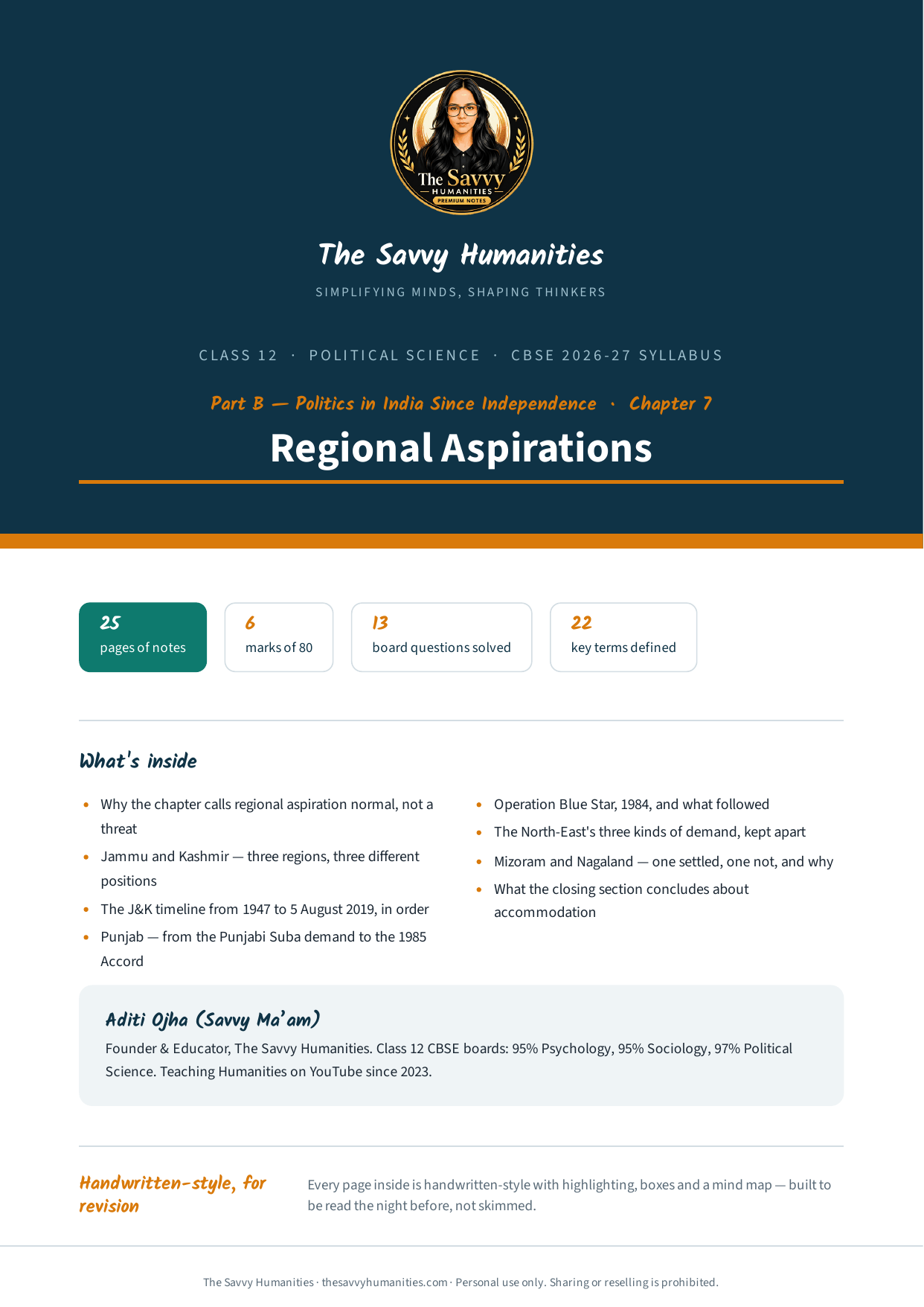
Unit 7 of Part B in the CBSE Class 12 Political Science paper carries 6 marks out of 80 — the joint-largest unit in Part B. Checked against CBSE’s own 2026-27 curriculum document.
Why does the chapter call regional aspiration normal rather than a threat?
Because Indian nationalism balanced unity and diversity on the principle that the nation would not mean the negation of the region. The chapter’s own position is that the expression of regional issues is not an aberration or an abnormal phenomenon, and is best answered through democratic negotiation rather than suppression. That framing is the spine of the whole unit, and an answer that misses it misses the question.
Jammu and Kashmir — three regions, three different positions
Jammu, the Kashmir valley and Ladakh do not want the same thing, and treating the state as one bloc is the commonest error here. The notes also define Kashmiriyat — the valley’s distinct regional identity and shared way of life — and explain why it makes the Kashmiri aspiration a regional rather than a religious one.
The J&K timeline from 1947 to 5 August 2019, in order
Hari Singh’s wish for independent status and the Instrument of Accession after the tribal invasion of 1947; Article 370 and provisional autonomy; Sheikh Abdullah as Prime Minister of the state from March 1948, his dismissal in 1953 and years of detention, the accord with Indira Gandhi in 1974, his majority in 1977 and death in 1982; Farooq Abdullah; the 1987 election, won heavily by the National Conference-Congress alliance but widely believed not to reflect popular choice, with insurgency following within two years; and NCERT’s “2002 and Beyond” section through the coalitions and the Hurriyat Conference to the abolition of Article 370 on 5 August 2019 by the Jammu and Kashmir Reorganisation Act 2019, which constituted the state into two Union Territories — Jammu and Kashmir, and Ladakh.
Punjab — from the Punjabi Suba demand to the 1985 Accord
The Akali Dal, formed 1920; the demand for a Punjabi Suba, met by the reorganisation of 1966; the Anandpur Sahib Resolution of 1973, with the notes setting out honestly that interpretations varied on whether it sought greater autonomy within India or a separate nation; and the turn to Khalistan by the extremist elements who took over after the Akali government was dismissed in 1980.
Operation Blue Star, 1984, and what followed
The army action of June 1984 against militants based in the Golden Temple at Amritsar, which — in NCERT’s own words — flushed out the militants but damaged the historic temple and hurt Sikh sentiment. What followed is recorded as the chapter records it: the assassination of Prime Minister Indira Gandhi on 31 October 1984, and the killing of more than two thousand Sikhs in the national capital and hundreds more elsewhere. Negotiation came with the Punjab Accord of 1985 between Rajiv Gandhi and Harchand Singh Longowal — Chandigarh to Punjab, a commission on the border dispute, a tribunal on river waters. Violence took a further decade to end.
The North-East’s three kinds of demand, kept apart
Demands for autonomy, demands for statehood, and movements against outsiders are three different things, and the notes keep them separate. The All Party Hill Leaders Conference of 1960 and the reorganisation that followed; the Sixth Schedule and Autonomous Councils — District Councils for the Karbis and Dimasas, an Autonomous Council for the Bodos; and the Assam movement of 1979-1985 led by AASU, ending in the Assam Accord of 1985, with the notes stating plainly that the issue remains a live one.
Mizoram and Nagaland — one settled, one not, and why
The Mizo National Front under Laldenga, formed after the famine of 1959, launched an armed struggle in 1966 and ended it with the peace agreement of 1986; Laldenga became Chief Minister and gave up the demand for secession. The Naga National Council under Angami Zapu Phizo declared independence in 1951 and began an armed struggle; that problem still awaits a final resolution. The comparison is the answer to a favourite question.
What else is in the file
- Chapter at a glance — a one-page mind map of the whole chapter
- A 22-term glossary of every definition the paper can ask for
- 13 board-pattern questions with full model answers
- A revision tracker to tick off each topic as read, practised and revised
The file
- Format: PDF, A4 — works on a phone and prints cleanly
- Length: 25 pages plus cover
- Delivery: instant download link after payment, plus a copy by email
- Free updates: if CBSE changes the syllabus or a correction goes in, the updated file is sent to you at no cost. You never pay twice for the same chapter.
By Aditi Ojha (Savvy Ma’am) — Founder and educator, The Savvy Humanities. Teaching Humanities on YouTube since 2023. These notes pair with the free chapter video; QR codes inside the file link to it.