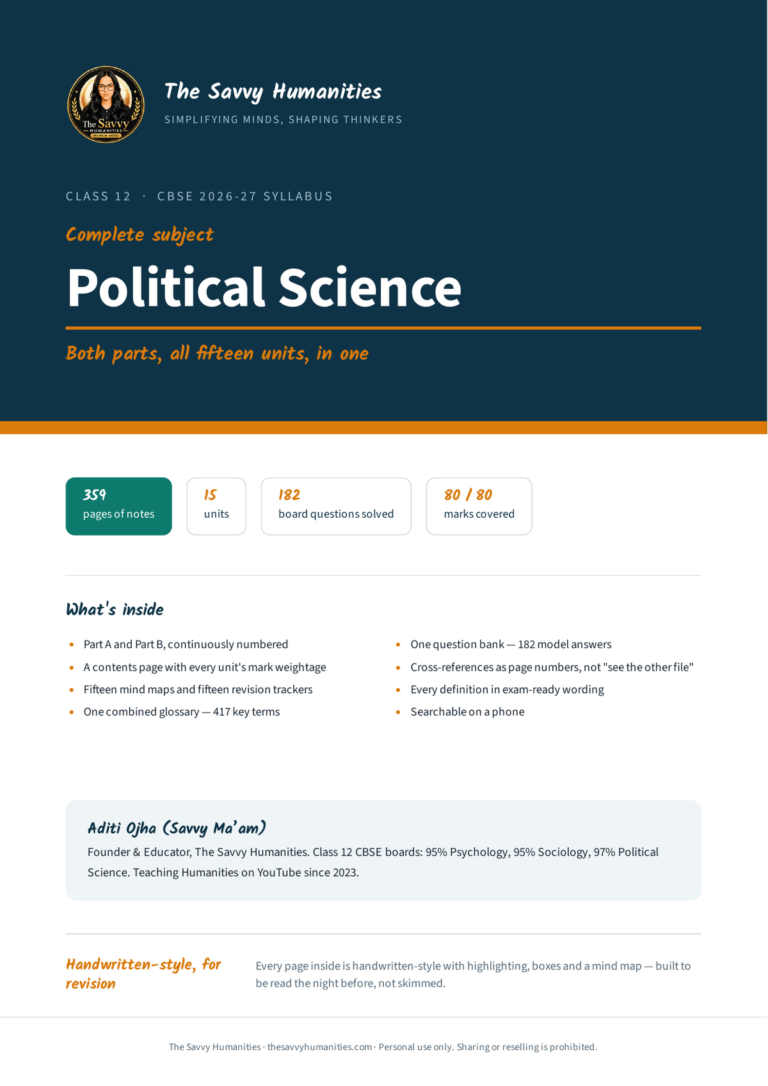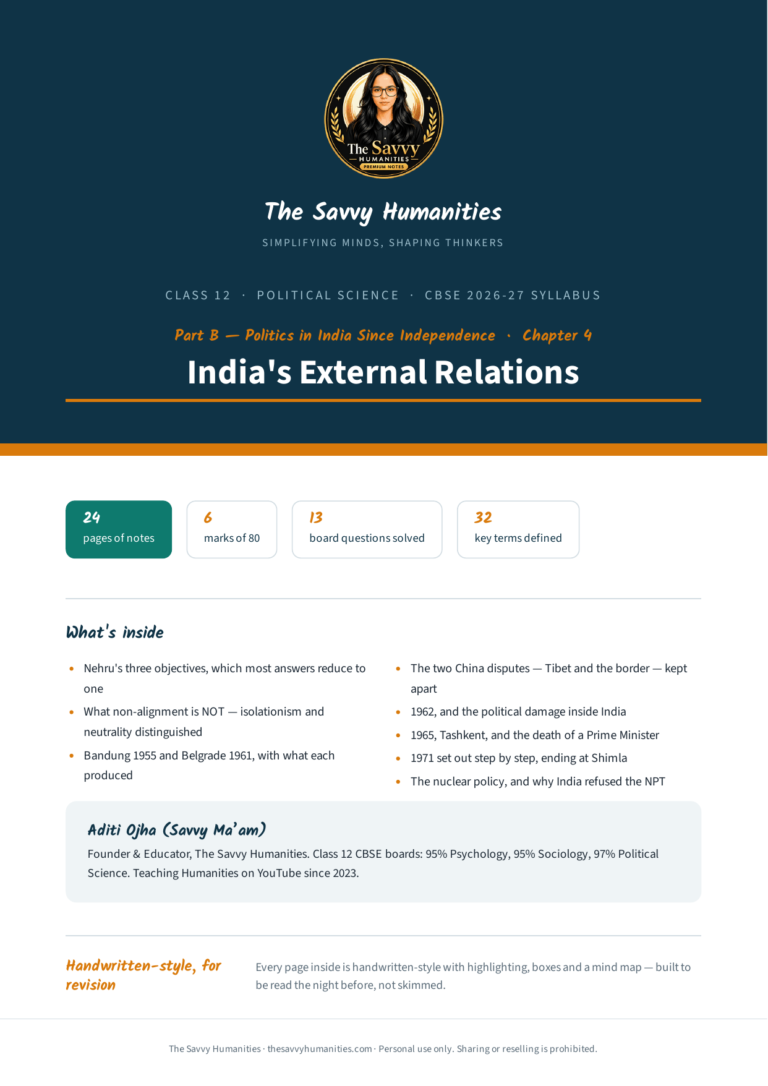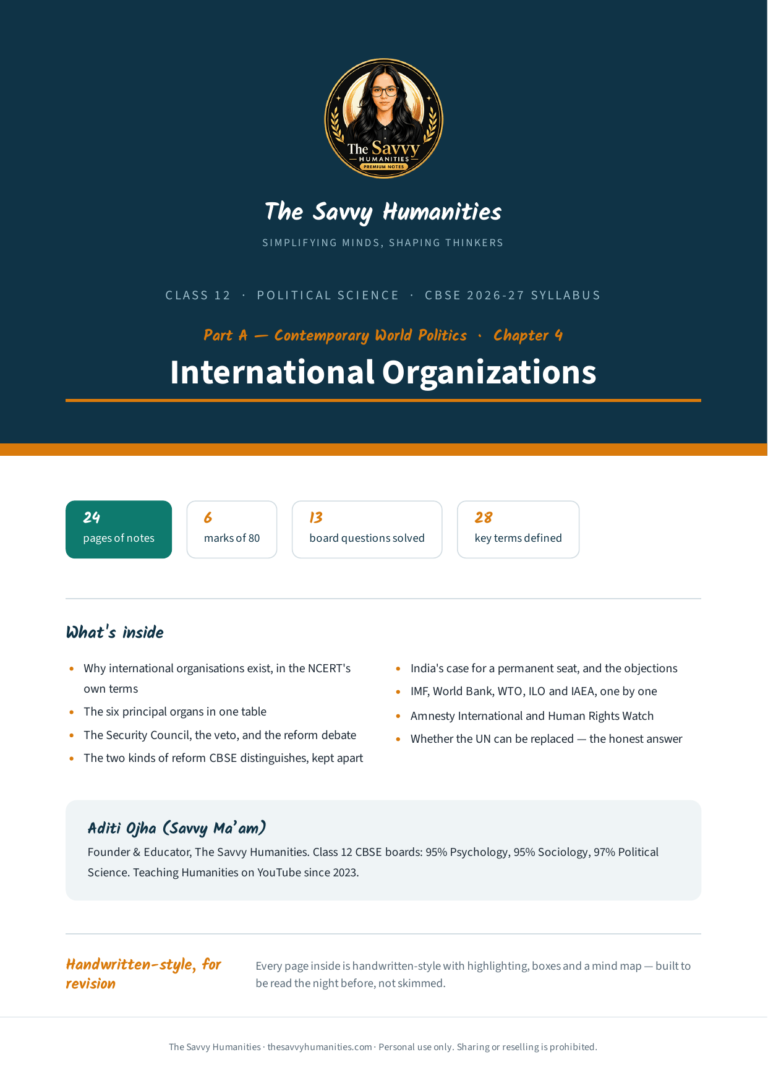
Exam-oriented handwritten-style notes — every page laid out like class notes, with highlighting, boxes and a mind map, built to be read the night before rather than skimmed.
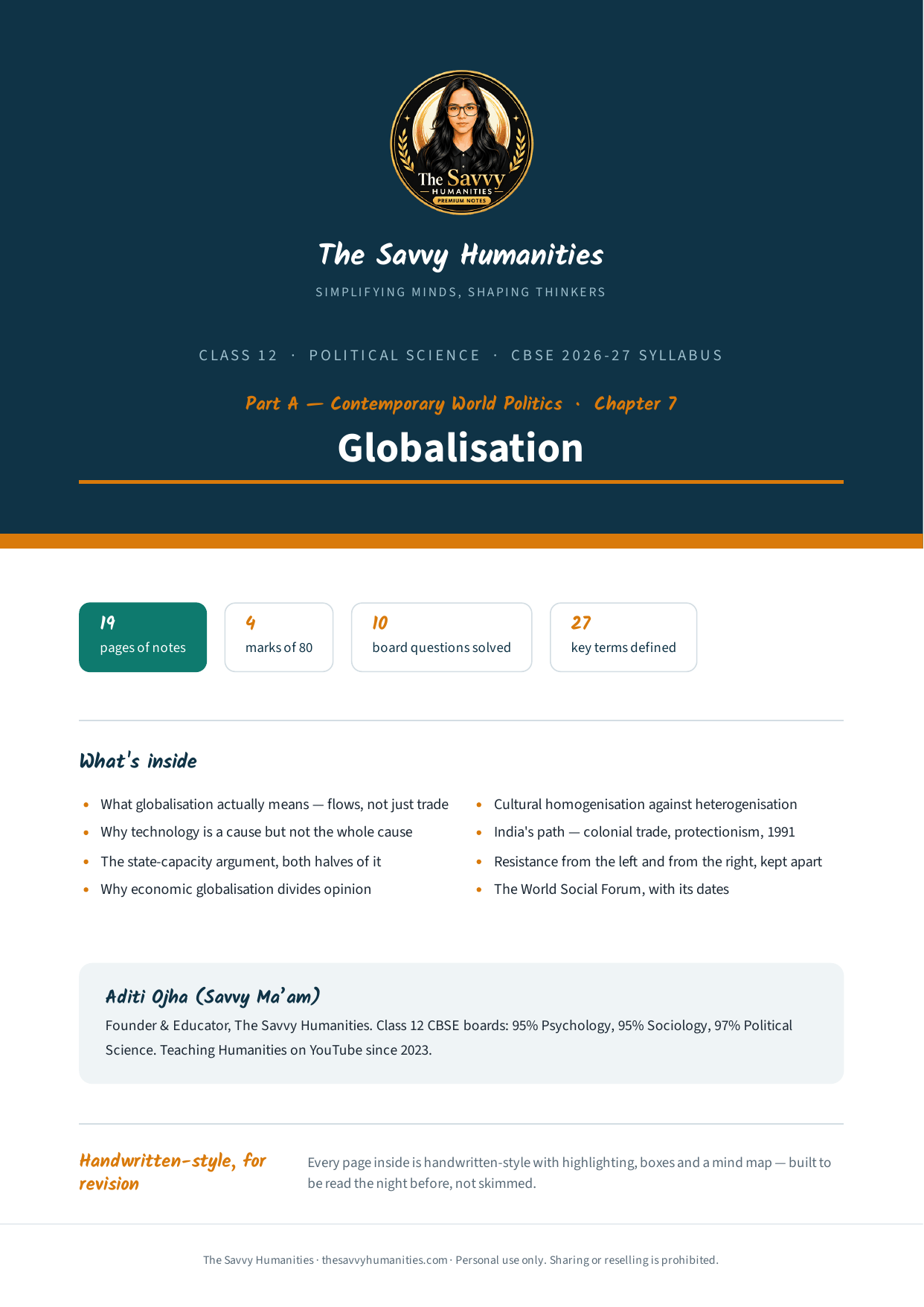
Unit 7 of the CBSE Class 12 Political Science paper carries 4 marks out of 80, and it is the last chapter of Part A. Checked against CBSE’s own 2026-27 curriculum document.
What is inside
- Chapter at a glance — a one-page mind map of the whole chapter
- Complete topic-by-topic notes, NCERT-aligned, in CBSE’s own topic order
- What globalisation actually means — flows, not just trade — worldwide flows of ideas, capital, commodities and people, and why the concept is multi-dimensional rather than purely economic. Treating it as a trade question is the commonest way to lose marks here
- Why technology is a cause but not the whole cause — the distinction the examiner is looking for
- The state-capacity argument, both halves of it — the case that globalisation shrinks the state, and the case that it has actually increased state capacity; an evaluate question needs both
- Why economic globalisation divides opinion — the welfare state against the minimal state, the social safety net, and the role of the IMF and WTO
- Cultural homogenisation against heterogenisation — McDonaldisation and the critics’ charge of cultural imperialism, set against the argument that cultures also diversify
- India’s path — colonial trade, protectionism, 1991 — import substitution and why it was chosen, then the economic reforms of 1991, liberalisation and privatisation
- Resistance from the left and from the right, kept apart — two different critiques of the same process, including swadeshi, which students routinely merge with the left-wing case
- The World Social Forum, with its dates — Porto Alegre, the Indian Social Forum, and Seattle 1999
- A 27-term glossary of every definition the paper can ask for
- 10 board-pattern questions with full model answers
- A revision tracker to tick off each topic as read, practised and revised
Why 10 questions and not 13
Every other Part A chapter carries 6 marks and has 13 solved questions. This unit carries 4, so the question bank has 10 and stops at the 4-mark level. A 4-mark unit will not produce a 6-mark question, and padding one in would only waste your time. The notes say so plainly rather than quietly matching the other chapters.
Written for the 2026-27 syllabus
Nothing from CBSE’s list for this unit is left out — all five sub-topics are covered. The Cold War Era and US Hegemony in World Politics were removed from the 2026-27 syllabus and appear nowhere in this set.
The file
- Format: PDF, A4 — works on a phone and prints cleanly
- Length: 19 pages plus cover
- Delivery: instant download link after payment, plus a copy by email
- Free updates: if CBSE changes the syllabus or a correction goes in, the updated file is sent to you at no cost. You never pay twice for the same chapter.
By Aditi Ojha (Savvy Ma’am) — Founder and educator, The Savvy Humanities. Teaching Humanities on YouTube since 2023. These notes pair with the free chapter video; QR codes inside the file link to it.