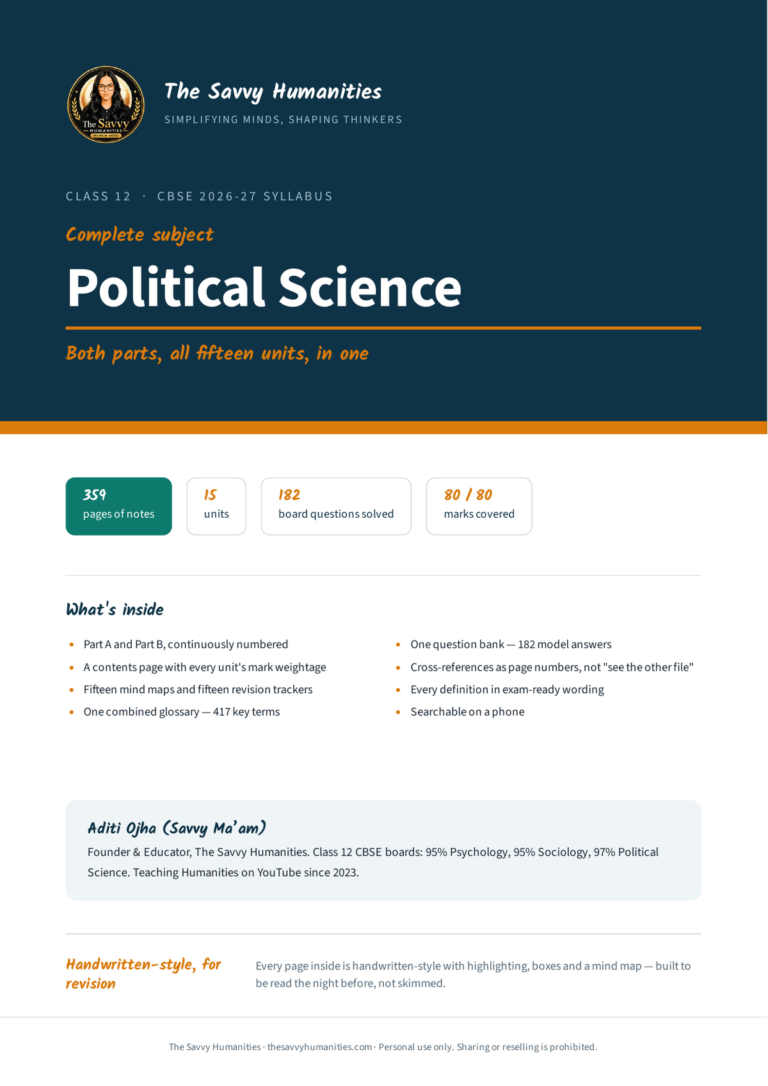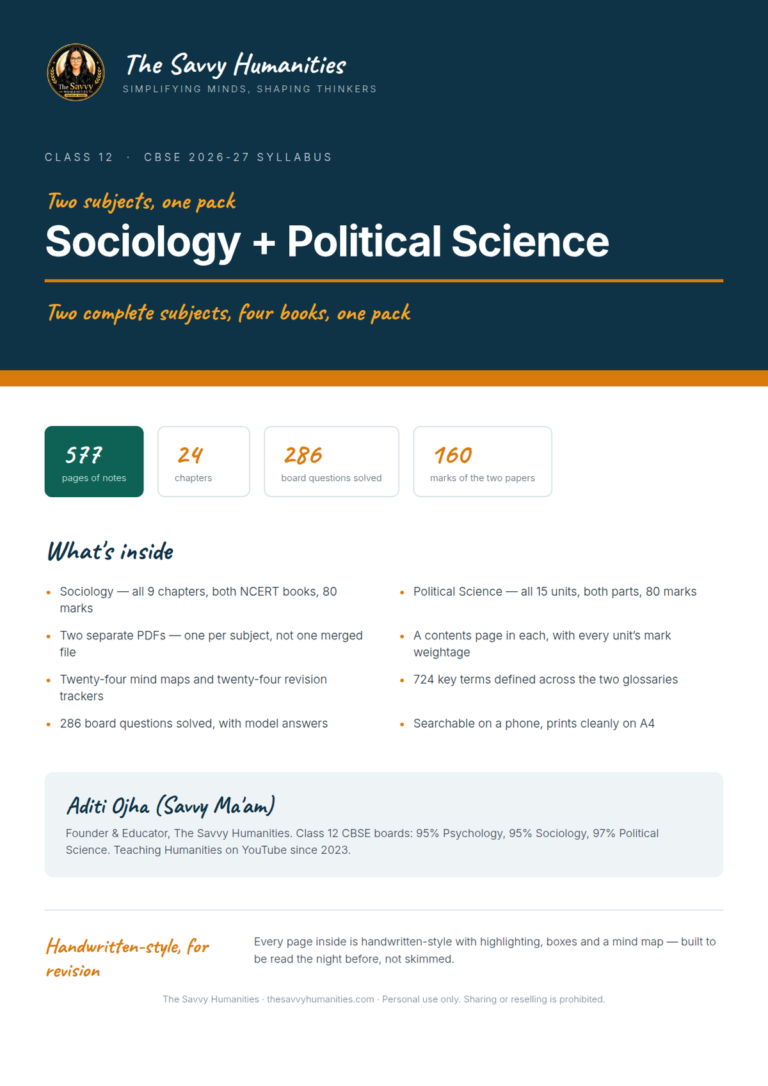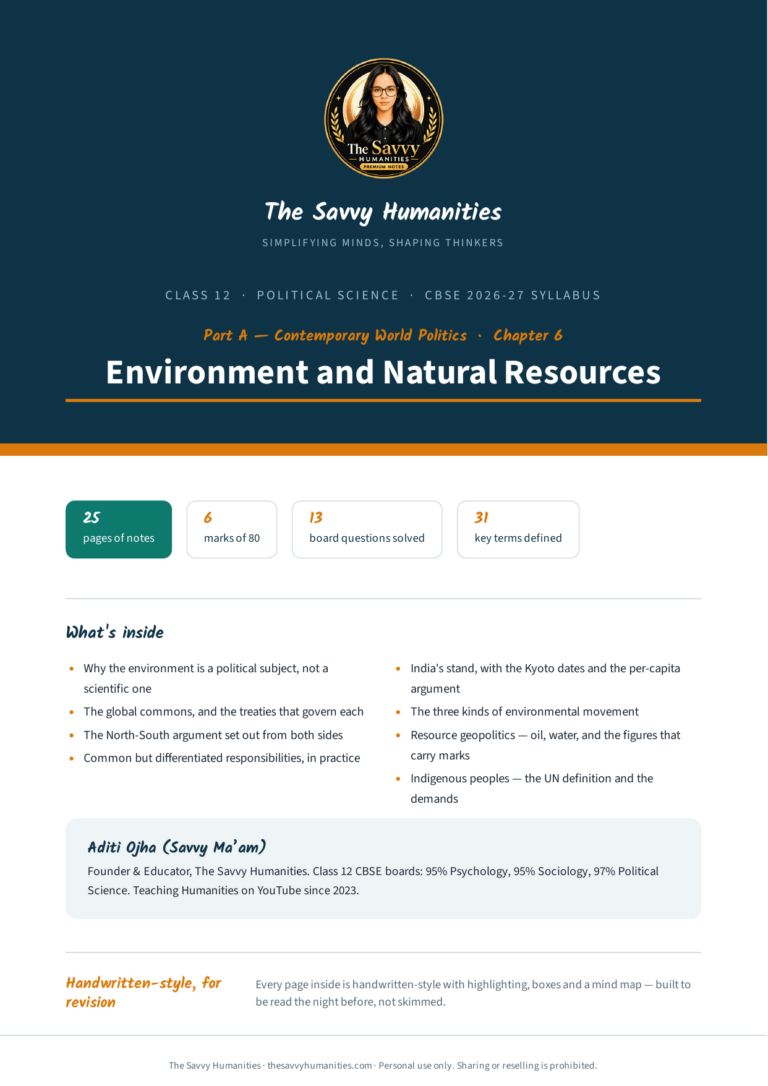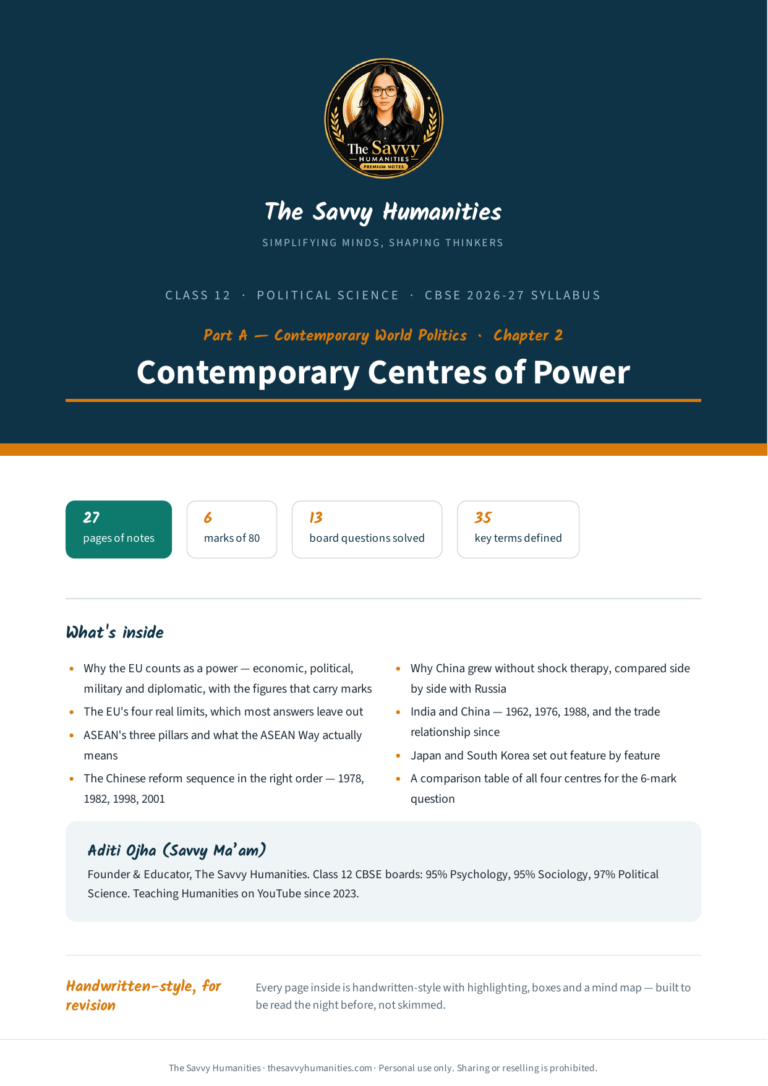
Exam-oriented handwritten-style notes — every page laid out like class notes, with highlighting, boxes and a mind map, built to be read the night before rather than skimmed.
Unit 4 of the CBSE Class 12 Political Science paper carries 6 marks out of 80, checked against CBSE’s own 2026-27 curriculum document. This is the unit where definitions decide the mark — most of what the examiner asks for is a body, its composition and what it can actually do.
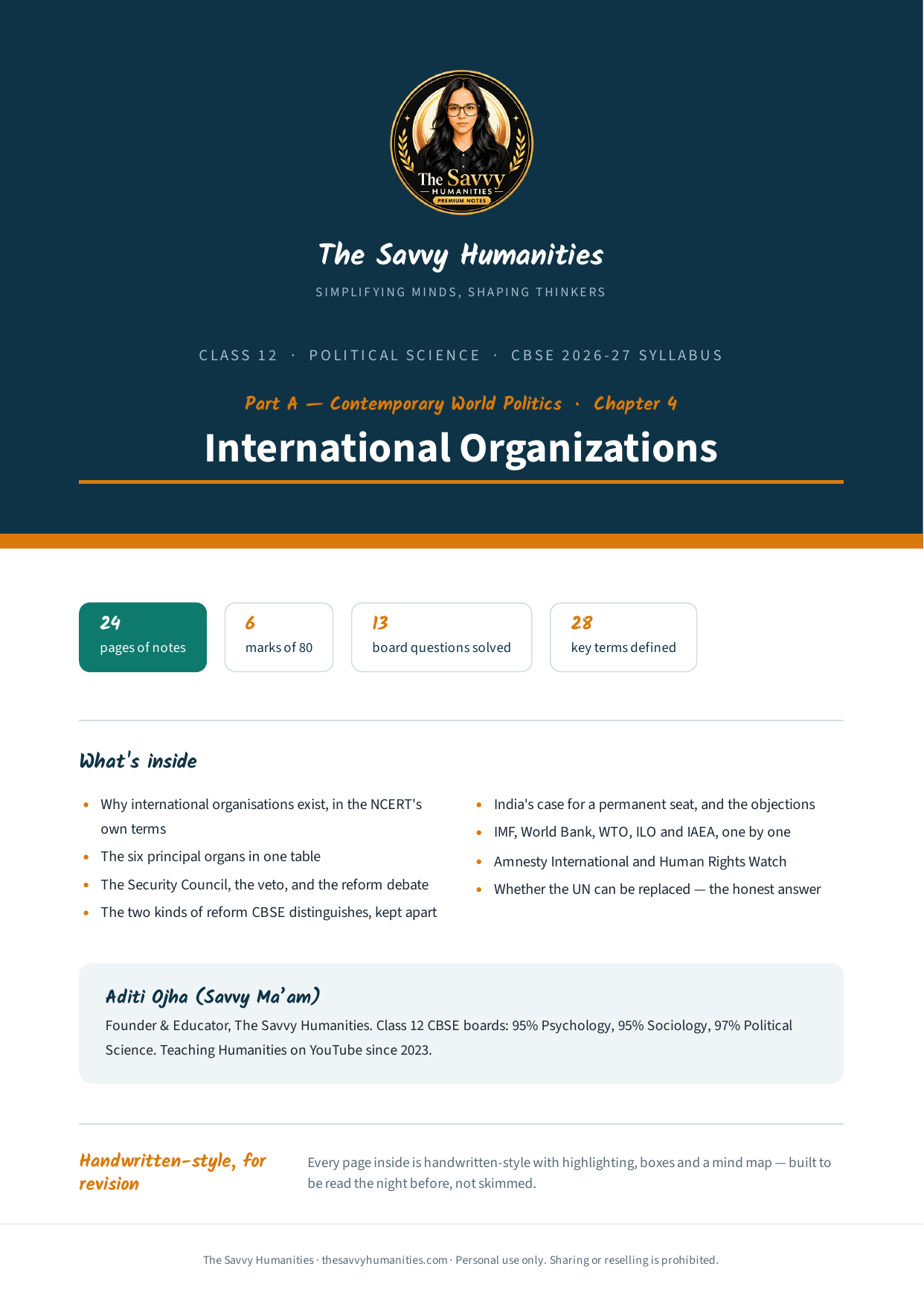
What is inside
- Chapter at a glance — a one-page mind map of the whole chapter
- Complete topic-by-topic notes, NCERT-aligned, in CBSE’s own topic order
- Why international organisations exist, in NCERT’s own terms — and the line that stops the commonest error: an international organisation is not a super-state with authority over its members
- The evolution of the UN — the League of Nations, why it failed, and 1945 with 51 founding members against 193 today
- The six principal organs in one table — General Assembly, Security Council, ECOSOC, International Court of Justice, Trusteeship Council and Secretariat, with which decisions bind members and which only recommend
- The Security Council, the veto, and the reform debate — five permanent members and ten elected, what the veto actually blocks, and the three complaints behind the 1992 General Assembly resolution
- The two kinds of reform CBSE distinguishes, kept apart — reform of structures and processes (who sits there and how they vote) against reform of jurisdiction (what the UN should be doing). Running them together is where answers lose marks
- India’s case for a permanent seat, and the objections — both sides, not just the case for
- IMF, World Bank, WTO, ILO and IAEA, one by one — what each is for, with the ILO’s tripartite structure and its founding in 1919, older than the UN itself
- Amnesty International and Human Rights Watch — what an NGO is, and why bodies with no legal authority matter
- Whether the UN can be replaced — the honest answer, rather than a slogan in either direction
- A 28-term glossary of every definition the paper can ask for
- 13 board-pattern questions with full model answers
- A revision tracker to tick off each topic as read, practised and revised
Written for the 2026-27 syllabus
Nothing from CBSE’s list for this unit is left out — all ten sub-topics are covered. US Hegemony in World Politics is printed in the NCERT book between Units 3 and 4 but was removed from the 2026-27 syllabus, so it is covered nowhere in this set; where American influence over the UN appears here, it is only as part of the reform argument.
Figures that change from year to year — the exact size of agency lending, for instance — are deliberately left out, so the file does not go stale between the day you buy it and the day you sit the paper.
The file
- Format: PDF, A4 — works on a phone and prints cleanly
- Length: 24 pages plus cover
- Delivery: instant download link after payment, plus a copy by email
- Free updates: if CBSE changes the syllabus or a correction goes in, the updated file is sent to you at no cost. You never pay twice for the same chapter.
By Aditi Ojha (Savvy Ma’am) — Founder and educator, The Savvy Humanities. Teaching Humanities on YouTube since 2023. These notes pair with the free chapter video; QR codes inside the file link to it.