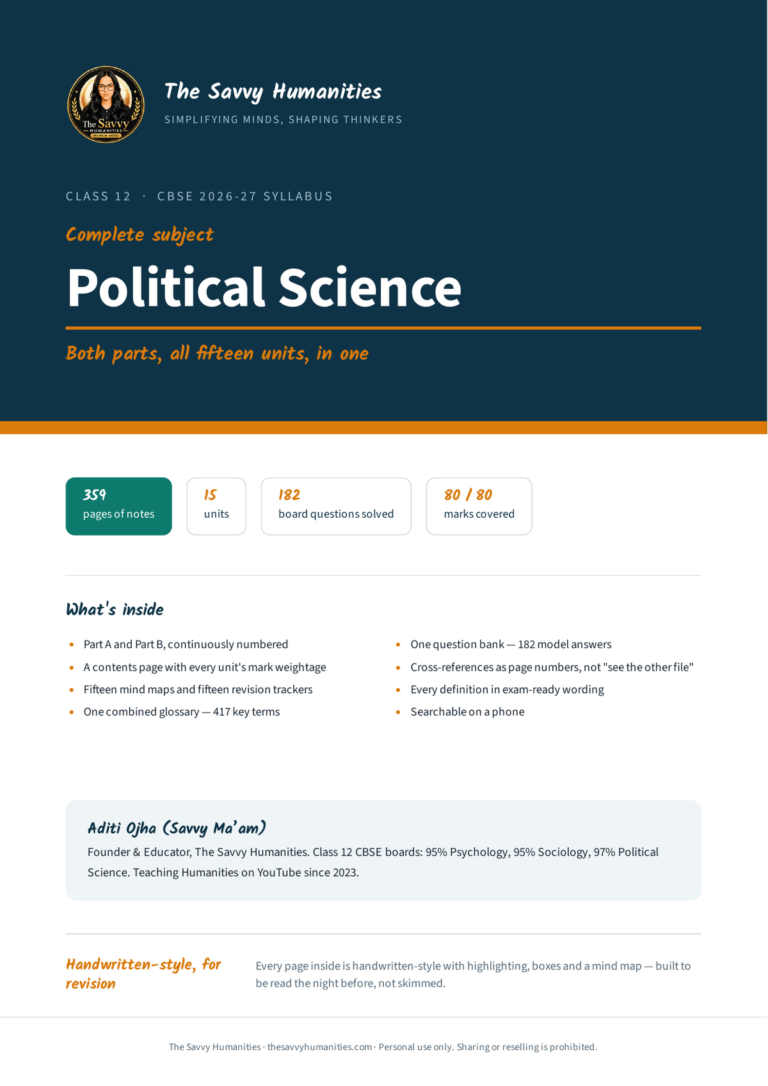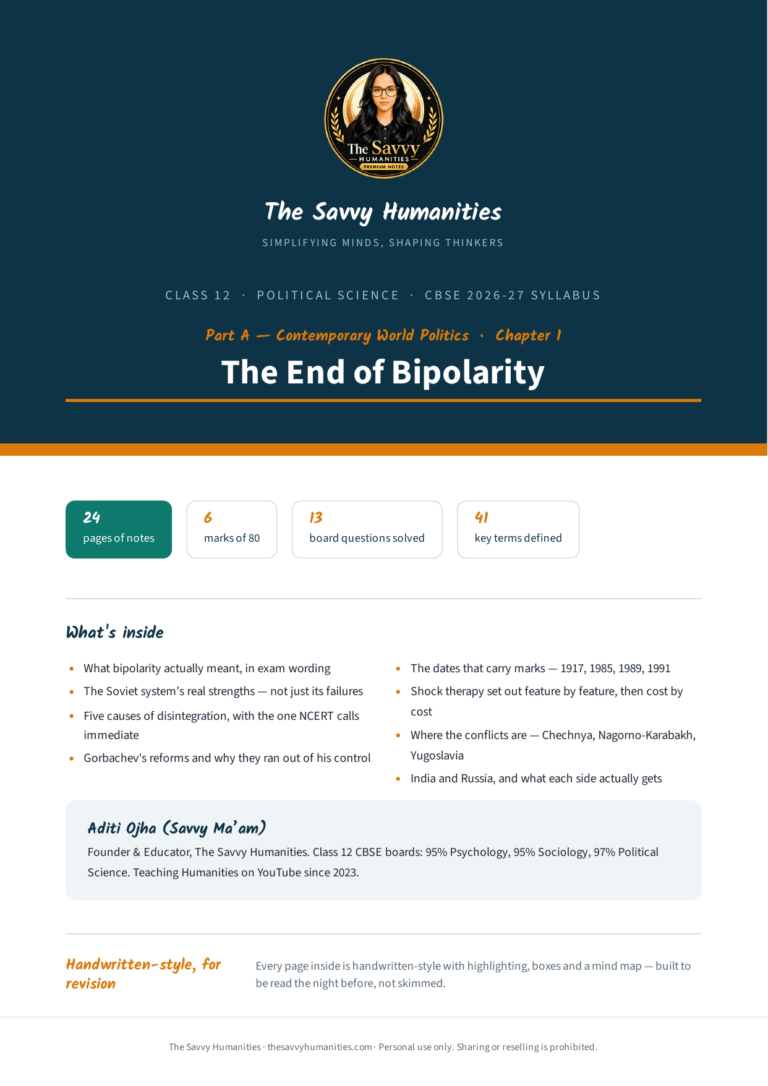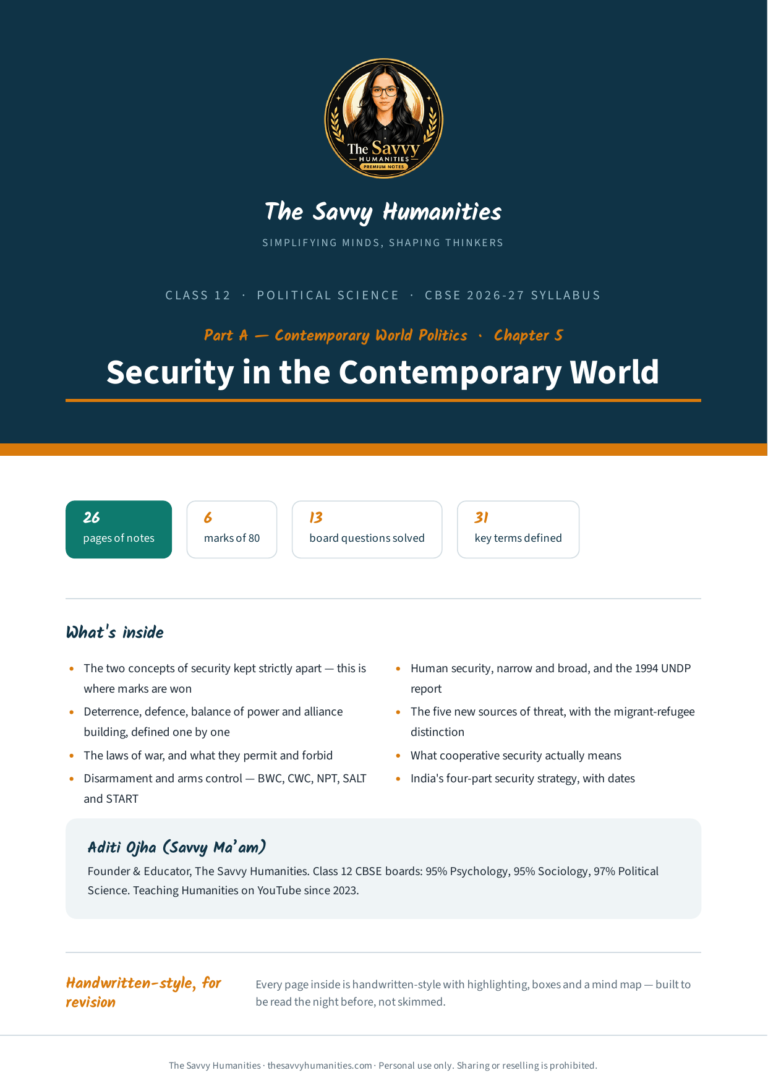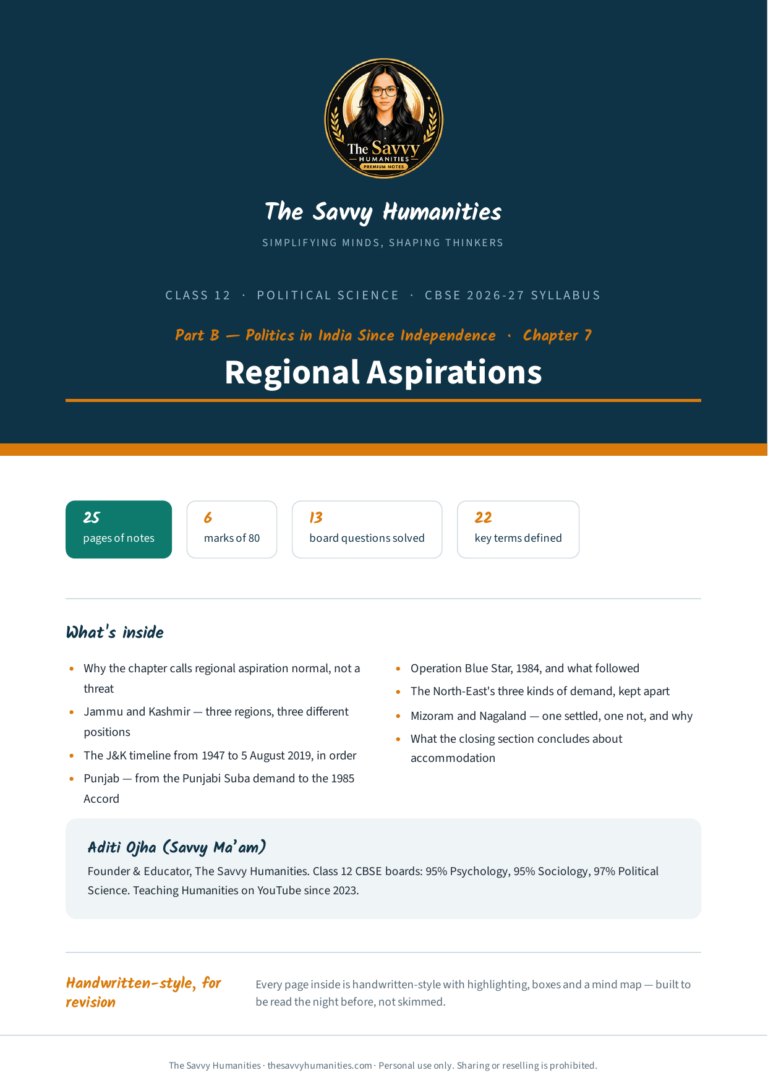
Exam-oriented handwritten-style notes — every page laid out like class notes, with highlighting, boxes and a mind map, built to be read the night before rather than skimmed.
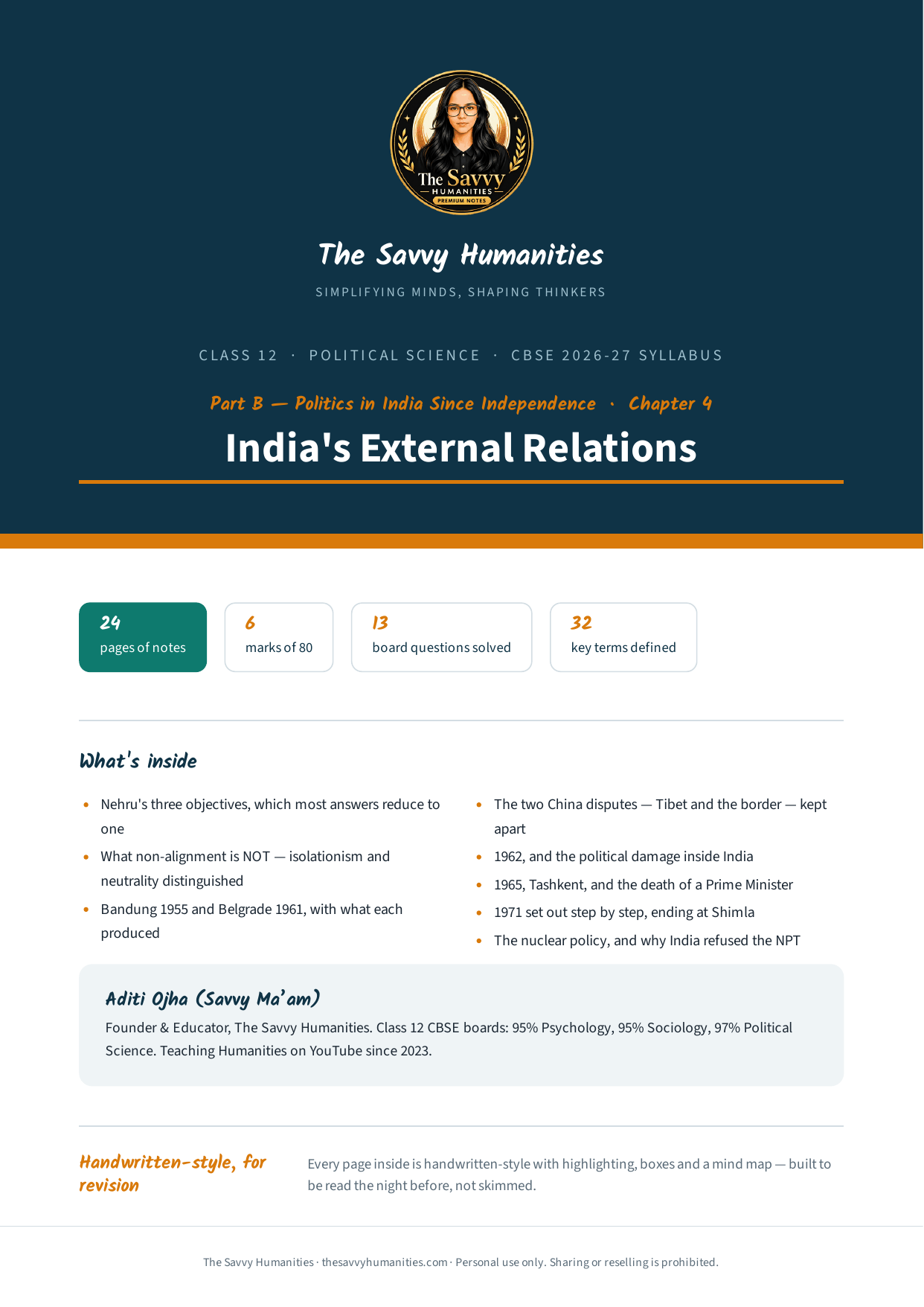
Unit 4 of Part B in the CBSE Class 12 Political Science paper carries 6 marks out of 80, checked against CBSE’s own 2026-27 curriculum document, which lists four sub-topics: the international context, the policy of non-alignment, peace and conflict with China and Pakistan, and India’s nuclear policy.
What were Nehru’s three objectives?
To preserve hard-earned sovereignty, protect territorial integrity, and promote rapid economic development. Most answers reduce these to one and lose marks. The notes keep all three separate and show how each shaped a different part of the policy.
What is non-alignment NOT?
This is where the marks are won. Non-alignment is not isolationism — isolationism means staying out of world affairs altogether, and India was intensely involved. Non-alignment is not neutrality either — neutrality is about staying out of wars, while non-alignment is about staying out of blocs, keeping the freedom to judge each issue on its merits. The notes define all three side by side.
Bandung 1955 and Belgrade 1961 — what each produced
The Asian Relations Conference in New Delhi in March 1947, before independence; the Bandung Conference of 1955 in Indonesia, the zenith of India’s engagement with newly independent nations, which led to the founding of the Non-Aligned Movement; and the first NAM summit at Belgrade in September 1961. India’s consistent opposition to apartheid is set in the same frame.
The two China disputes, kept apart
Students merge them and lose the answer. They are separate:
- Tibet — China’s takeover in 1950, India’s misgivings, conceding China’s claim in 1954, and the Dalai Lama’s asylum in 1959, after which China alleged India was permitting anti-China activities
- The boundary — Aksai Chin in the western sector and NEFA, now Arunachal Pradesh, in the eastern
Around them: Hindi-Chini bhai bhai, and Panchsheel, the Five Principles of Peaceful Coexistence declared jointly by Nehru and Zhou Enlai on 29 April 1954.
1962, and the political damage inside India
The October 1962 attack in both disputed regions, Chushul, the second wave in November and the unilateral Chinese withdrawal. Then the part answers leave out — what it did to politics at home: the resignation of Defence Minister V.K. Krishna Menon, and the first no-confidence motion in Indian parliamentary history, moved against the government and defeated.
1965, Tashkent, and the death of a Prime Minister
The Tashkent Agreement of January 1966 between Lal Bahadur Shastri and General Ayub Khan, brokered by the Soviet Union. Shastri died at Tashkent the night the agreement was signed.
1971, step by step, ending at Shimla
The Awami League’s sweep of East Pakistan in the 1970 elections and the majority it won across Pakistan, power denied, Sheikh Mujib-ur Rahman’s arrest, the military crackdown, the refugee crisis, the Treaty of Peace and Friendship with the Soviet Union in August 1971 and the criticism that it departed from non-alignment, the December conflict, and the Shimla Agreement of 3 July 1972 between Indira Gandhi and Zulfikar Ali Bhutto.
Why did India refuse to sign the NPT?
Because it considered the 1968 treaty discriminatory — it allowed states that had already tested to keep their weapons. The notes trace the programme from Homi J. Bhabha in the late 1940s, through the 1974 test India described as a peaceful explosion, to the declared no-first-use posture alongside a continued commitment to a nuclear-free world.
What else is in the file
- Chapter at a glance — a one-page mind map of the whole chapter
- A 32-term glossary of every definition the paper can ask for — the fullest in Part B so far
- 13 board-pattern questions with full model answers
- A revision tracker to tick off each topic as read, practised and revised
The file
- Format: PDF, A4 — works on a phone and prints cleanly
- Length: 24 pages plus cover
- Delivery: instant download link after payment, plus a copy by email
- Free updates: if CBSE changes the syllabus or a correction goes in, the updated file is sent to you at no cost. You never pay twice for the same chapter.
By Aditi Ojha (Savvy Ma’am) — Founder and educator, The Savvy Humanities. Teaching Humanities on YouTube since 2023. These notes pair with the free chapter video; QR codes inside the file link to it.