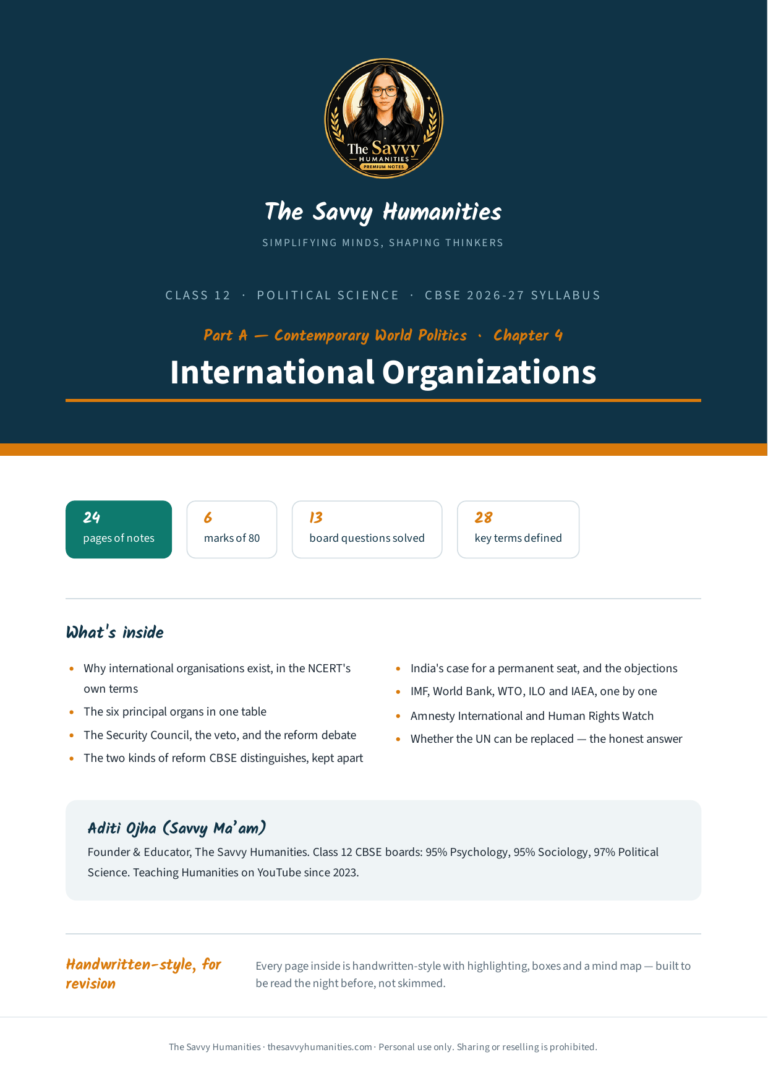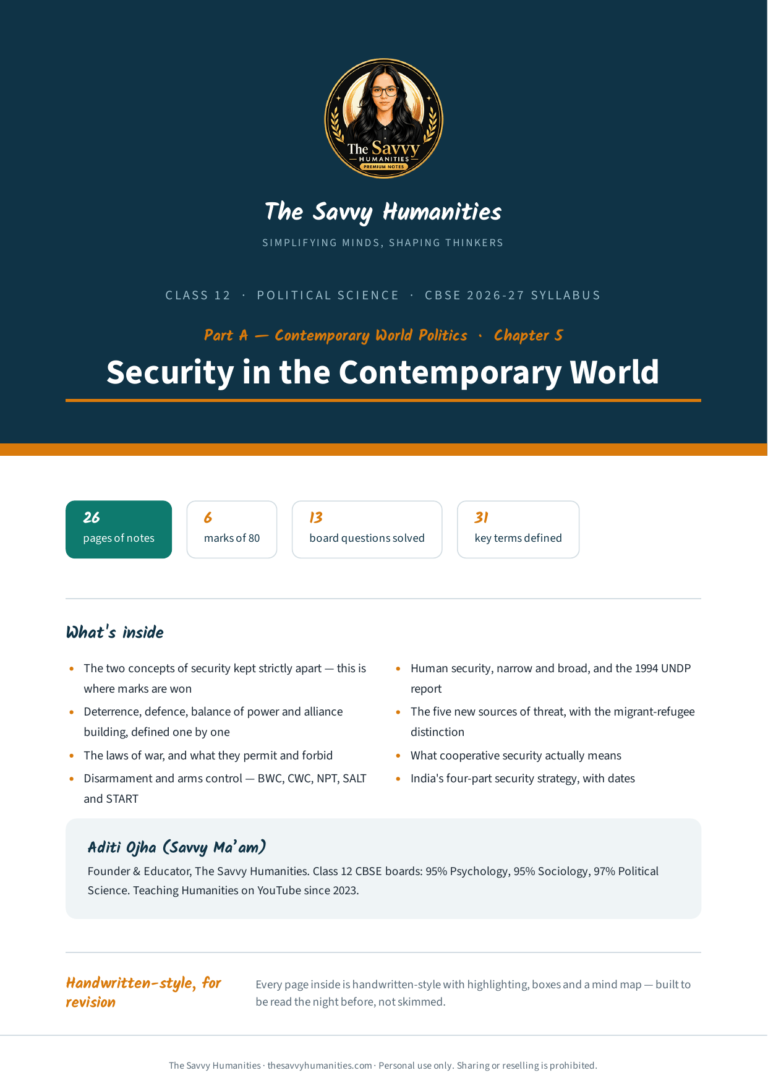
Exam-oriented handwritten-style notes — every page laid out like class notes, with highlighting, boxes and a mind map, built to be read the night before rather than skimmed.
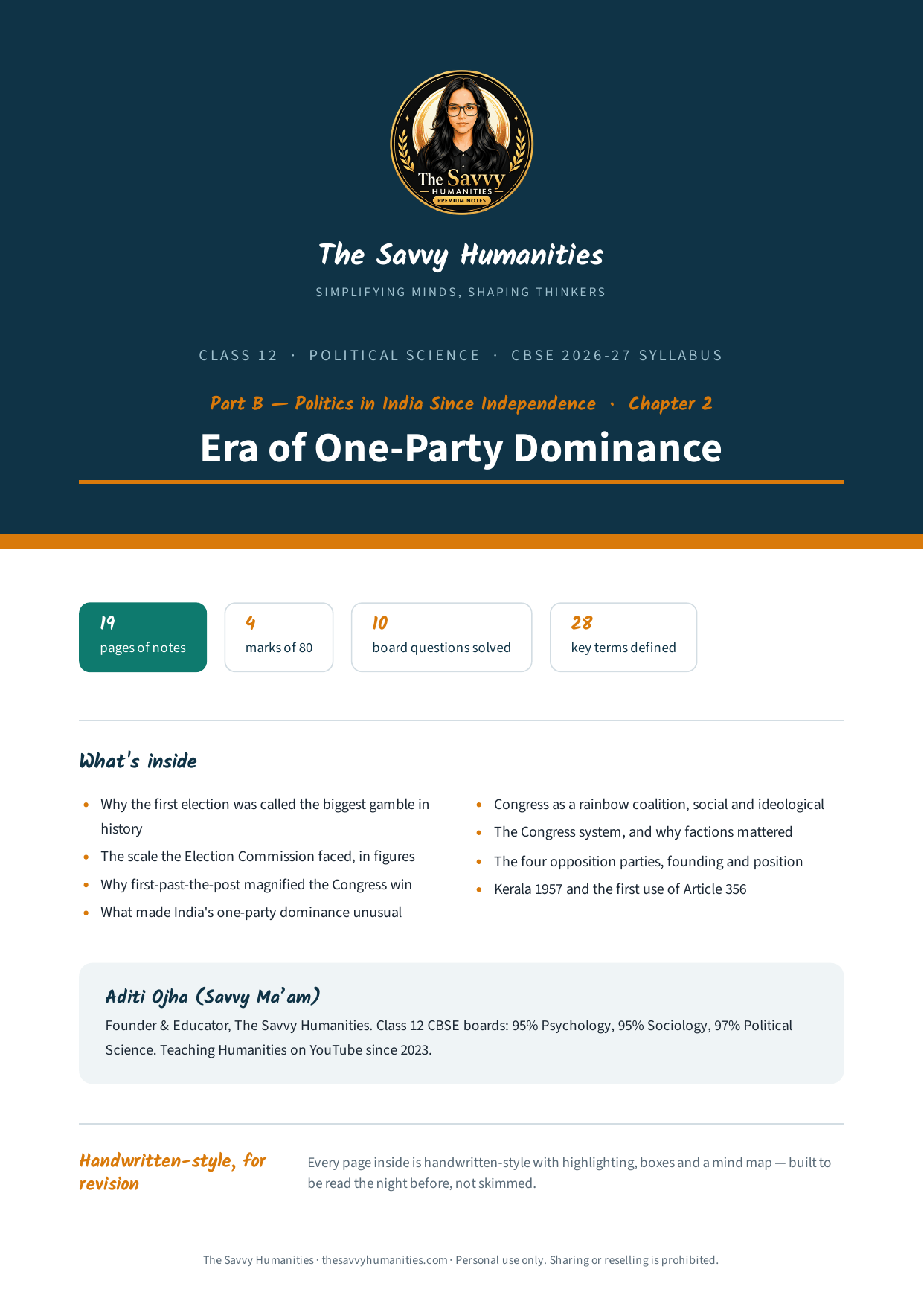
Unit 2 of Part B in the CBSE Class 12 Political Science paper carries 4 marks out of 80, checked against CBSE’s own 2026-27 curriculum document, which lists three sub-topics: the challenge of building democracy, Congress dominance in the first three general elections, and the emergence of opposition parties.
Why was India’s first election called the biggest gamble in history?
Because no country had tried universal adult franchise on this scale at this level of poverty and literacy. The notes give the figures the paper asks for: an electorate of about 17 crore, roughly 85 per cent of whom could not read or write; over 3,200 constituencies drawn from nothing, 489 of them Lok Sabha seats; a separate ballot box per candidate carrying the election symbol; the Election Commission set up in January 1950 under Sukumar Sen; polling from October 1951 to February 1952. It covers why observers expected it to fail, and what actually happened.
Why did first-past-the-post magnify the Congress win?
Because the candidate with the most votes in a seat takes it outright. Congress won about three-quarters of the seats on about 45 per cent of the votes — 364 of 489 in 1952, and held the position through 1957 and 1962. The notes keep the vote share and the seat share apart, which is the distinction the examiner is testing.
What made India’s one-party dominance unusual?
That it was produced by free competition rather than by suppressing it. The notes contrast this with one-party systems elsewhere, and explain the two sources of Congress’s reach: it was a social coalition, a rainbow-like alliance across caste, class, religion, language and region, and an ideological coalition, holding revolutionaries and pacifists, conservatives and radicals together.
What was the Congress system, and why did factions matter?
The arrangement in which Congress both governed and contained the opposition, so the ruling party was itself the main arena of competition. Factions were the mechanism by which disagreement was expressed inside the party instead of leaving it — which is why they belong in the answer rather than being treated as a weakness.
The four opposition parties, founding and position
Each set out with its founding, its leaders and where it stood, described as NCERT describes them:
- Socialist Party — from the Congress Socialist Party of 1934, separate from 1948 after Congress barred dual membership; democratic socialism, distinct from both Congress and the Communists. Rammanohar Lohia, Jayaprakash Narayan, Acharya Narendra Dev
- Communist Party of India — the Telangana uprising and the abandonment of armed struggle in 1951; the 1964 split into CPI and CPI(M)
- Bharatiya Jana Sangh — formed 1951 under Shyama Prasad Mukherjee, with roots in the RSS and the Hindu Mahasabha; Akhand Bharat
- Swatantra Party — formed August 1959 under C. Rajagopalachari after the Nagpur resolution; opposed to planning, nationalisation, land ceilings and progressive taxation
Kerala 1957 and the first use of Article 356
E.M.S. Namboodiripad formed a Communist government in Kerala in 1957 — the first communist government anywhere in the world to come to power through democratic elections. It was dismissed in 1959 under Article 356, the first dismissal of a state government by that route. The notes set out the sequence and why the case is a board favourite.
What else is in the file
- Chapter at a glance — a one-page mind map of the whole chapter
- A 28-term glossary of every definition the paper can ask for
- 10 board-pattern questions with full model answers
- A revision tracker to tick off each topic as read, practised and revised
Why 10 questions and not 13
This unit carries 4 marks, so the question bank has 10 and carries no 6-markers — a 4-mark unit does not produce them. That is deliberate, not an omission, and the notes say so on their own first page.
The file
- Format: PDF, A4 — works on a phone and prints cleanly
- Length: 19 pages plus cover
- Delivery: instant download link after payment, plus a copy by email
- Free updates: if CBSE changes the syllabus or a correction goes in, the updated file is sent to you at no cost. You never pay twice for the same chapter.
By Aditi Ojha (Savvy Ma’am) — Founder and educator, The Savvy Humanities. Teaching Humanities on YouTube since 2023. These notes pair with the free chapter video; QR codes inside the file link to it.