Exam-oriented handwritten-style notes — every page laid out like class notes, with highlighting, boxes and a mind map, built to be read the night before rather than skimmed.
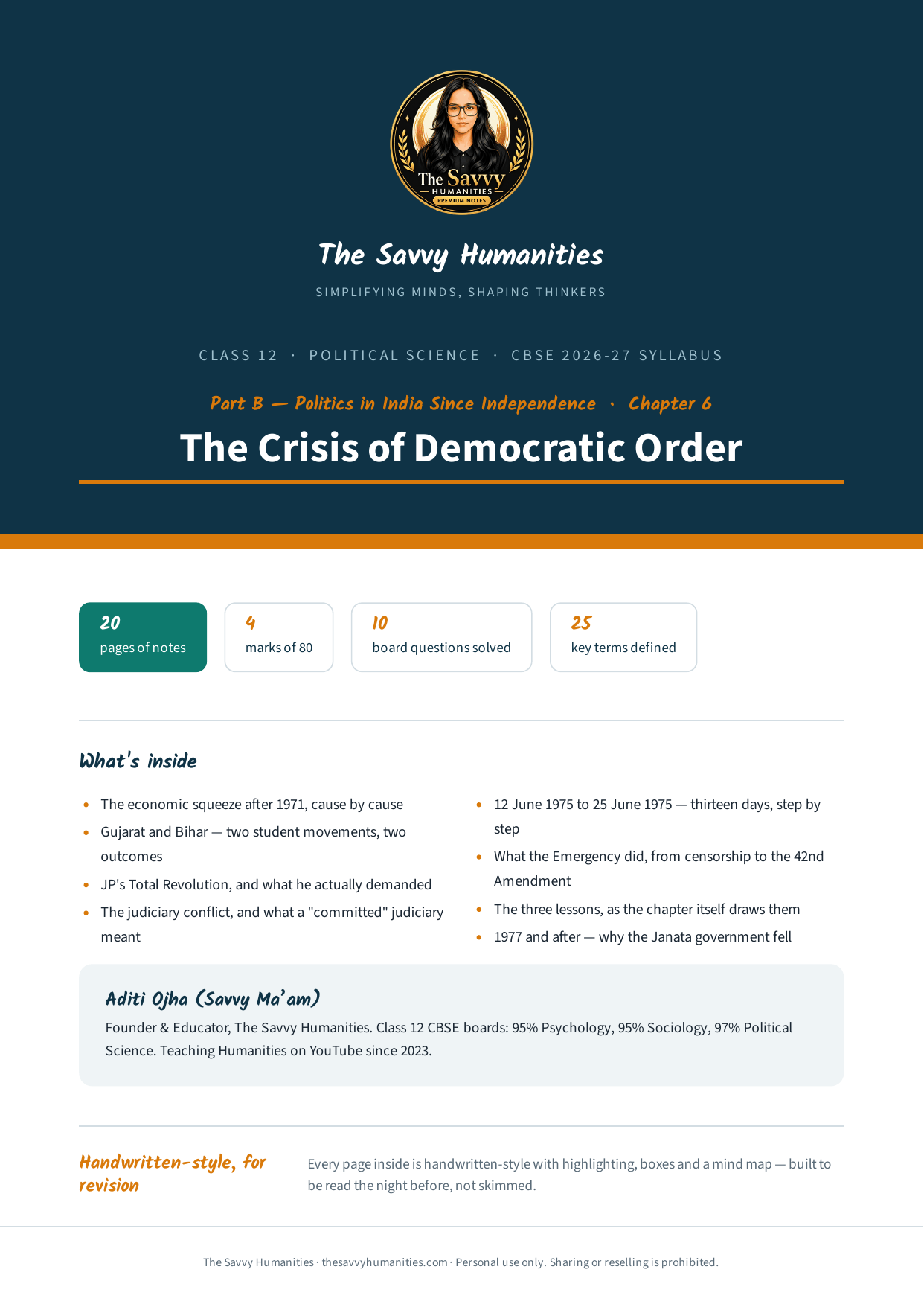
Unit 6 of Part B in the CBSE Class 12 Political Science paper carries 4 marks out of 80, checked against CBSE’s own 2026-27 curriculum document, which lists four sub-topics: the background to the Emergency, the declaration itself, what it did, and the 1977 election and after.
The economic squeeze after 1971, cause by cause
Not a general statement about hardship, but the causes laid out one at a time: the Bangladesh crisis — about eight million people crossing into India from East Pakistan, and the war that followed, after which the United States stopped all aid to India — set beside rising prices, a poor monsoon, and falling industrial output.
Gujarat and Bihar — two student movements, two outcomes
Both began as student protests in 1974 and they did not end the same way. Gujarat, January 1974, against rising prices of food grains, cooking oil and other essentials, and against corruption in high places; elections there in June 1975 ended in the Congress being defeated. Bihar, March 1974, which invited Jayaprakash Narayan to lead it and so became a national movement. The railway strike of May 1974, called by the National Coordination Committee led by George Fernandes, lasted twenty days and ended without a settlement.
What did JP actually demand?
Total Revolution — revolution in the social, economic and political spheres in order to establish true democracy — alongside his specific demand for the dismissal of the Congress government in Bihar. He led the Bihar movement on condition that it stay non-violent and spread beyond Bihar. The notes give the demand as he made it, because answers that paraphrase it loosely lose the mark.
The judiciary conflict, and what a “committed” judiciary meant
Two positions, each stated as its holders stated it. The parliamentary supremacy argument: that an elected Parliament rather than the courts should have the final word. The idea of a committed judiciary, voiced by people close to the Prime Minister — a judiciary and bureaucracy committed to the vision of the executive and legislature, which is the opposite of an independent judiciary. Around them: the supersession of judges in 1973, when the seniority of three judges was set aside and Justice A.N. Ray appointed Chief Justice over them.
12 June 1975 to 25 June 1975 — thirteen days, step by step
The Allahabad High Court judgment of 12 June 1975 declaring Indira Gandhi’s election to the Lok Sabha invalid because government servants had been used in her campaign, leaving her six months to be re-elected; and the proclamation of Emergency under Article 352 on 25 June 1975, issued by President Fakhruddin Ali Ahmed immediately on the Prime Minister’s recommendation. The notes run the thirteen days in order, because the sequence is the answer.
What the Emergency did
Set out as matters of record, with the legal mechanism in each case:
- Press censorship — prior approval required for all material to be published
- Preventive detention on a large scale — arrest without trial to prevent an anticipated act
- Habeas corpus suspended in effect — in April 1976 a Constitution bench accepted the government’s plea that such writs could not be filed during the Emergency
- The 42nd Amendment — the elections of the Prime Minister, President and Vice-President made unchallengeable in court, and legislature terms extended from five years to six
- The forced sterilisation drive, concentrated mostly in the northern states
- The Shah Commission afterwards, whose report found the administration and police had become vulnerable to political pressures
The three lessons, as the chapter itself draws them
Attributed, not asserted: that it is extremely difficult to do away with democracy in India; that the constitutional ambiguity was corrected; and that the courts became active in protecting civil liberties. The correction is worth knowing precisely — an internal Emergency now requires “armed rebellion”, replacing the vaguer “internal disturbance” of 1975, and Cabinet advice to the President must be given in writing.
1977 and after — why the Janata government fell
The Janata Party, formed on the eve of the 1977 elections by the major opposition parties under JP’s leadership with the message “save democracy”, which turned the poll into a referendum on the Emergency; Congress for Democracy under Jagjivan Ram, which merged with it; Morarji Desai heading the first non-Congress government at the centre since independence; and Charan Singh’s government after the split, in power about four months before the January 1980 elections.
What else is in the file
- Chapter at a glance — a one-page mind map of the whole chapter
- A 25-term glossary of every definition the paper can ask for
- 10 board-pattern questions with full model answers — 10 rather than 13 because a 4-mark unit carries no 6-markers
- A revision tracker to tick off each topic as read, practised and revised
The file
- Format: PDF, A4 — works on a phone and prints cleanly
- Length: 20 pages plus cover
- Delivery: instant download link after payment, plus a copy by email
- Free updates: if CBSE changes the syllabus or a correction goes in, the updated file is sent to you at no cost. You never pay twice for the same chapter.
By Aditi Ojha (Savvy Ma’am) — Founder and educator, The Savvy Humanities. Teaching Humanities on YouTube since 2023. These notes pair with the free chapter video; QR codes inside the file link to it.