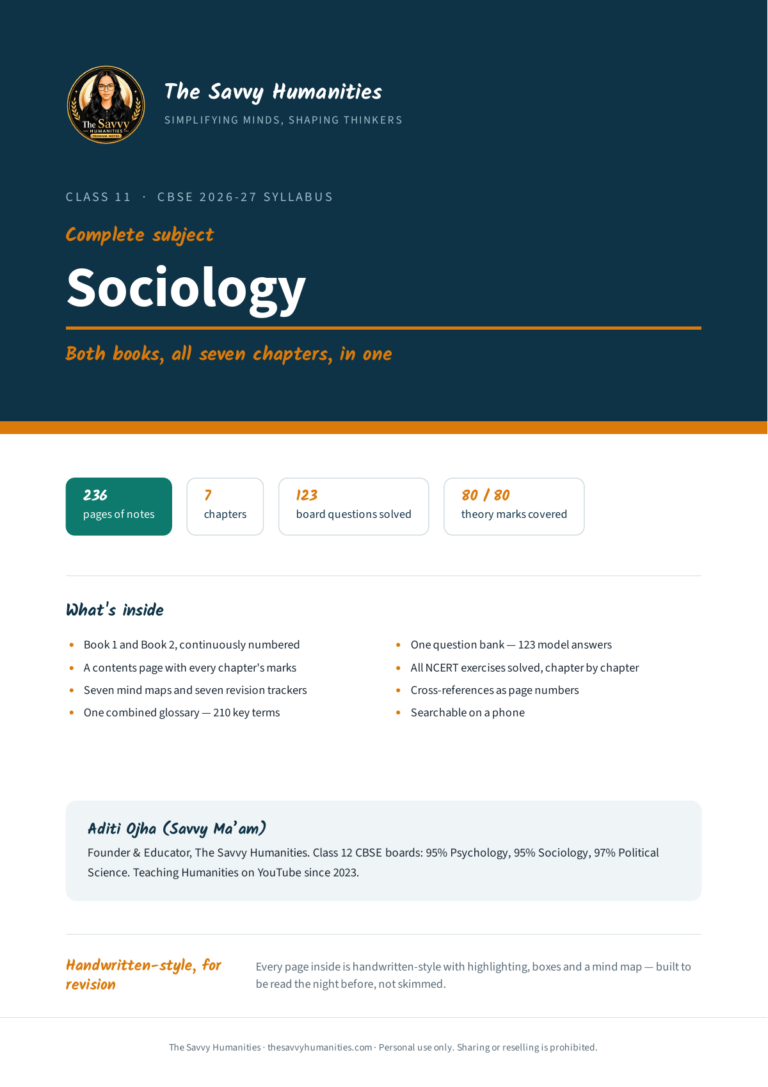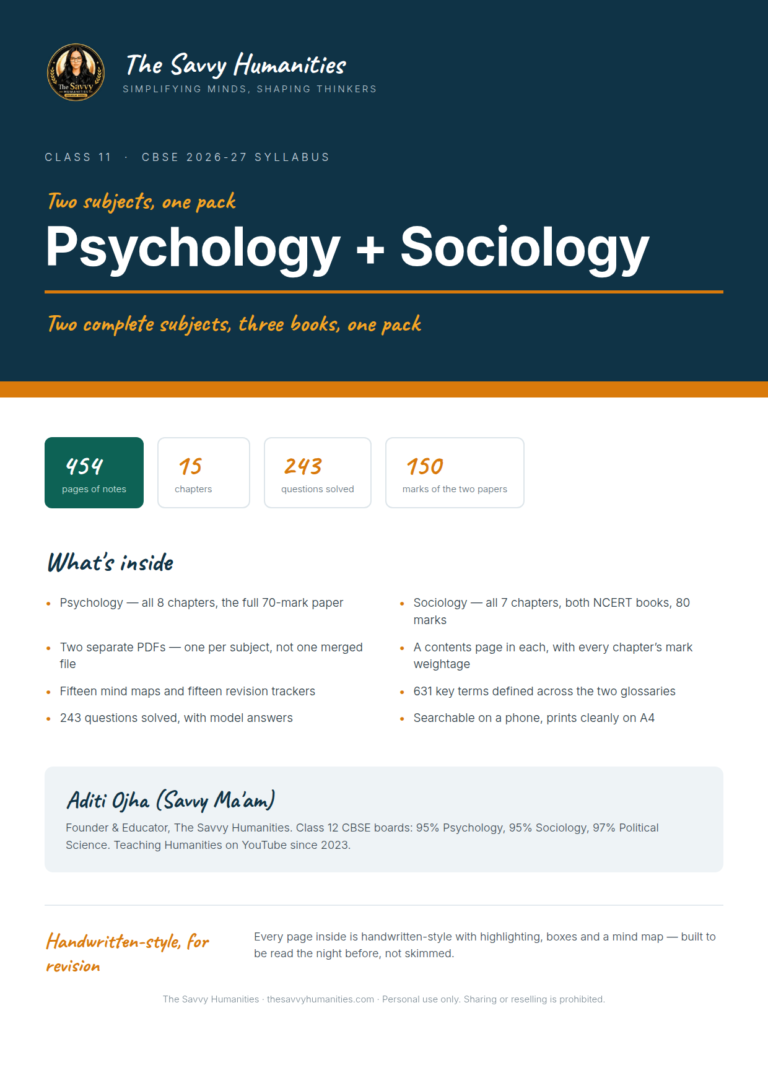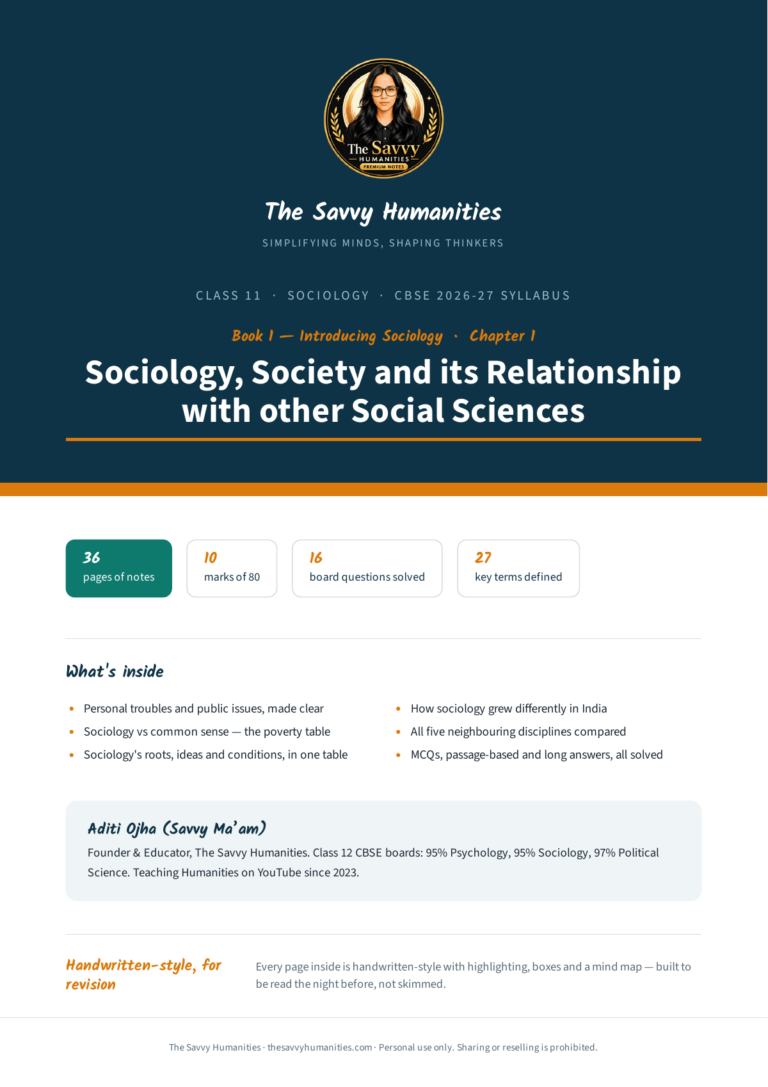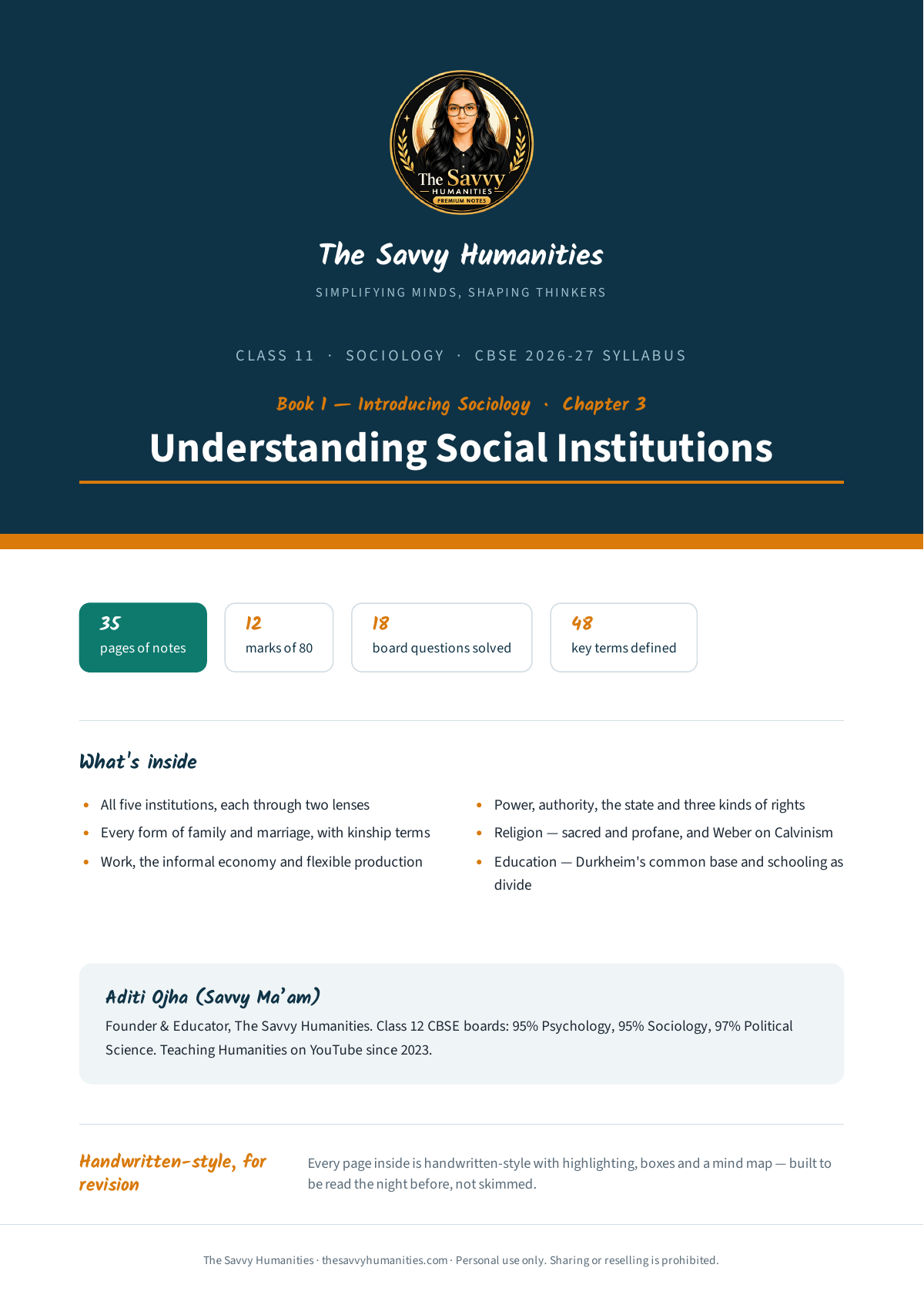
Exam-oriented handwritten-style notes — every page laid out like class notes, with highlighting, boxes and a mind map, built to be read the night before rather than skimmed.
Unit 3 of the CBSE Class 11 Sociology paper carries 12 marks out of 80. CBSE lists five sub-topics, one for each institution, which makes this the widest chapter in the course.
What are the five social institutions in Class 11 Sociology?
Family, marriage and kinship; work and economic life; political institutions; religion; and education. Each one is read through two lenses — the functionalist view and the conflict view — so a “discuss” question always has both sides ready.
What forms of family and marriage does the chapter cover?
Every form it names — nuclear and joint families, matrilineal and patrilineal descent, monogamy and polygamy — together with endogamy, exogamy and the kinship terms (consanguineous and affinal kin).
What is the difference between power and authority?
Power is the ability to get your way; authority is power accepted as legitimate. The notes add the state and the three kinds of rights — civil, political and social.
What does the chapter say about religion and education?
Religion through Durkheim’s sacred and profane and Weber on Calvinism; education through Durkheim’s idea of a common base, and schooling as a source of division. Work covers the informal economy and flexible production.
What else is in the file
- Chapter at a glance — a one-page mind map of the whole chapter
- A 48-term glossary of every definition the paper can ask for
- 18 questions solved with full model answers — board-pattern MCQs, passage-based and long answers (including 7 NCERT exercise questions), 1, 2, 4 and 6 markers
- A revision tracker to tick off each topic as read, practised and revised
The file
- Format: PDF, A4 — works on a phone and prints cleanly
- Length: 35 pages plus cover
- Delivery: instant download link after payment, plus a copy by email
- Free updates: if CBSE changes the syllabus or a correction goes in, the updated file is sent to you at no cost. You never pay twice for the same chapter.
By Aditi Ojha (Savvy Ma’am) — Founder and educator, The Savvy Humanities. Teaching Humanities on YouTube since 2023. These notes pair with the free chapter videos; QR codes inside the file link to them.