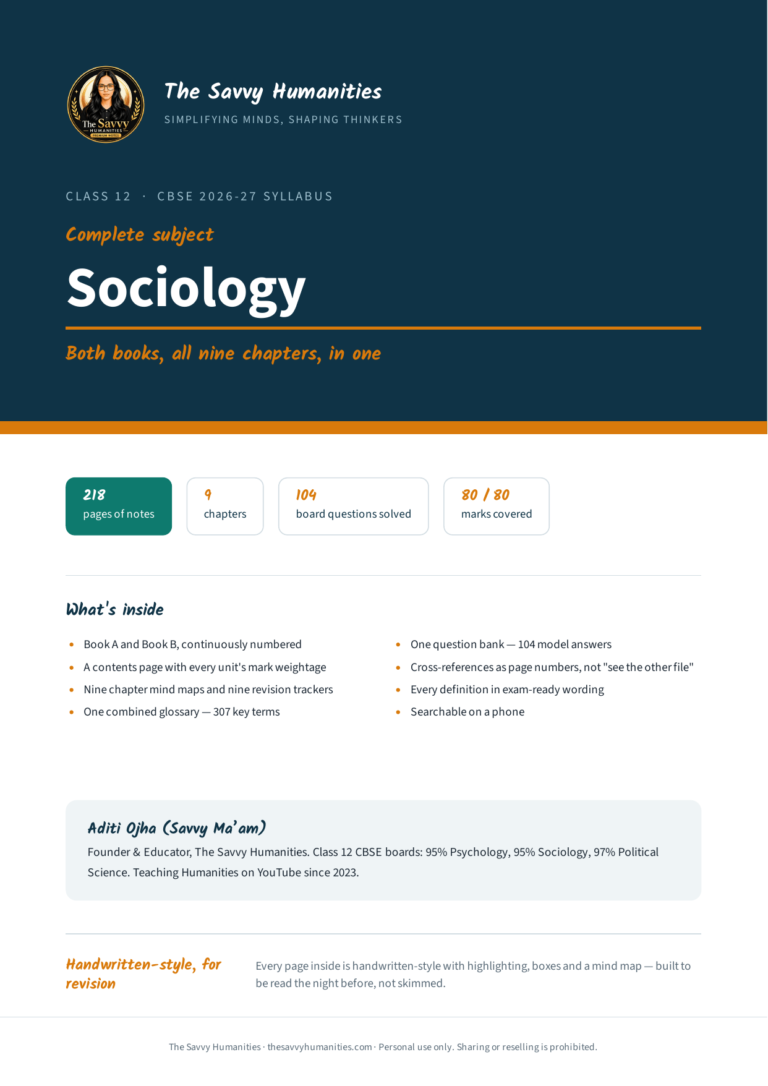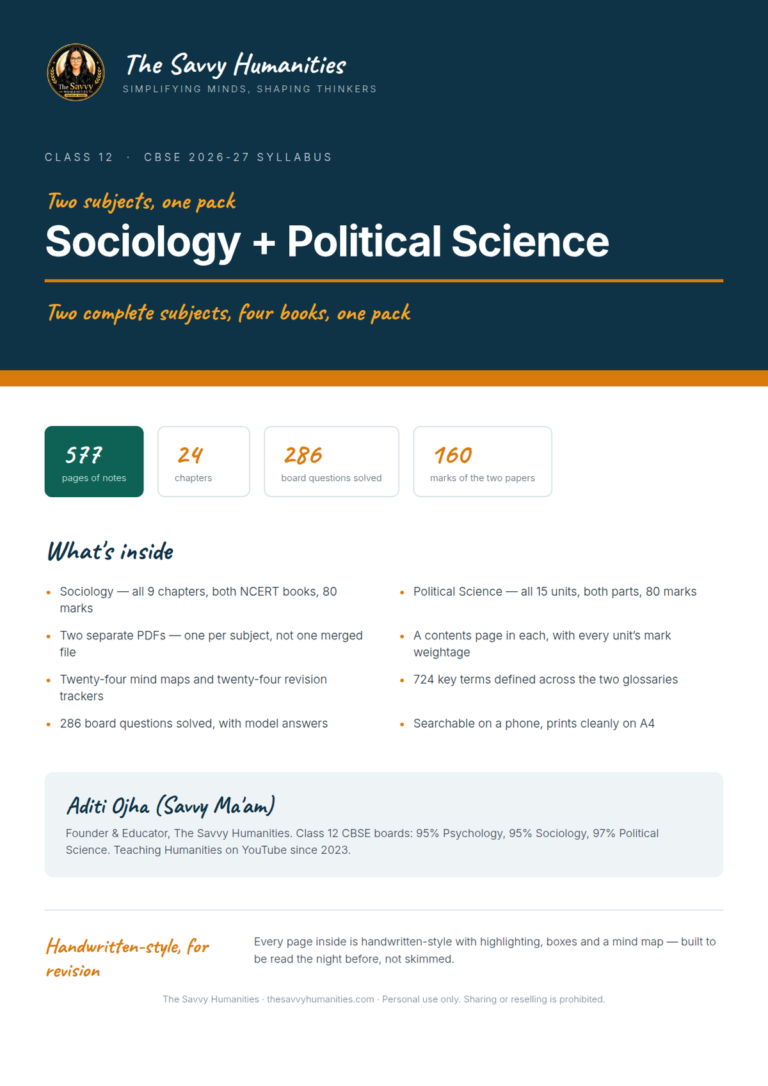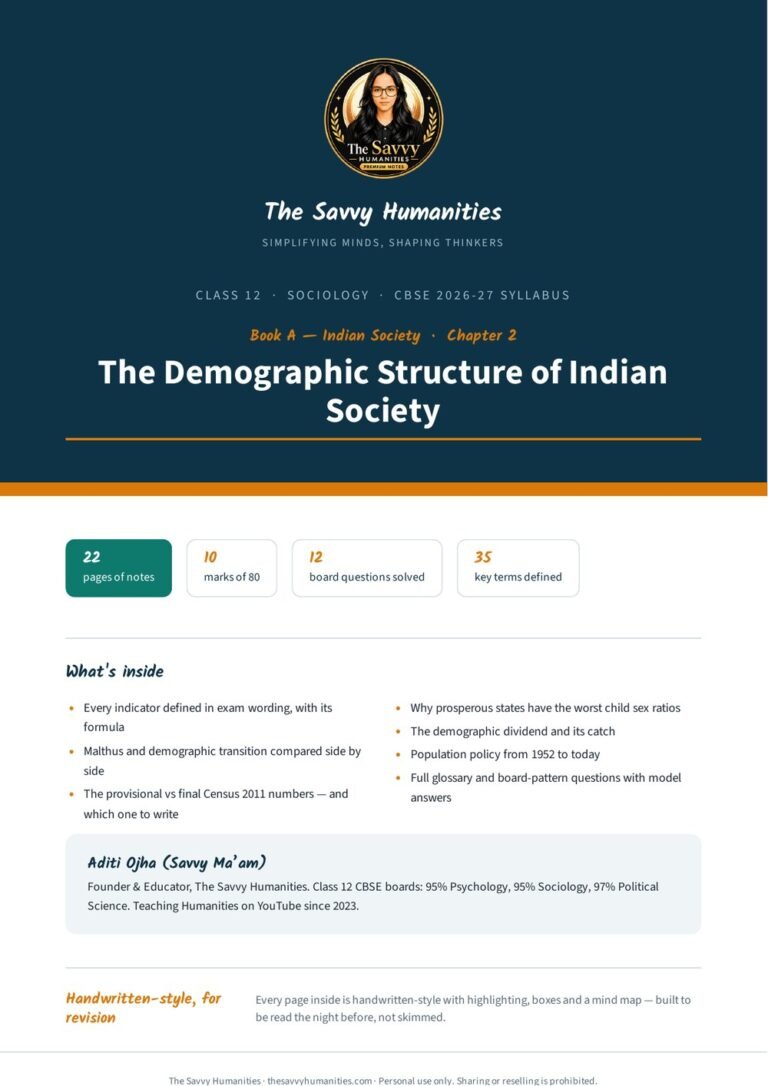
Exam-oriented handwritten-style notes — every page laid out like class notes, with highlighting, boxes and a mind map, built to be read the night before rather than skimmed.
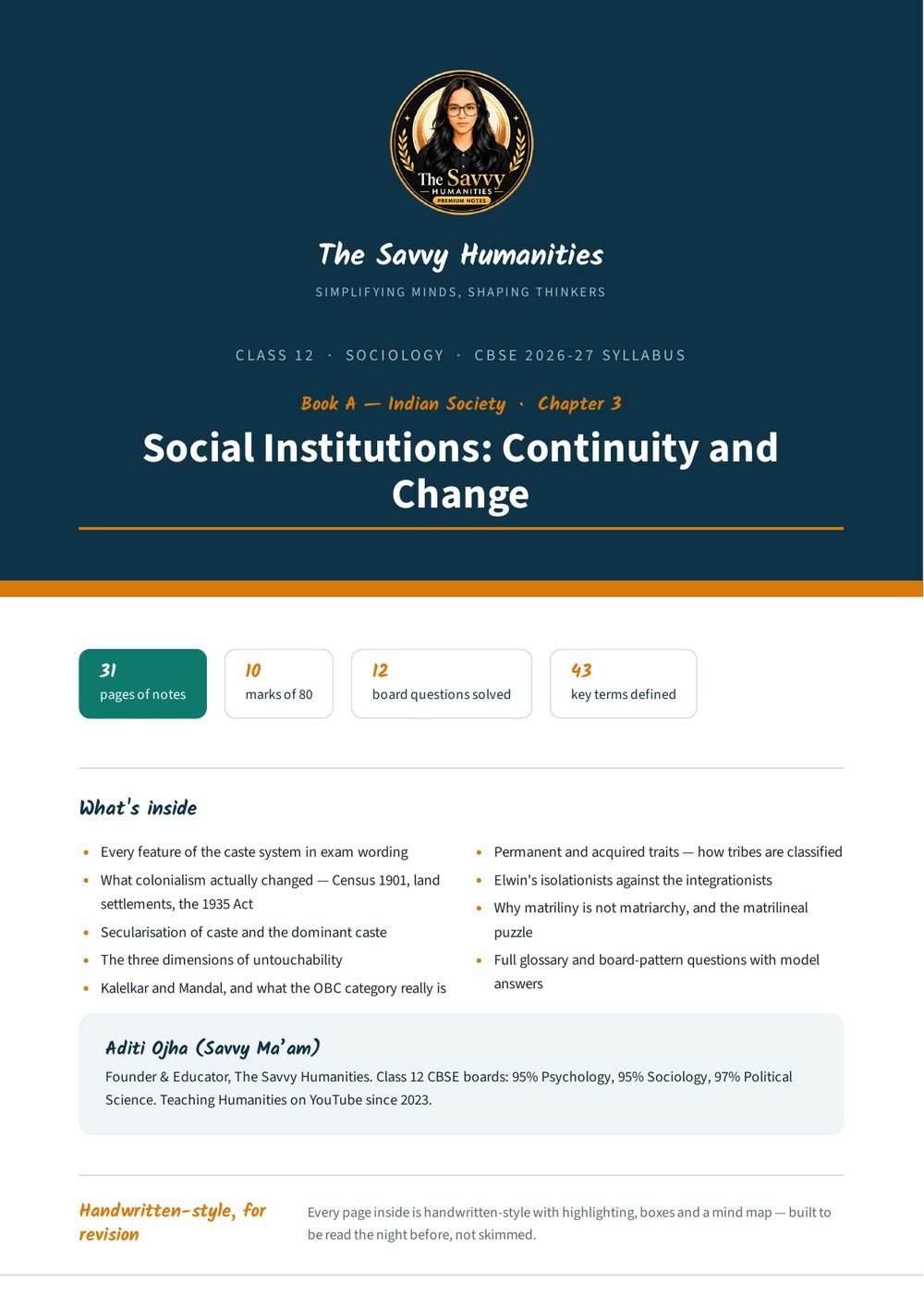
Unit 3 of the CBSE Class 12 Sociology paper carries 10 marks out of 80, and it is the longest chapter in Book A. Three institutions sit inside it — caste, tribe and family — and the examiner can take a 6-marker from any of them. This is the chapter where a student who has only read the caste half loses marks on the tribal and family halves.
What is inside
- Chapter at a glance — a one-page mind map covering all three institutions
- Complete topic-by-topic notes, NCERT-aligned, in CBSE’s own topic order
- Every feature of the caste system in exam wording — varna and jati separated properly, endogamy and exogamy, hierarchy, purity and pollution, the jajmani system, panchamas and dvija
- What colonialism actually changed — the Census of 1901 under Herbert Risley, the land settlements, and the Government of India Act 1935
- Secularisation of caste and M. N. Srinivas’s dominant caste
- All three dimensions of untouchability — exclusion, humiliation and subordination, exploitation — with begar and Article 17
- Kalelkar and Mandal, and what the OBC category really is, including the creamy layer
- How tribes are classified — permanent traits against acquired traits, and the Fifth and Sixth Schedules
- Elwin’s isolationists against the integrationists, and national development versus tribal development
- Why matriliny is not matriarchy — matrilineal, patrilineal, matrilocal, patrilocal, and the matrilineal puzzle
- A 43-term glossary of every definition the paper can ask for
- 12 board-pattern questions with full model answers — three each at 1, 2, 4 and 6 marks
- A revision tracker to tick off each topic as read, practised and revised
Written for the 2026-27 syllabus
Nothing from CBSE’s list for this chapter is left out. Sanskritisation, Westernisation and Modernisation are cross-referenced where they touch caste, but they are taught in full in Book B, Cultural Change, so they are not padded in here. The Market as a Social Institution is not covered at all, because CBSE has removed it from the syllabus — it is still printed in the NCERT book, which is exactly how students lose weeks on chapters that cannot be asked.
The file
- Format: PDF, A4 — works on a phone and prints cleanly
- Length: 31 pages plus cover
- Delivery: instant download link after payment, plus a copy by email
- Free updates: if CBSE changes the syllabus or a correction goes in, the updated file is sent to you at no cost. You never pay twice for the same chapter.
By Aditi Ojha (Savvy Ma’am) — Founder and educator, The Savvy Humanities. Teaching Humanities on YouTube since 2023. These notes pair with the free chapter video; QR codes inside the file link to it.