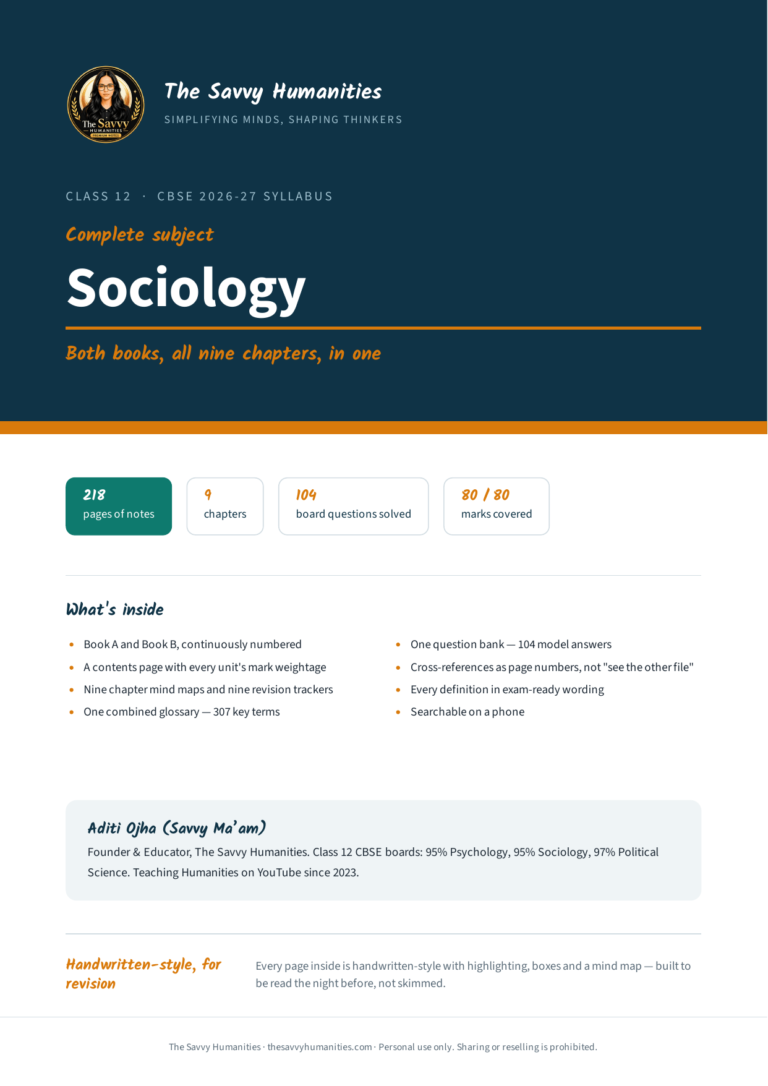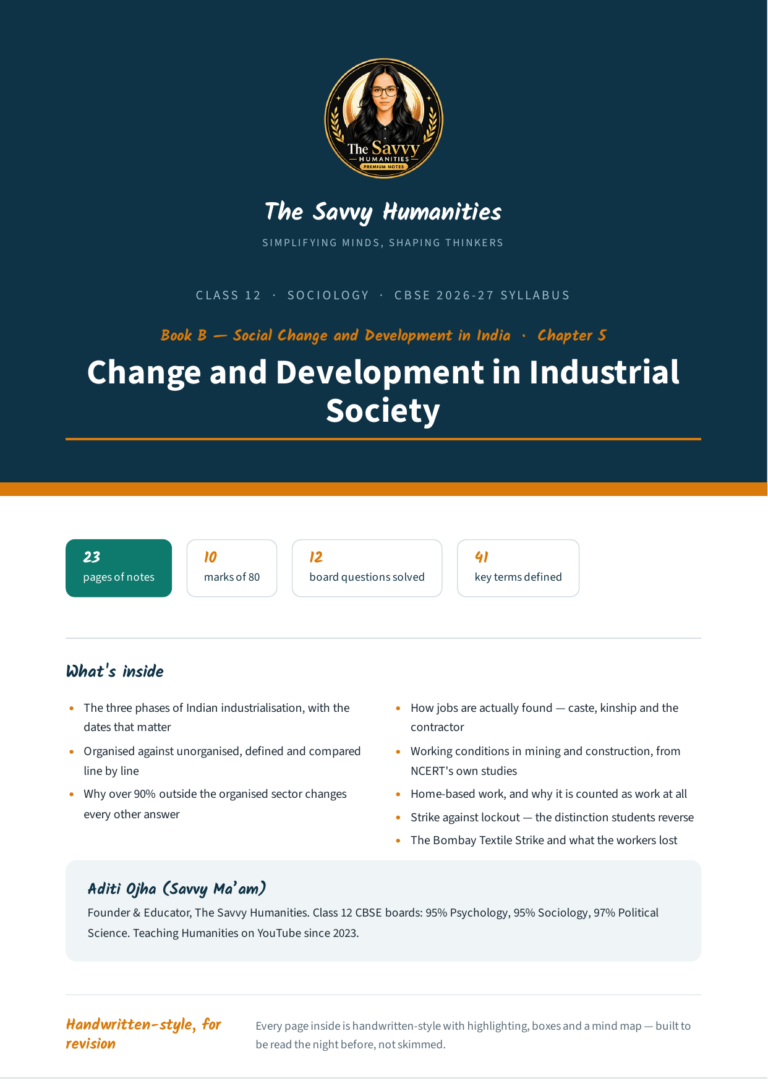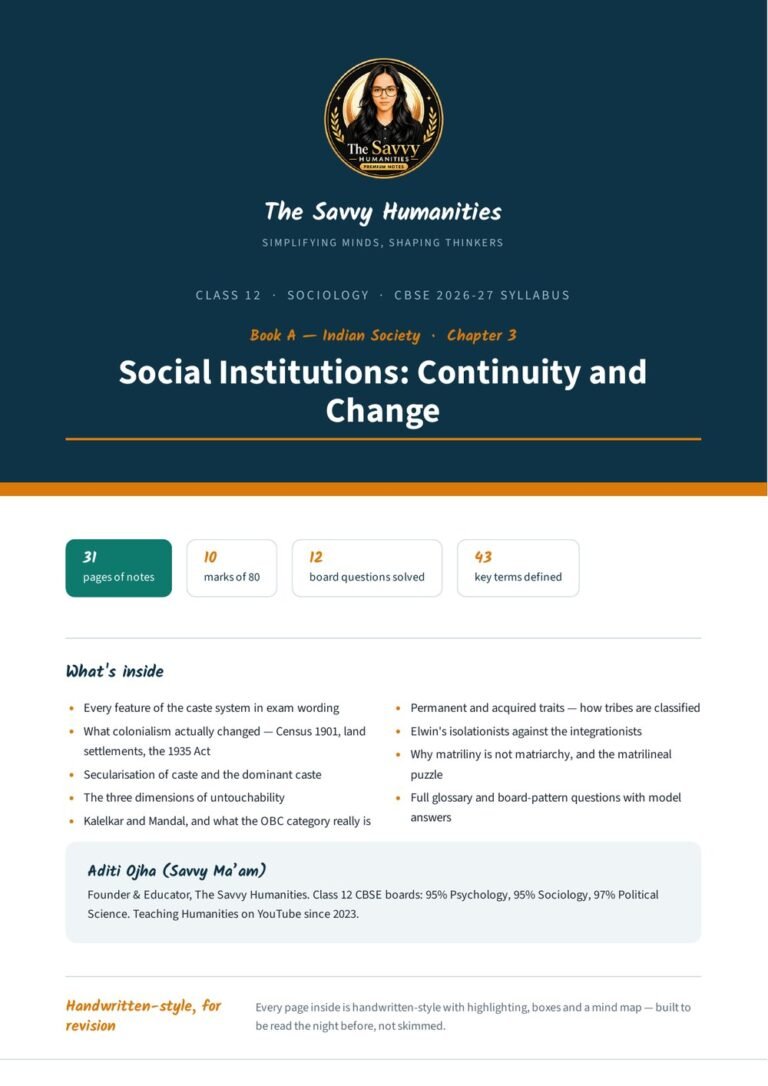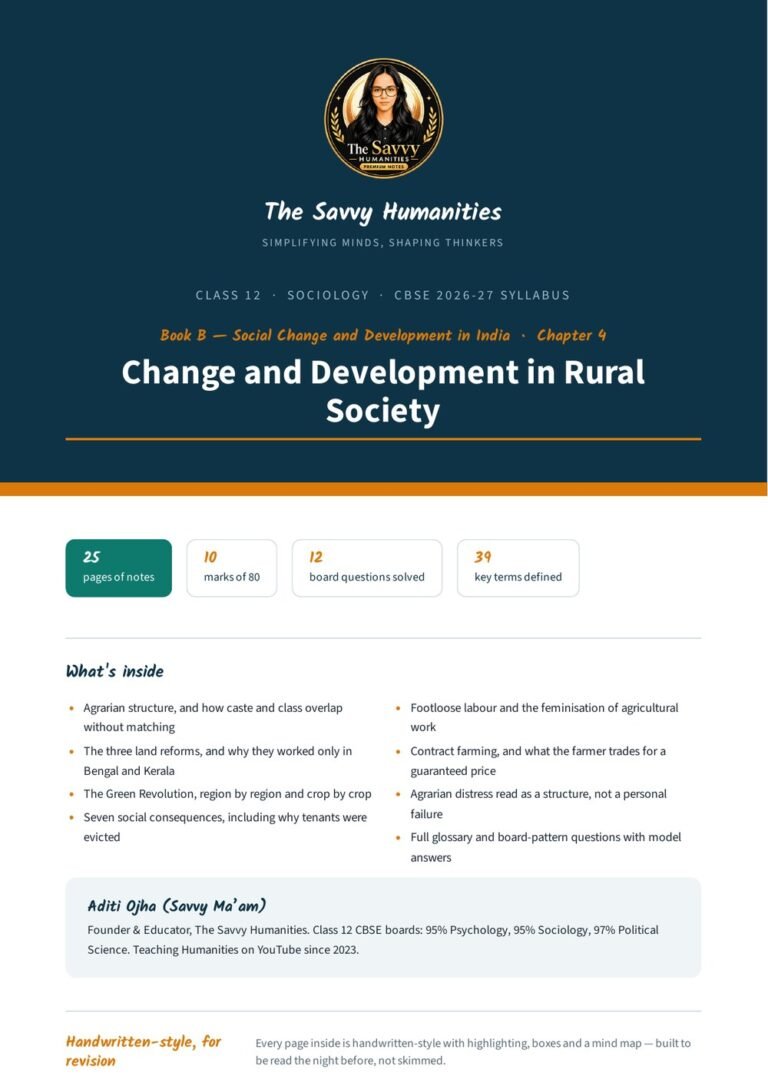
Exam-oriented handwritten-style notes — every page laid out like class notes, with highlighting, boxes and a mind map, built to be read the night before rather than skimmed.
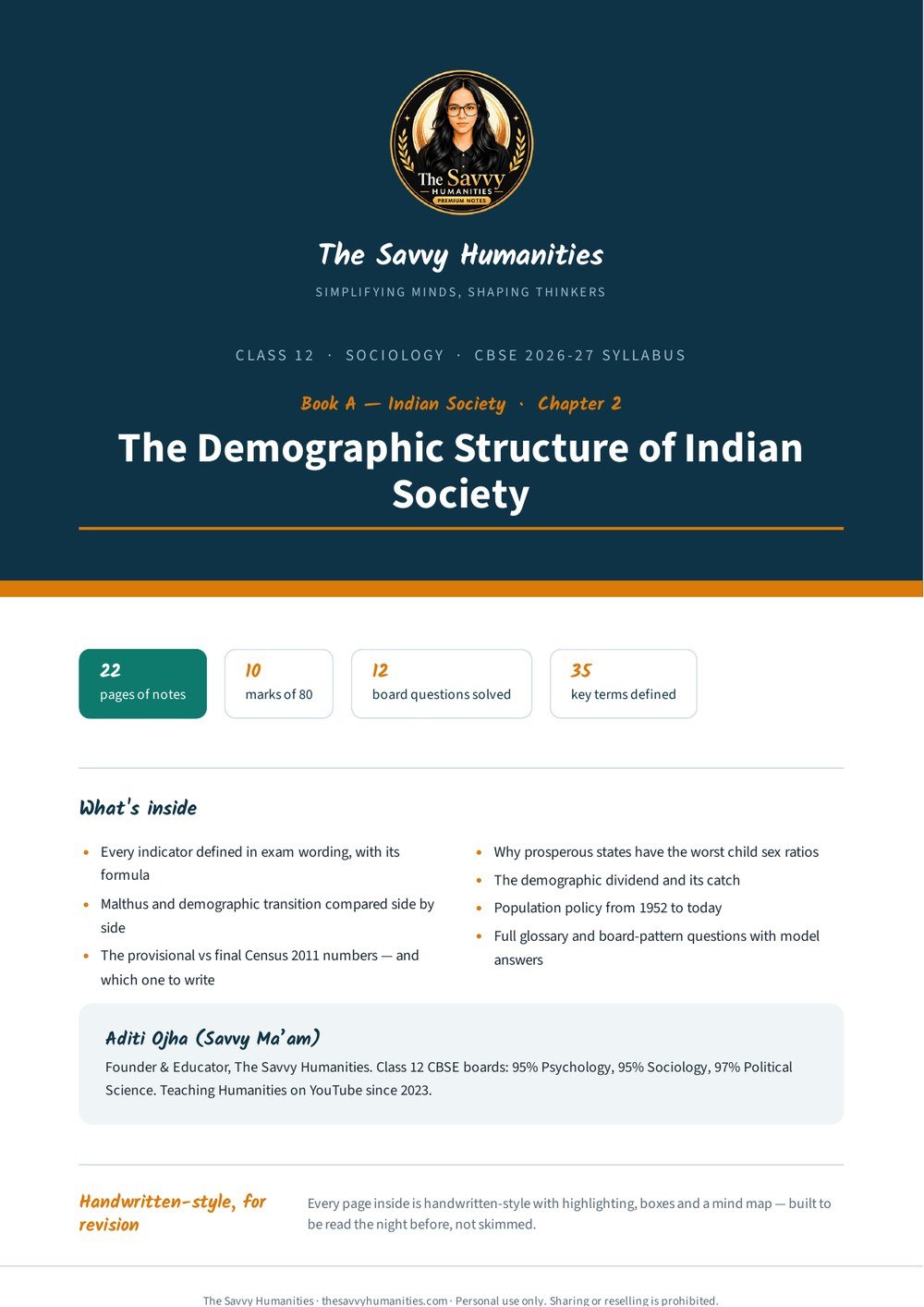
Unit 2 of the CBSE Class 12 Sociology paper carries 10 marks out of 80. It is built almost entirely on definitions, two theories and a handful of numbers, which makes it one of the cheapest 10 marks in the paper to secure — provided the numbers you write are the right ones.
What is inside
- Chapter at a glance — a one-page mind map covering all eleven syllabus topics
- Complete topic-by-topic notes, NCERT-aligned, in CBSE’s own topic order
- Every indicator defined in exam wording, with its formula — birth rate, death rate, rate of natural increase, fertility rate, TFR, IMR, MMR, sex ratio, child sex ratio, dependency ratio and life expectancy
- Malthus and the theory of demographic transition, compared side by side — including why history refuted Malthus in nineteenth-century Europe, which is the part students miss
- The Census 2011 numbers the paper actually asks for — sex ratio 940, child sex ratio 914, literacy 74.04%, and 1921 as the Year of the Great Divide
- The prosperity paradox — why Punjab, Haryana and Himachal have the worst child sex ratios, female foeticide and the PCPNDT Act
- The demographic dividend, and the catch that comes with it
- Population policy from 1952 to today — the world’s first state family planning programme, the coercion of the Emergency in 1975-77, and the National Population Policy 2000
- A 35-term glossary of every definition the paper can ask for
- 12 board-pattern questions with full model answers — three each at 1, 2, 4 and 6 marks
- A revision tracker to tick off each topic as read, practised and revised
Written for the 2026-27 syllabus
Every topic in this file is on CBSE’s list for this chapter, and nothing has been added to pad the page count. The Market as a Social Institution is not covered anywhere in these notes, because CBSE has removed it from the syllabus — it is still printed in the NCERT book, which is exactly how students lose weeks on chapters that cannot be asked.
Worth knowing too: Introducing Indian Society, the chapter before this one, carries no marks at all. This is the first chapter of the book the paper can actually examine.
The file
- Format: PDF, A4 — works on a phone and prints cleanly
- Length: 22 pages plus cover
- Delivery: instant download link after payment, plus a copy by email
- Free updates: if CBSE changes the syllabus or a correction goes in, the updated file is sent to you at no cost. You never pay twice for the same chapter.
By Aditi Ojha (Savvy Ma’am) — Founder and educator, The Savvy Humanities. Teaching Humanities on YouTube since 2023. These notes pair with the free chapter video; QR codes inside the file link to it.