Exam-oriented handwritten-style notes — every page laid out like class notes, with highlighting, boxes and a mind map, built to be read the night before rather than skimmed.
Unit 11 of the CBSE Class 12 Sociology paper carries 10 marks out of 80, checked against CBSE’s own 2026-27 curriculum document. Back to full weight after two 5-mark chapters — so expect 6-markers here, and study it accordingly.
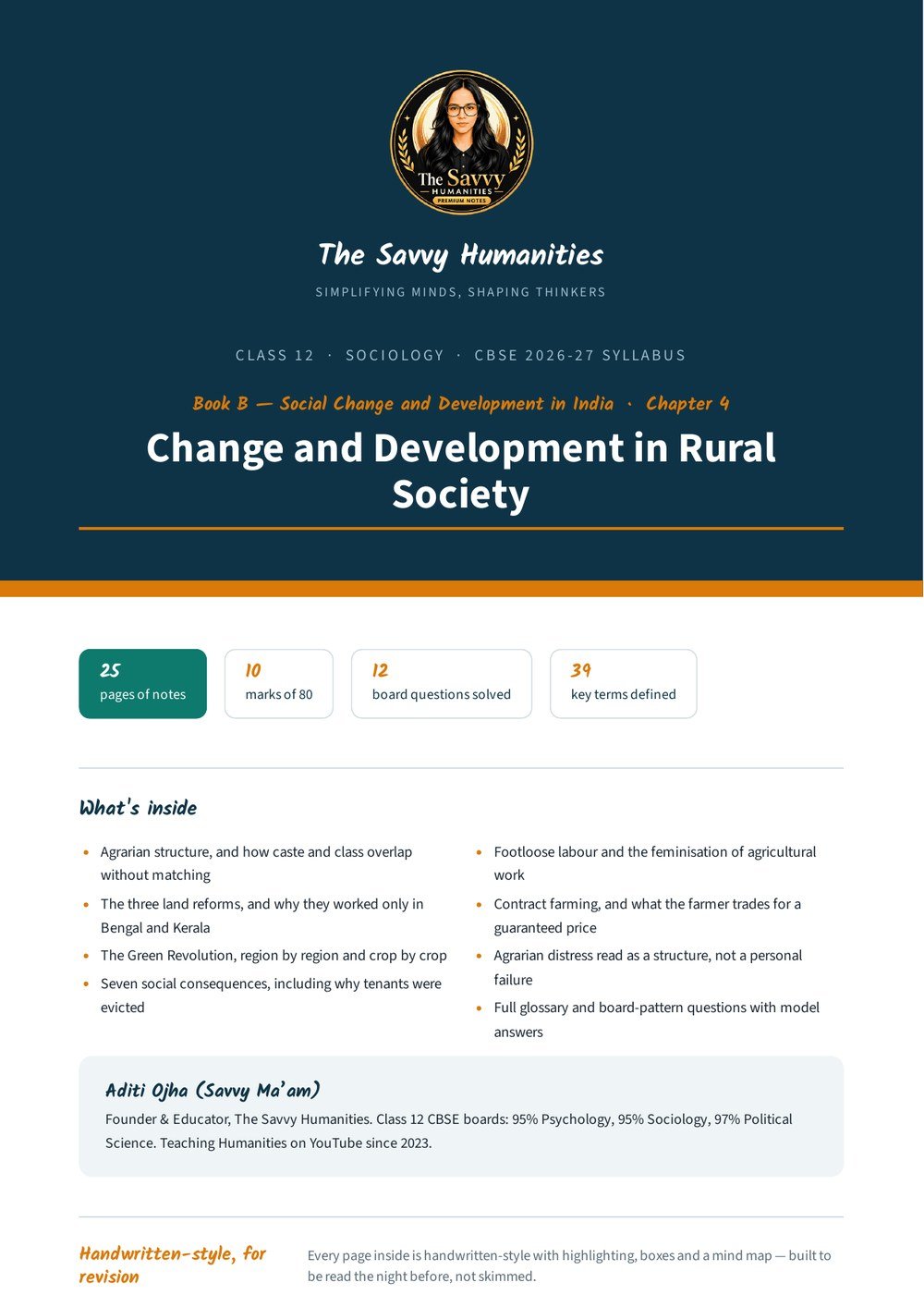
What is inside
- Chapter at a glance — a one-page mind map of the whole chapter
- Complete topic-by-topic notes, NCERT-aligned, in CBSE’s own topic order
- Agrarian structure, and how caste and class overlap without matching — dominant caste by region (Jats, Kammas, Reddis, Patidars, Vokkaligas, Lingayats), landlord, tenant, sharecropper and agricultural labourer kept distinct
- The three land reforms, and why they worked only in Bengal and Kerala — zamindari abolition, tenancy abolition and land ceilings, with the loopholes that defeated them: personal cultivation and benami transfers
- Operation Barga and the bargadar — what West Bengal actually did differently
- The Green Revolution, region by region and crop by crop — HYV seeds, assured irrigation as the condition that decided which regions got it, and self-sufficiency in food grains
- Seven social consequences, including why tenants were evicted — the rise of the rich farmers as a political class, and the shift from the jajmani and patron-client relationship to a plain employer-employee one
- Footloose labour, circulation of labour and the feminisation of agricultural work — women’s rising share of farm labour without any matching rise in land ownership
- Contract farming, and what the farmer trades for a guaranteed price — export crops over food crops, and dependence on the company for inputs
- Agrarian distress read as a structure, not a personal failure — rising input costs, the retreat of institutional credit and the return of the moneylender, withdrawn agricultural extension, and the ecological cost in the falling water table
- A 39-term glossary of every definition the paper can ask for
- 12 board-pattern questions with full model answers
- A revision tracker to tick off each topic as read, practised and revised
Written for the 2026-27 syllabus
Nothing from CBSE’s list for this chapter is left out, and nothing is padded in. Industrial work, employment and trade unions belong to Unit 12, Change and Development in Industrial Society, and are not covered here.
Three chapters printed in this book are not covered at all, because CBSE removed them from the 2026-27 syllabus: The Story of Indian Democracy, Globalisation and Social Change, and Mass Media and Communications. That is also why this is Chapter 4 with no Chapter 3 on the store — Chapter 3 is one of the removed ones.
The file
- Format: PDF, A4 — works on a phone and prints cleanly
- Length: 25 pages plus cover
- Delivery: instant download link after payment, plus a copy by email
- Free updates: if CBSE changes the syllabus or a correction goes in, the updated file is sent to you at no cost. You never pay twice for the same chapter.
By Aditi Ojha (Savvy Ma’am) — Founder and educator, The Savvy Humanities. Teaching Humanities on YouTube since 2023. These notes pair with the free chapter video; QR codes inside the file link to it.