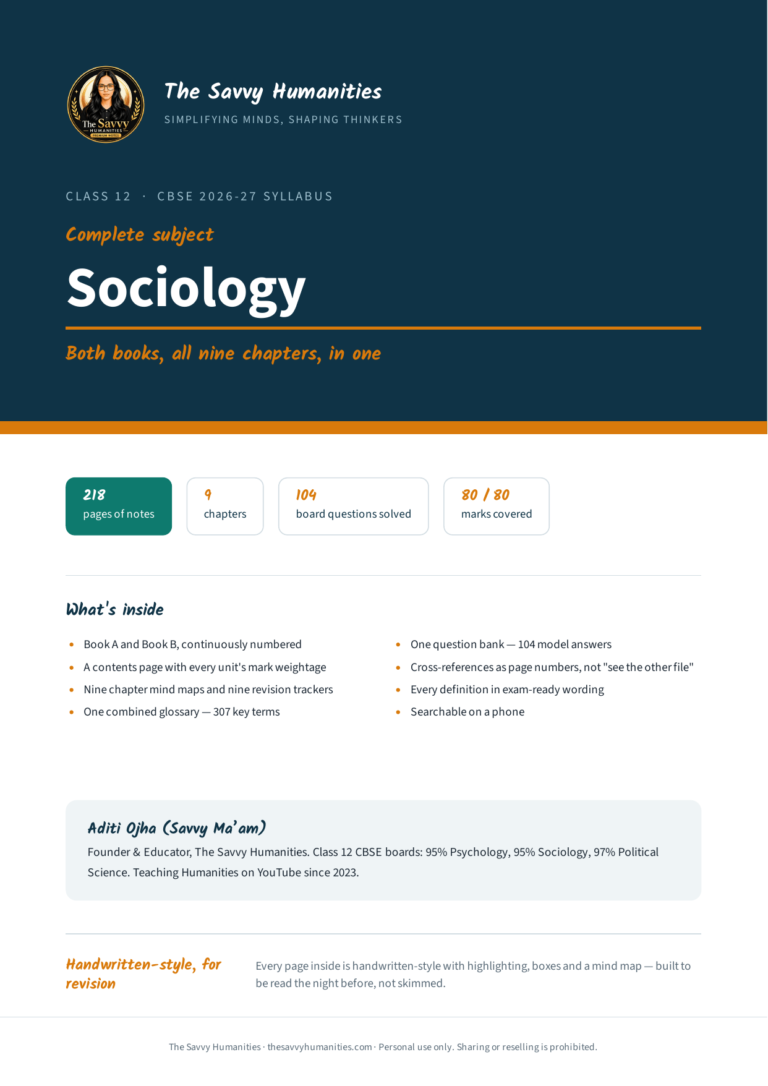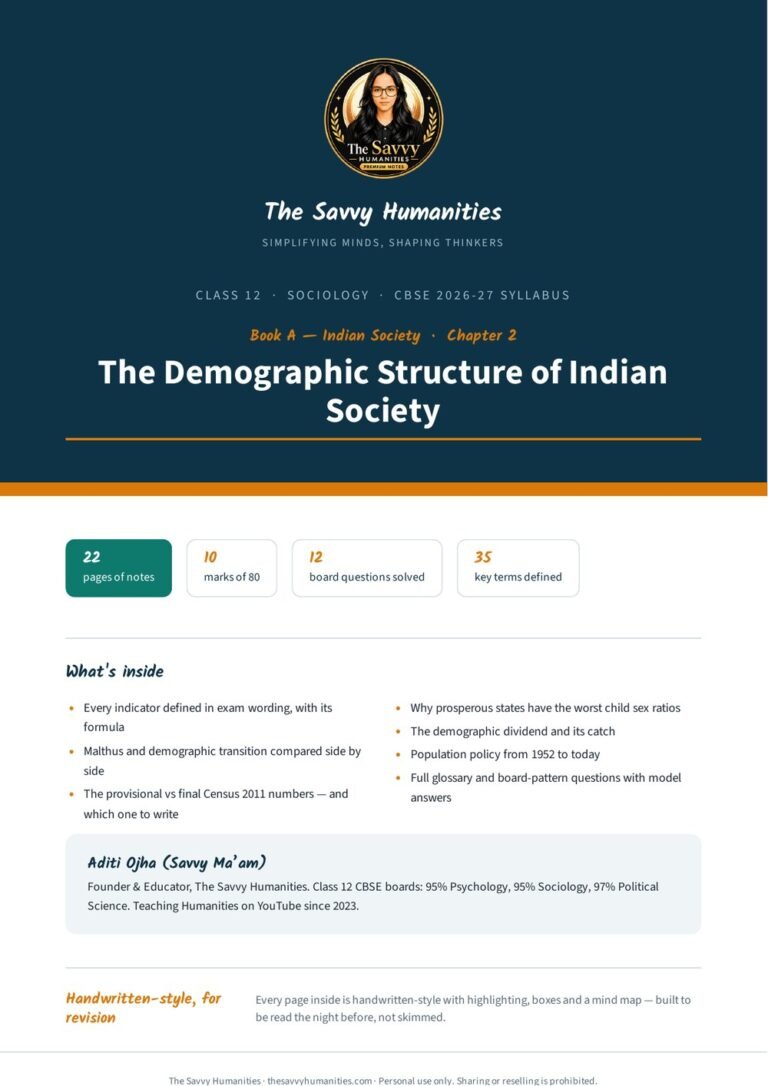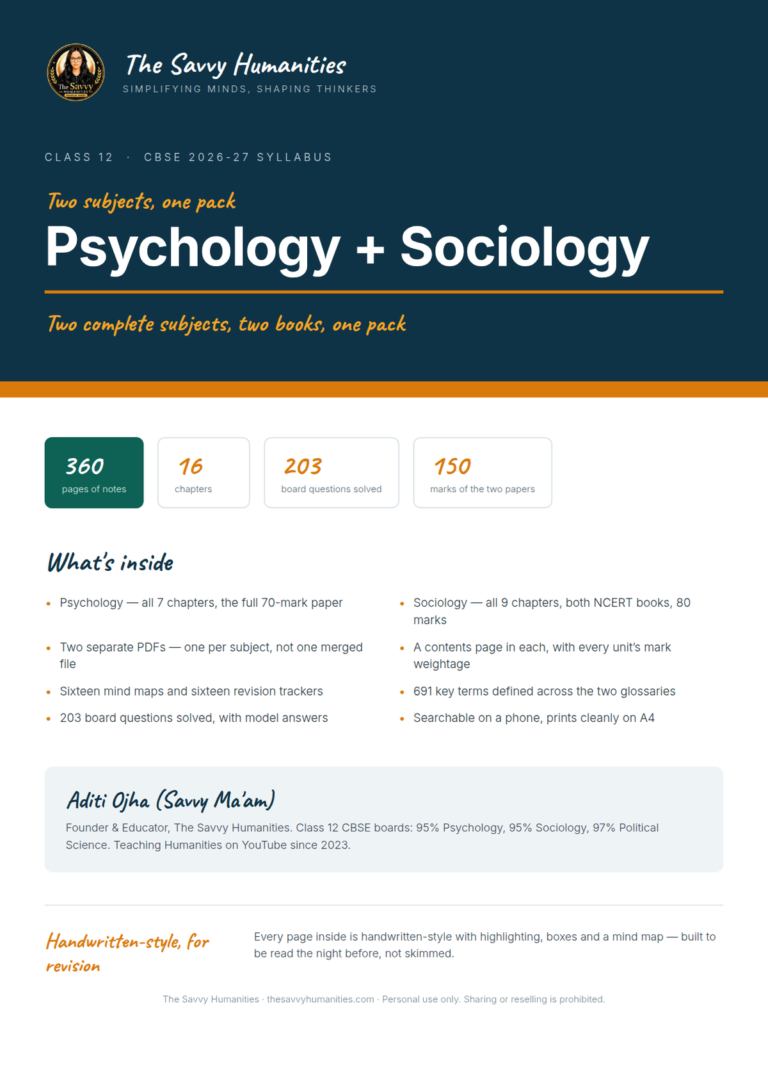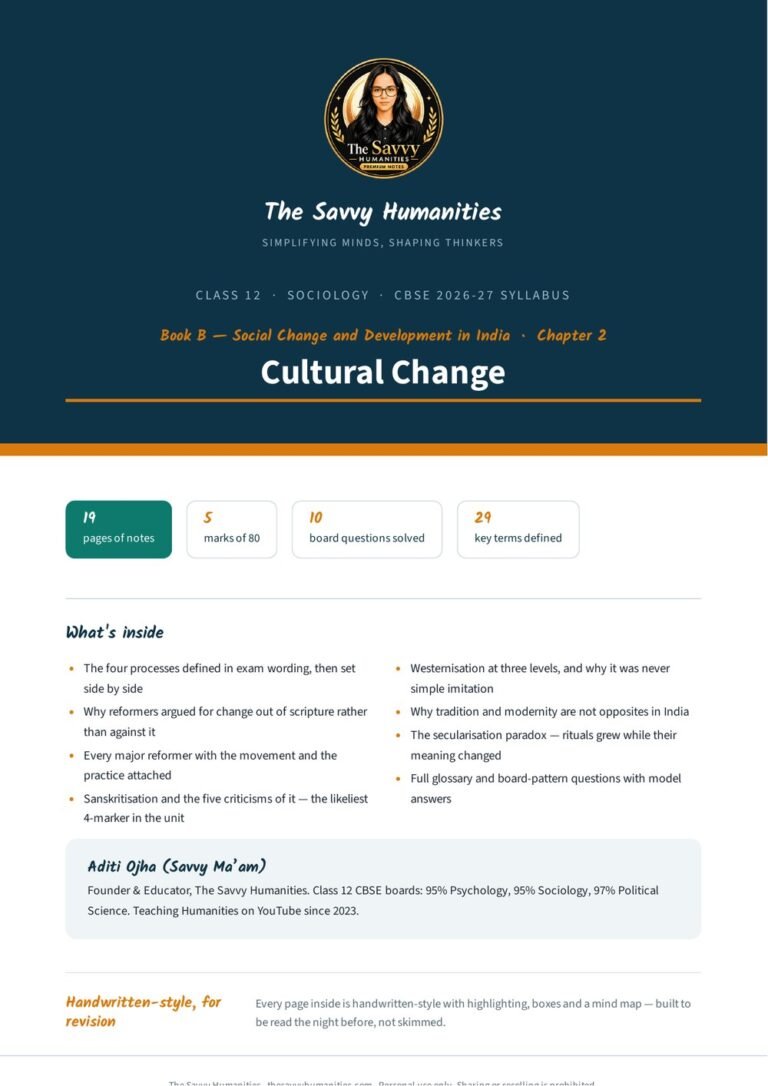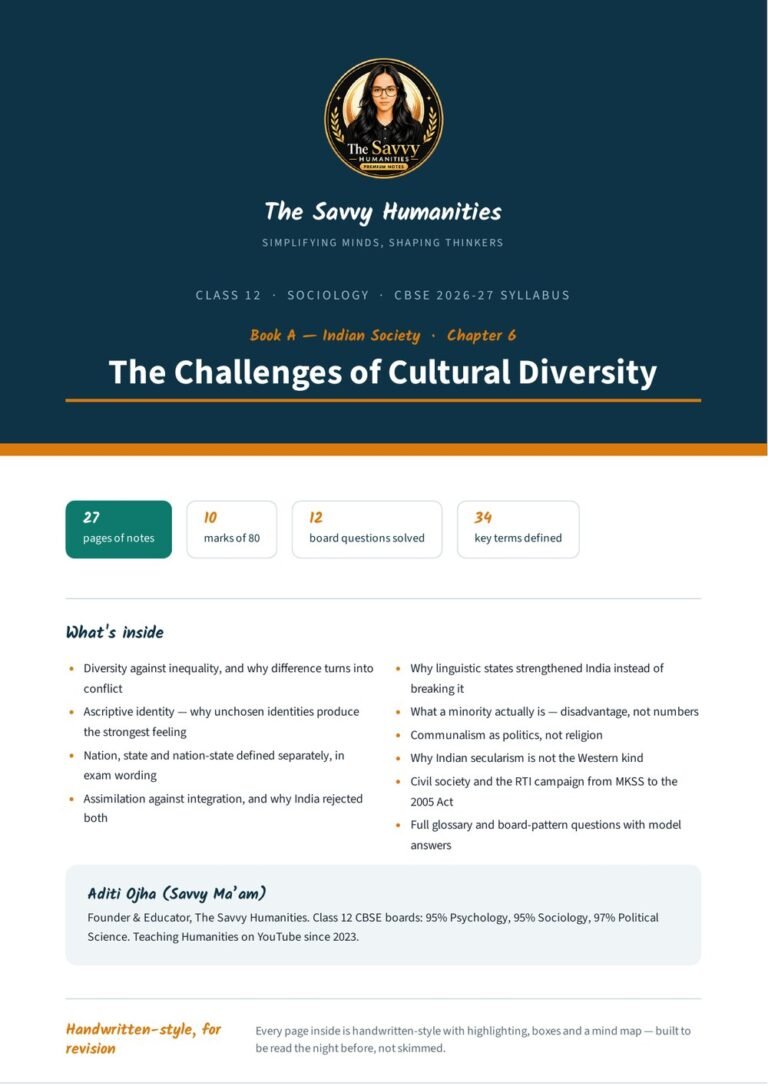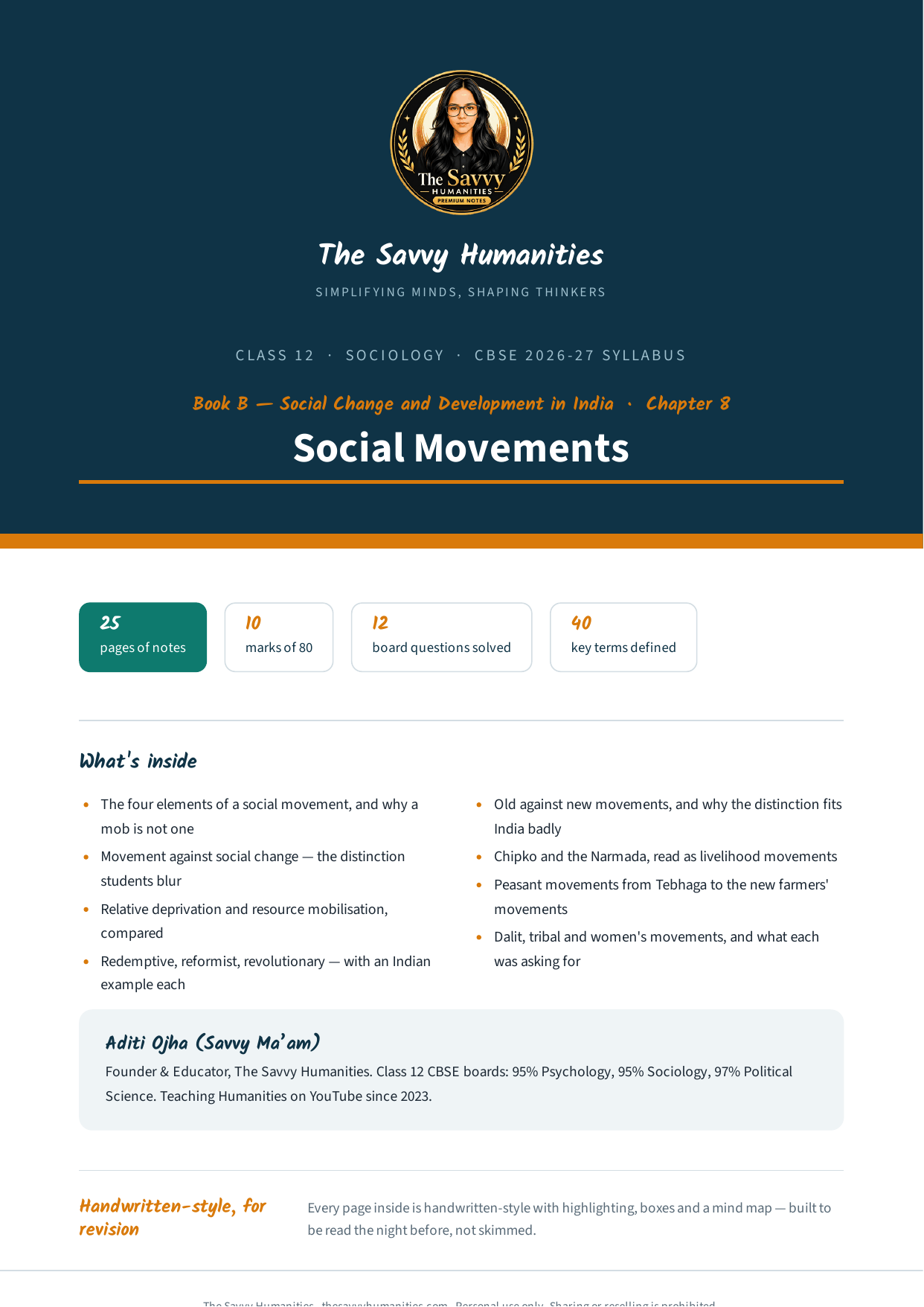
Exam-oriented handwritten-style notes — every page laid out like class notes, with highlighting, boxes and a mind map, built to be read the night before rather than skimmed.
Unit 15 of the CBSE Class 12 Sociology paper carries 10 marks out of 80, checked against CBSE’s own 2026-27 curriculum document. It is the last chapter of the course, and the one that gathers up the rest: caste, tribe, gender, land and the environment all return here, but as things people organised to change rather than as conditions they lived under.
What is inside
- Chapter at a glance — a one-page mind map of the whole chapter
- Complete topic-by-topic notes, NCERT-aligned, in CBSE’s own topic order
- The four elements of a social movement, and why a mob is not one — sustained collective action, organisation, leadership and ideology, against the momentary and unorganised crowd
- Movement against social change — the distinction students blur — social change is continuous and undirected; a movement is a deliberate effort. Plus counter-movements, which arise to resist the change another movement seeks
- Relative deprivation and resource mobilisation, compared — why movements begin, and what decides whether they succeed
- Redemptive, reformist and revolutionary — with an Indian example each, including the Ezhava movement under Sri Narayana Guru as the standard redemptive case
- Old against new movements, and why the distinction fits India badly — a full comparison table, and the qualification the examiner wants: the “new” movements here are frequently about survival and livelihood, not post-material concerns
- Chipko and the Narmada, read as livelihood movements — forest rights and forest produce in the Uttarakhand hills, and displacement and rehabilitation around the Sardar Sarovar project under Medha Patkar
- Peasant movements from the Indigo revolt to the new farmers’ movements — Deccan riots, Bardoli, the Kisan Sabha, Tebhaga and Telangana, then the Bharatiya Kisan Union, Shetkari Sangathana and the demand for remunerative prices
- Dalit, tribal and women’s movements, and what each was asking for — the Dalit Panthers and Dalit literature, the Jharkhand movement and the state created in 2000, and the autonomous women’s groups of the 1970s onwards and the law reform of 1983 that followed their campaigning
- A 40-term glossary of every definition the paper can ask for
- 12 board-pattern questions with full model answers
- A revision tracker to tick off each topic as read, practised and revised
Written for the 2026-27 syllabus
Nothing from CBSE’s list for this chapter is left out, and nothing is padded in. Some movements are studied more fully elsewhere in this set and appear here only as movements — the Jharkhand movement in Book A Chapter 5, the Bombay Textile Strike in Book B Chapter 5, and the nineteenth-century reformers in Book B Chapter 2.
Three chapters printed in this book are not covered at all, because CBSE removed them from the 2026-27 syllabus: The Story of Indian Democracy, Globalisation and Social Change, and Mass Media and Communications. That is why the Book B set on this store runs 1, 2, 4, 5 and 8 — those are every chapter still in the syllabus.
The file
- Format: PDF, A4 — works on a phone and prints cleanly
- Length: 25 pages plus cover
- Delivery: instant download link after payment, plus a copy by email
- Free updates: if CBSE changes the syllabus or a correction goes in, the updated file is sent to you at no cost. You never pay twice for the same chapter.
By Aditi Ojha (Savvy Ma’am) — Founder and educator, The Savvy Humanities. Teaching Humanities on YouTube since 2023. These notes pair with the free chapter video; QR codes inside the file link to it.