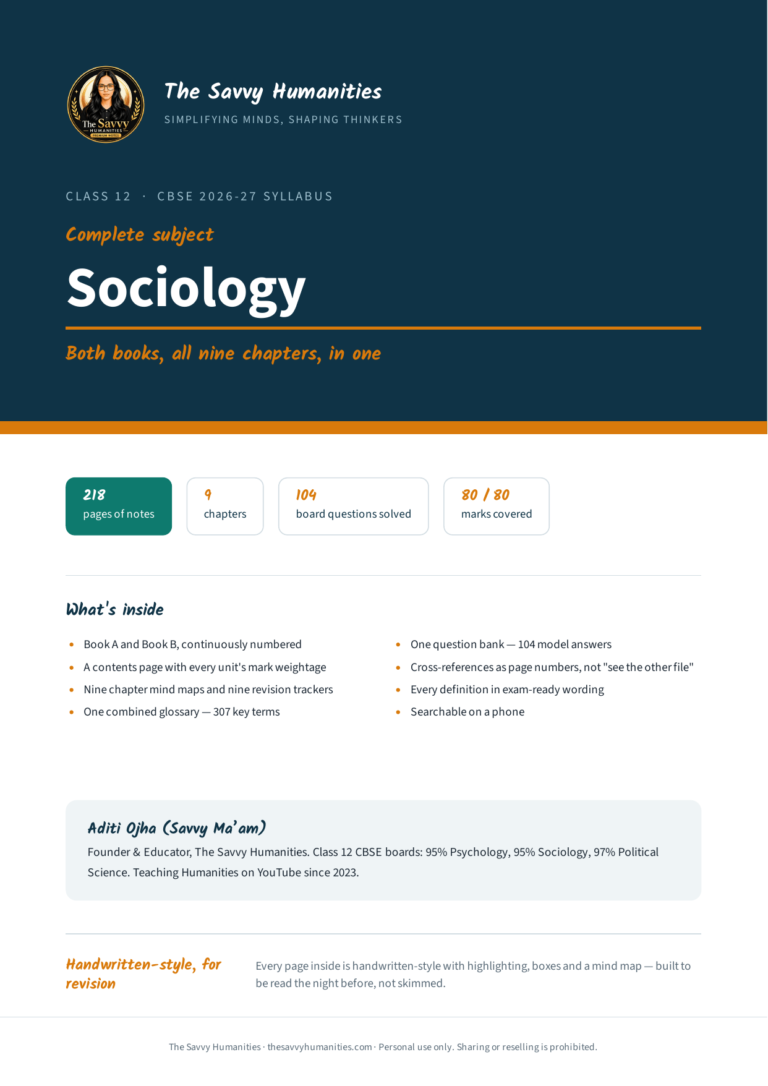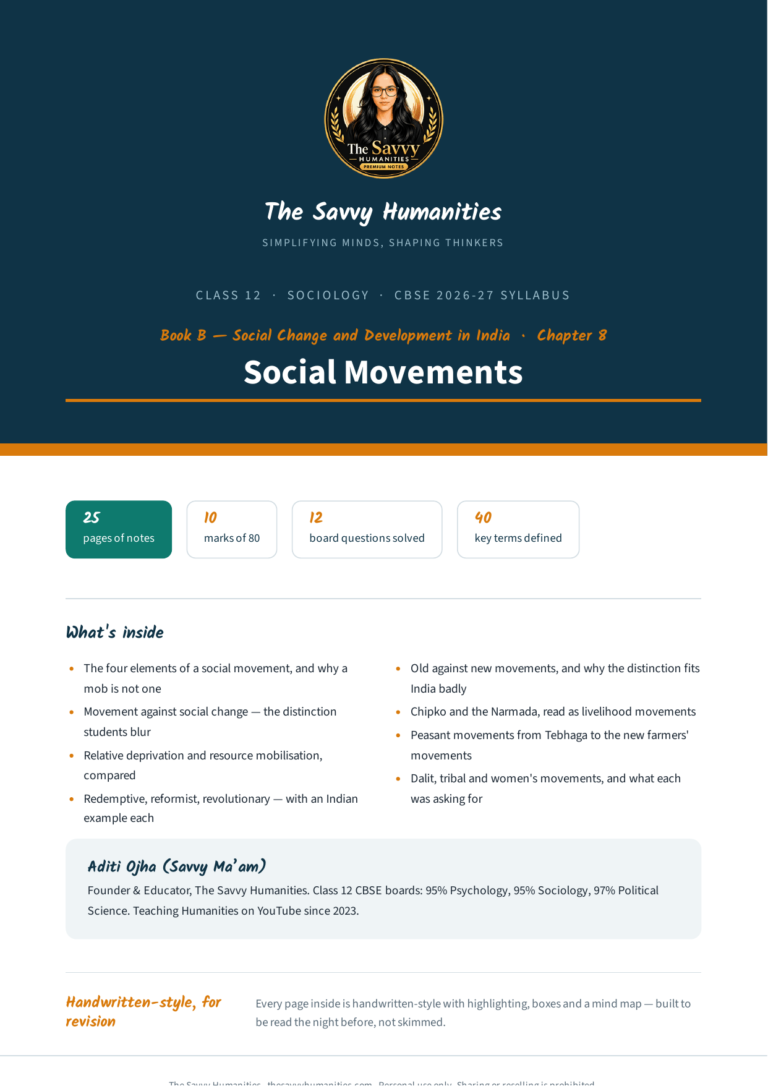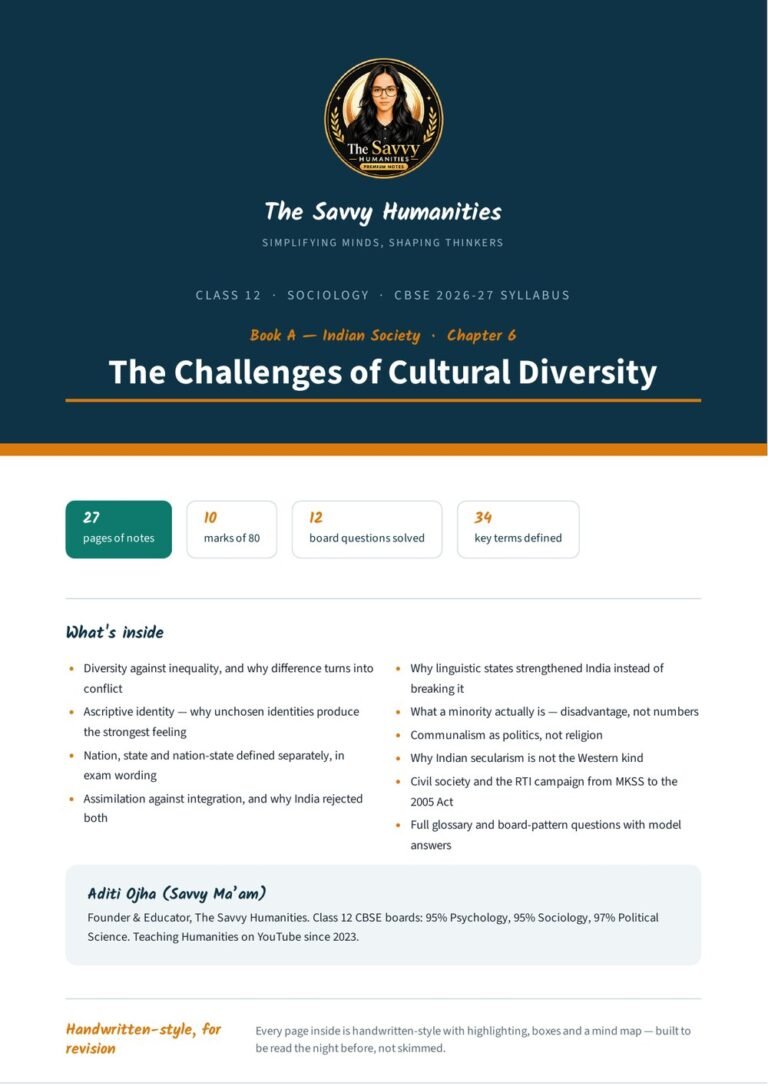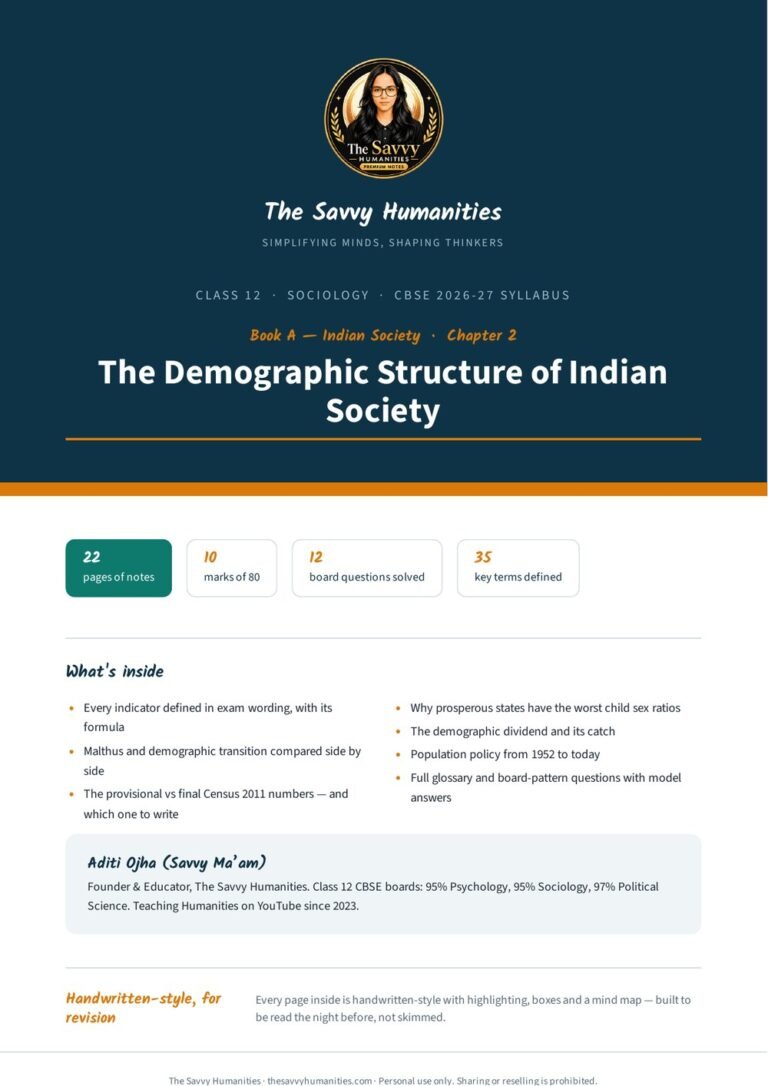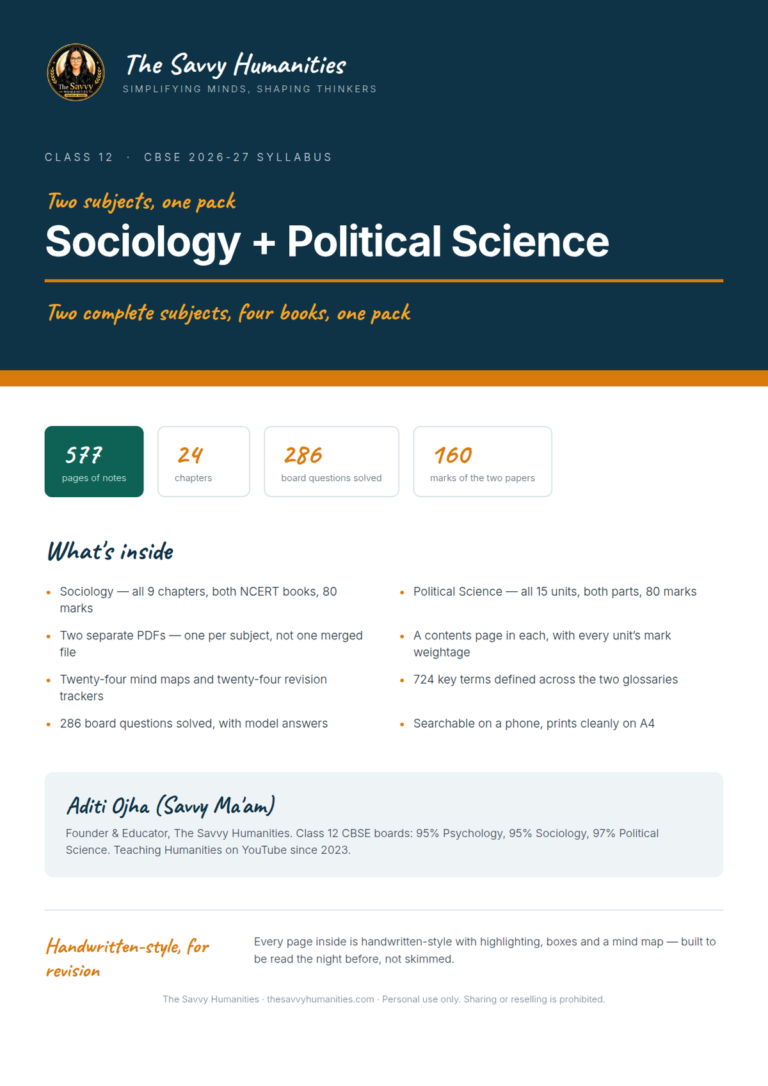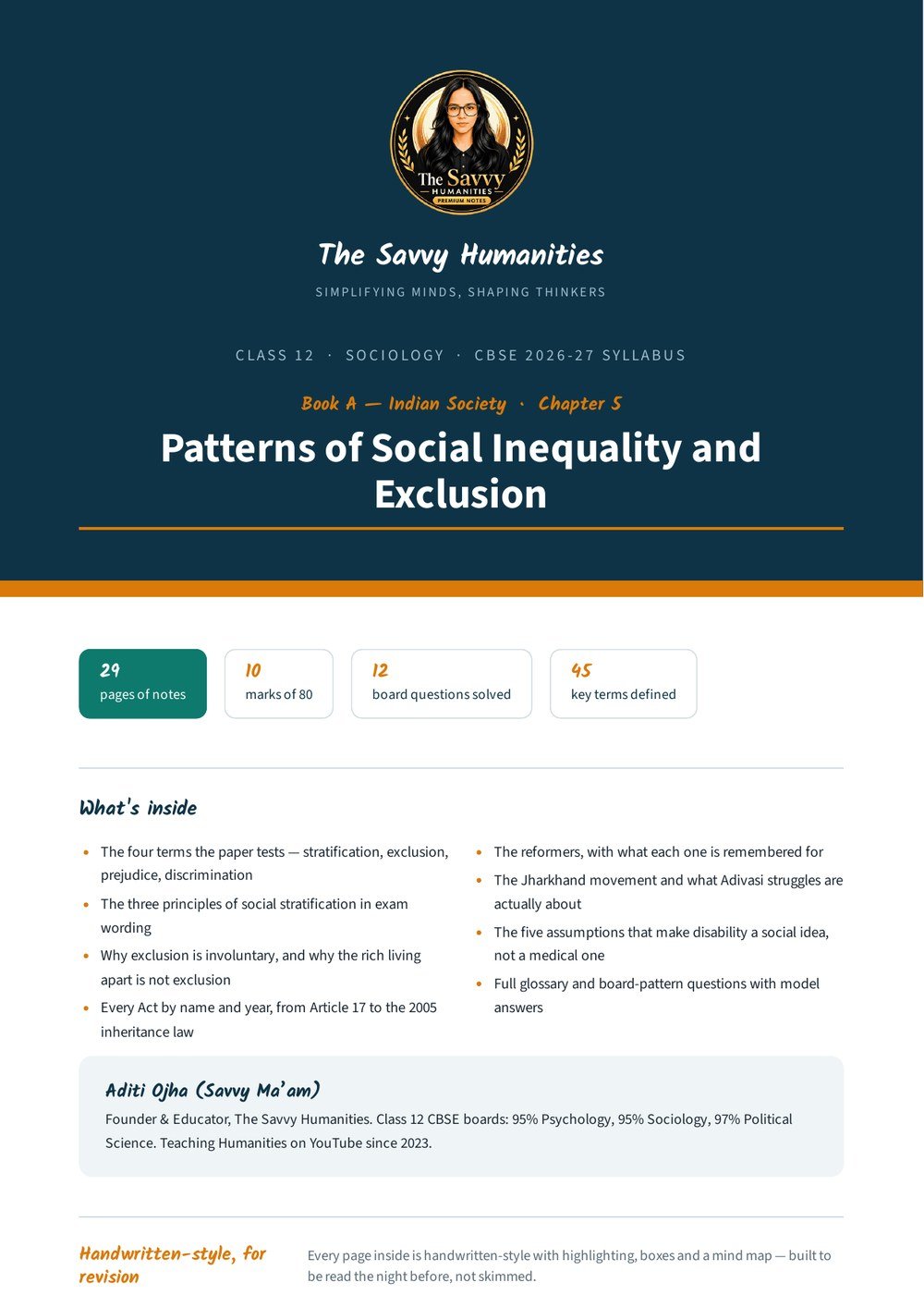
Exam-oriented handwritten-style notes — every page laid out like class notes, with highlighting, boxes and a mind map, built to be read the night before rather than skimmed.
Unit 5 of the CBSE Class 12 Sociology paper carries 10 marks out of 80. It is the chapter every student thinks they can write from general knowledge, and the one where general knowledge scores lowest — because the marks sit in four exact terms and in Acts that have to be named with the right year.
What is inside
- Chapter at a glance — a one-page mind map of the whole chapter
- Complete topic-by-topic notes, NCERT-aligned, in CBSE’s own topic order
- The four terms the paper actually tests, kept apart — social stratification, social exclusion, prejudice and discrimination, with stereotype and ideology alongside them
- The three principles of social stratification in exam wording
- Why exclusion is involuntary — and why the rich choosing to live apart is not social exclusion, which is the distinction that separates a 4-mark answer from a 2-mark one
- Every Act by name and year — Article 17, the Untouchability (Offences) Act 1955 and its 1976 renaming as the Protection of Civil Rights Act, the Prevention of Atrocities Act 1989, the Hindu Widow Remarriage Act 1856, the Dowry Prohibition Act 1961, the Criminal Law Amendment Act 1983 and the Hindu Succession Amendment Act 2005
- The reformers, with what each one is remembered for — Phule, Sri Narayana Guru, Ayyankali, Iyothee Thass, Periyar, Ambedkar, Tarabai Shinde and Rashsundari Debi
- The Jharkhand movement and what Adivasi struggles are actually about — land alienation, dikus and Jaipal Singh
- The five assumptions that make disability a social idea, not a medical one, plus the disability-poverty cycle and inclusive education
- A 45-term glossary of every definition the paper can ask for
- 12 board-pattern questions with full model answers — three each at 1, 2, 4 and 6 marks
- A revision tracker to tick off each topic as read, practised and revised
Written for the 2026-27 syllabus
Nothing from CBSE’s list for this chapter is left out, and nothing is repeated to pad the page count. Untouchability’s three dimensions are set out here inside the exclusion framework; the full caste-system treatment — varna and jati, the six features, colonialism — lives in the Chapter 3 notes and is not duplicated.
Why there is no Chapter 4: NCERT’s Chapter 4, The Market as a Social Institution, has been removed from the 2026-27 syllabus. It is still printed in the textbook, which is exactly how students lose weeks on a chapter that cannot be asked.
The file
- Format: PDF, A4 — works on a phone and prints cleanly
- Length: 29 pages plus cover
- Delivery: instant download link after payment, plus a copy by email
- Free updates: if CBSE changes the syllabus or a correction goes in, the updated file is sent to you at no cost. You never pay twice for the same chapter.
By Aditi Ojha (Savvy Ma’am) — Founder and educator, The Savvy Humanities. Teaching Humanities on YouTube since 2023. These notes pair with the free chapter video; QR codes inside the file link to it.