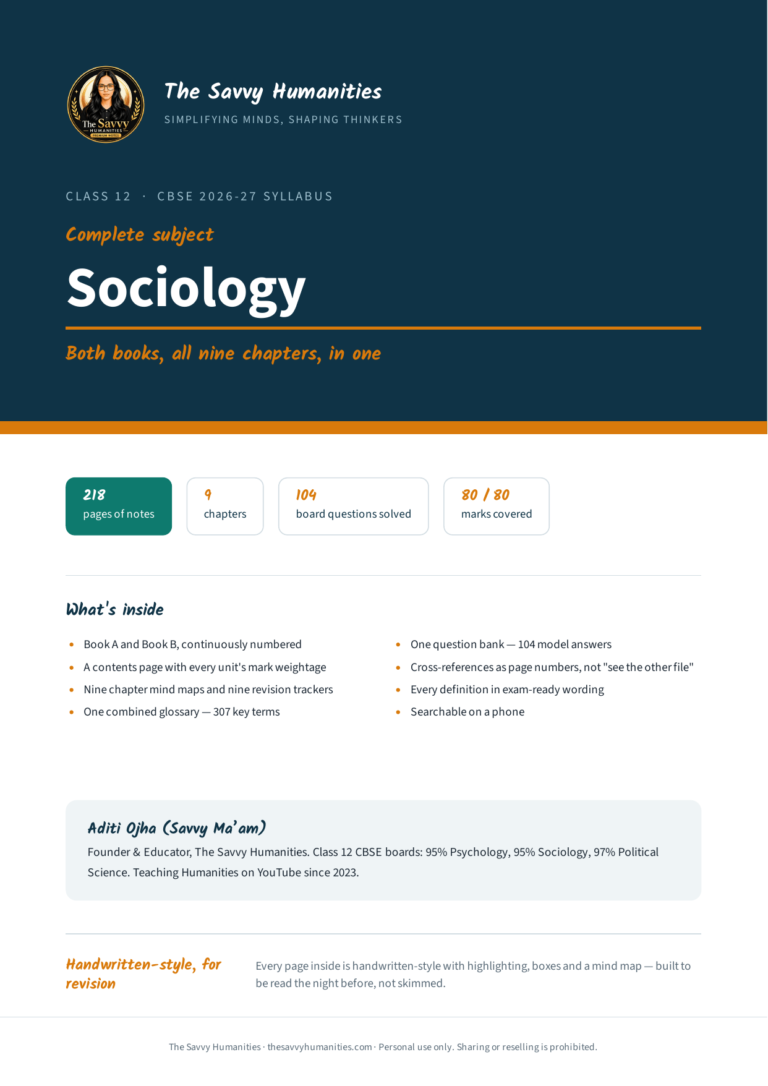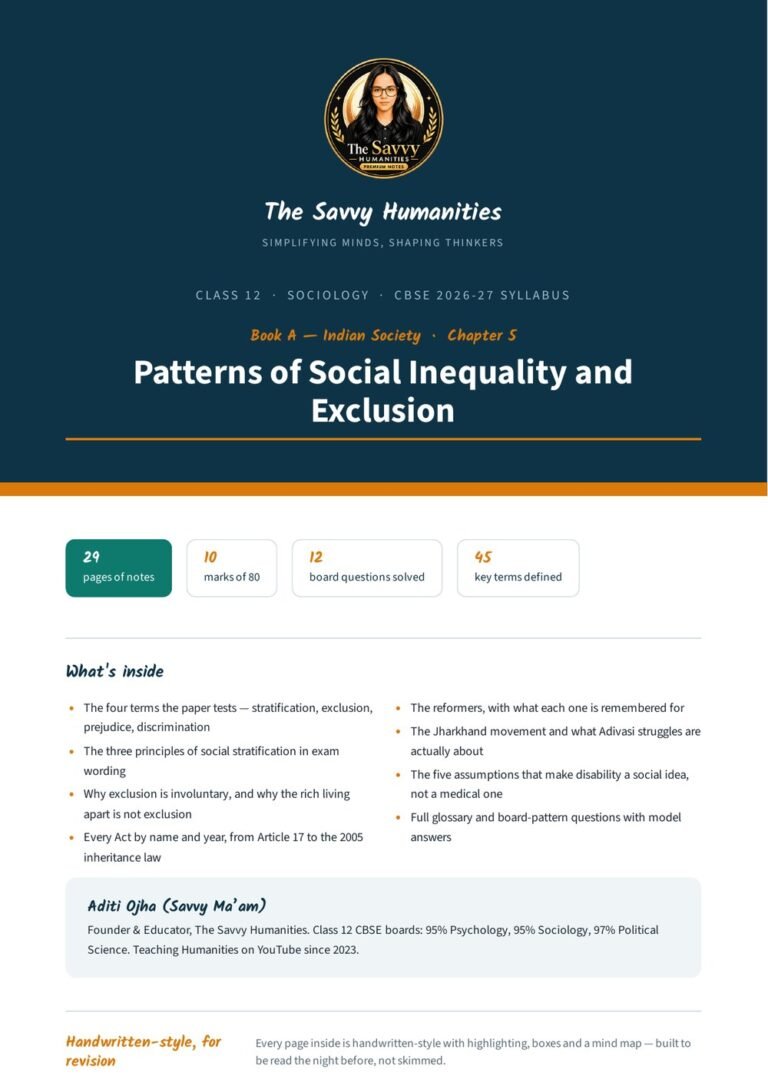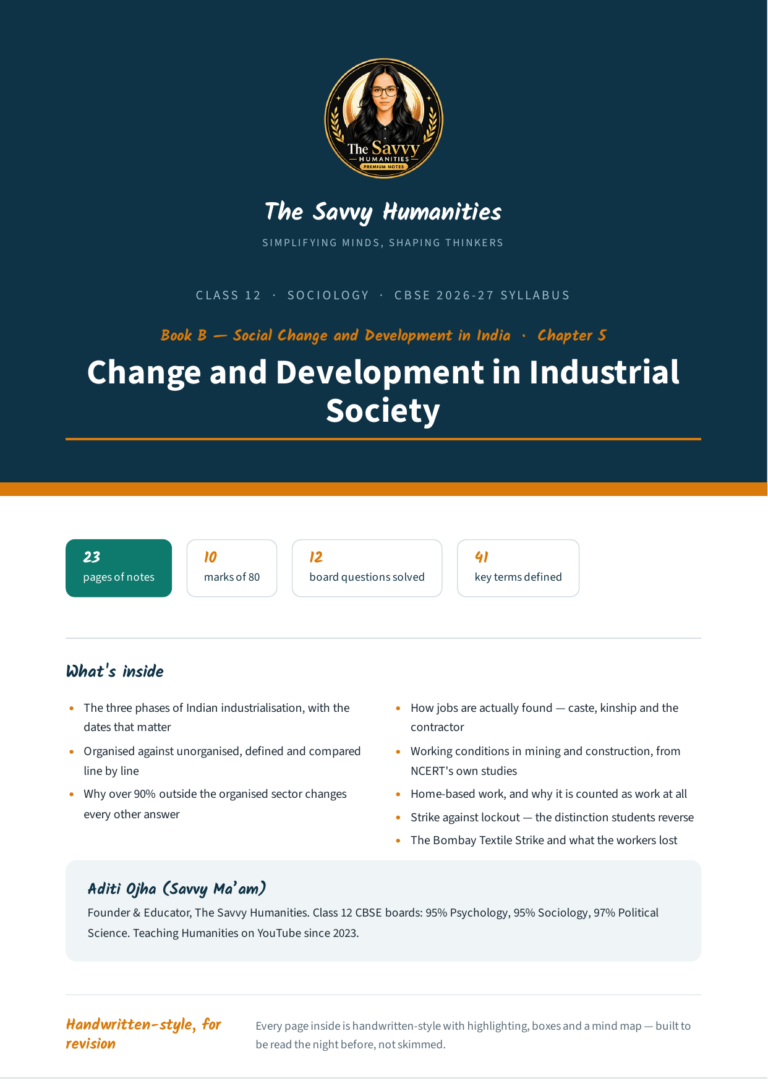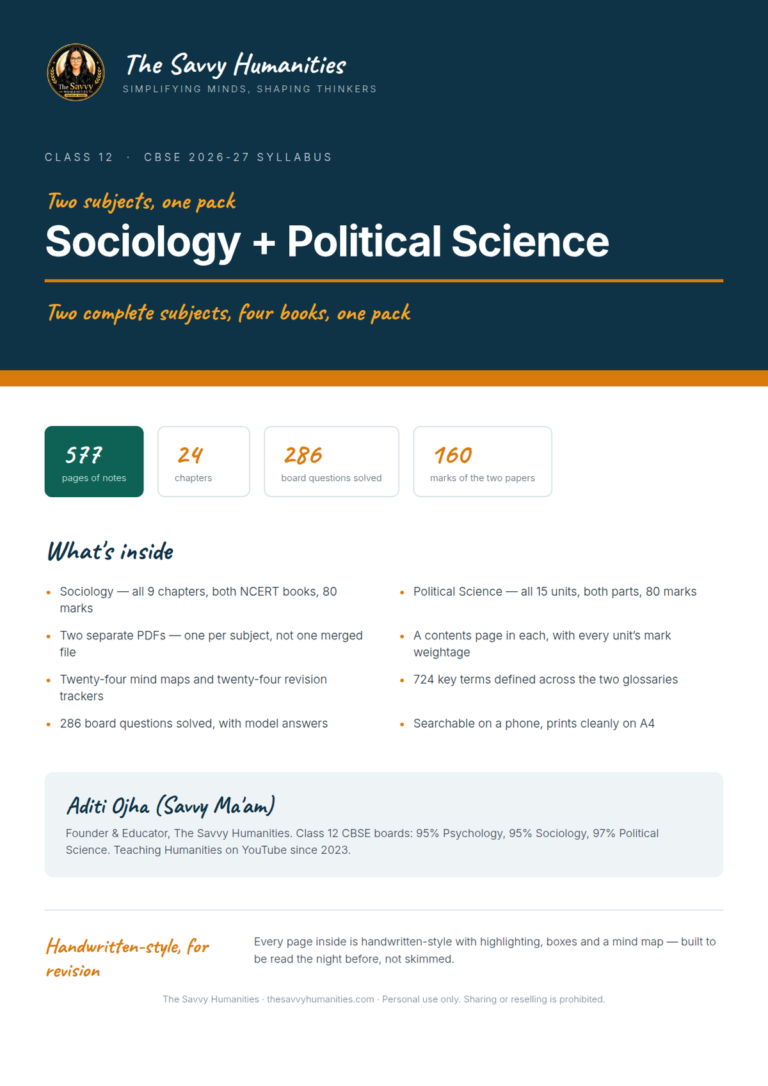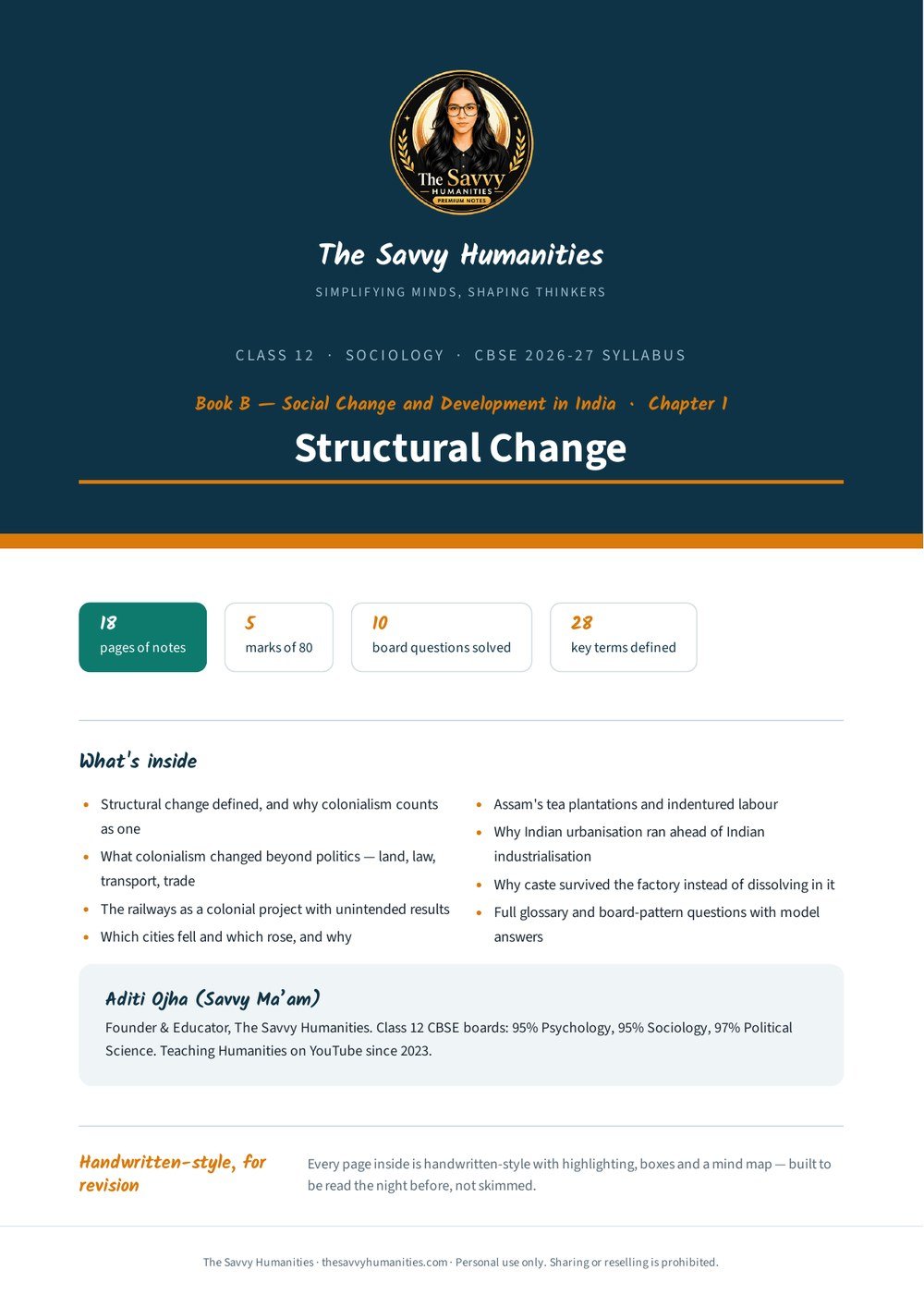
Exam-oriented handwritten-style notes — every page laid out like class notes, with highlighting, boxes and a mind map, built to be read the night before rather than skimmed.
Unit 8 of the CBSE Class 12 Sociology paper carries 5 marks out of 80 — not 10, and the notes say so on page 1, checked against CBSE’s own 2026-27 curriculum document. That number should change how you study it: expect 1- and 2-markers and at most a 4-marker from this unit, and spend your time accordingly. Knowing which units are cheap is worth marks on its own.
What is inside
- Chapter at a glance — a one-page mind map of the whole chapter
- Complete topic-by-topic notes, NCERT-aligned, in CBSE’s own topic order
- Structural change defined — change in the structure itself rather than change within it — and why colonialism counts as one
- What colonialism changed beyond politics — private property in land, contract law, forest laws, transport and trade
- The railways as a colonial project with unintended results
- Which cities fell and which rose, and why — Dhaka and its muslin against the rise of Bombay, Calcutta and Madras as port cities
- Deindustrialisation — handloom weaving ruined by cheap machine-made imports
- Assam’s tea plantations and indentured labour — recruitment by deception from Chota Nagpur, and the girmitiya shipped to Mauritius, Fiji and the Caribbean
- Why Indian urbanisation ran ahead of Indian industrialisation, with the informal and service sectors, seasonal migration and remittances
- Why caste survived the factory instead of dissolving in it — the jobber, who recruited through his own caste, kinship and village networks
- The landmarks that get asked by year — India’s first cotton textile mill, Bombay 1854, and TISCO at Jamshedpur, 1907
- A 28-term glossary of every definition the paper can ask for
- 10 board-pattern questions with full model answers
- A revision tracker to tick off each topic as read, practised and revised
Written for the 2026-27 syllabus
Nothing from CBSE’s list for this chapter is left out, and nothing is padded in. Sanskritisation, Westernisation and Modernisation belong to Unit 9, Cultural Change, and are not duplicated here.
Three chapters printed in this book are not covered at all, because CBSE removed them from the 2026-27 syllabus: The Story of Indian Democracy, Globalisation and Social Change, and Mass Media and Communications. They are still in the NCERT book, which is exactly how students lose weeks on chapters that cannot be asked.
The file
- Format: PDF, A4 — works on a phone and prints cleanly
- Length: 18 pages plus cover
- Delivery: instant download link after payment, plus a copy by email
- Free updates: if CBSE changes the syllabus or a correction goes in, the updated file is sent to you at no cost. You never pay twice for the same chapter.
By Aditi Ojha (Savvy Ma’am) — Founder and educator, The Savvy Humanities. Teaching Humanities on YouTube since 2023. These notes pair with the free chapter video; QR codes inside the file link to it.