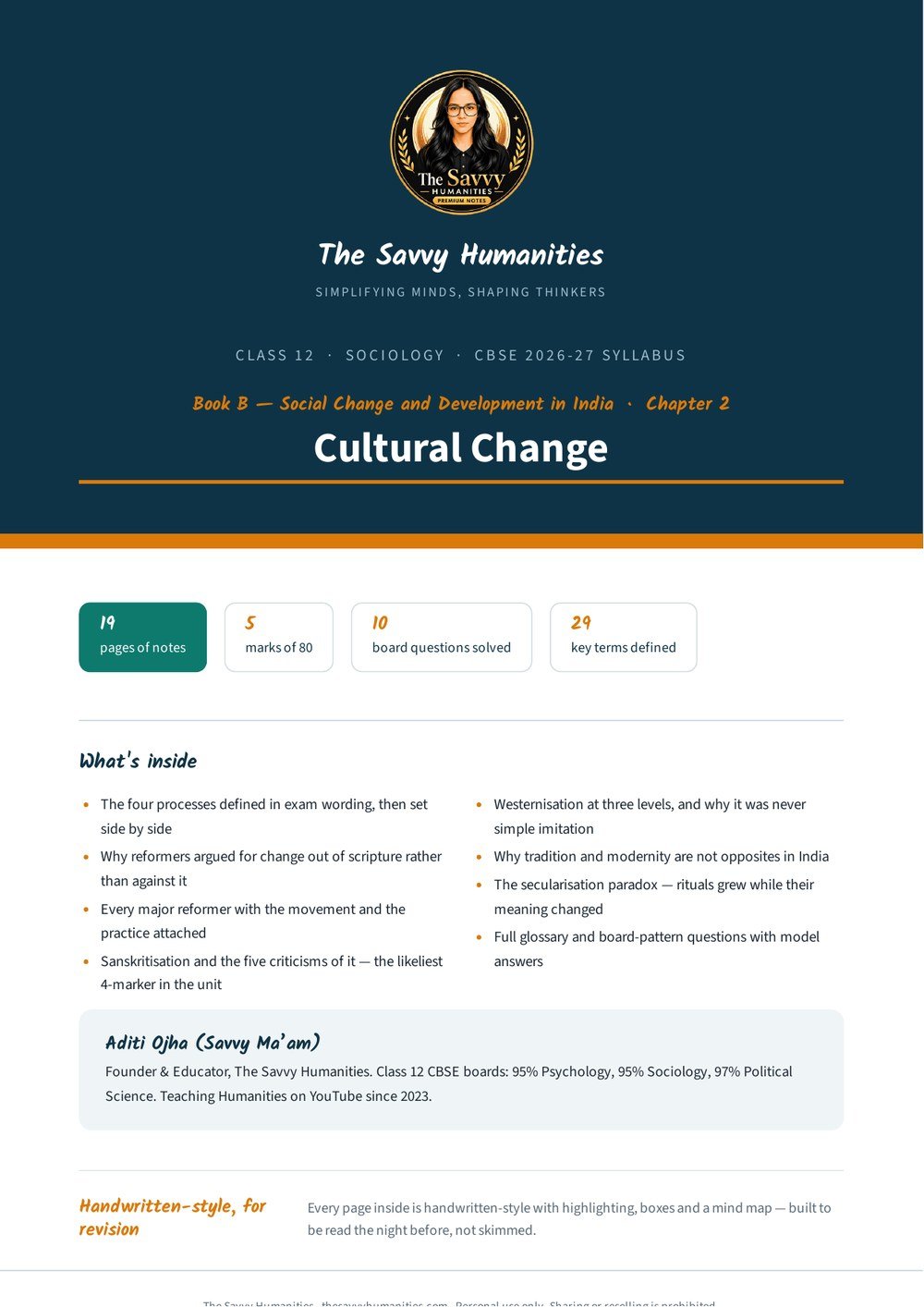
Exam-oriented handwritten-style notes — every page laid out like class notes, with highlighting, boxes and a mind map, built to be read the night before rather than skimmed.
Unit 9 of the CBSE Class 12 Sociology paper carries 5 marks out of 80 — not 10, checked against CBSE’s own 2026-27 curriculum document. But it is the unit with the most outsized importance in the paper: Sanskritisation, Westernisation, Modernisation and Secularisation are actually defined here, and then used by chapters worth far more than five marks. Learn them here and you are paid for them elsewhere.
What is inside
- Chapter at a glance — a one-page mind map of the whole chapter
- Complete topic-by-topic notes, NCERT-aligned, in CBSE’s own topic order
- The four processes defined in exam wording, then set side by side — the comparison is what the examiner is testing, and it is the part students most often blur
- Why reformers argued for change out of scripture rather than against it — colonial modernity, the print-based public sphere, and how reform arguments reached strangers
- Every major reformer with the movement and the practice attached — Rammohun Roy and Brahmo Samaj against sati, Vidyasagar and the Hindu Widow Remarriage Act 1856, Dayanand Saraswati and Arya Samaj with shuddhi, Phule and Satyashodhak Samaj, Sir Syed Ahmed Khan and the Aligarh movement, Sri Narayana Guru and the SNDP
- Sanskritisation and the five criticisms of it — the likeliest 4-marker in the unit — with positional change, the twice-born model, and the bride-price to dowry shift
- Westernisation at three levels, and why it was never simple imitation — selective adoption, and why the dominant caste is sometimes copied instead
- Why tradition and modernity are not opposites in India — the caste association with elections, membership and a media presence is the evidence
- The secularisation paradox — rituals grew rather than shrank while their meaning changed, with conspicuous display and the secularisation of caste
- The single path assumption of modernisation theory, and why it is discredited
- A 29-term glossary of every definition the paper can ask for
- 10 board-pattern questions with full model answers
- A revision tracker to tick off each topic as read, practised and revised
Written for the 2026-27 syllabus
Nothing from CBSE’s list for this chapter is left out, and nothing is padded in. Colonialism, industrialisation and urbanisation belong to Unit 8, Structural Change, and are not repeated here.
Three chapters printed in this book are not covered at all, because CBSE removed them from the 2026-27 syllabus: The Story of Indian Democracy, Globalisation and Social Change, and Mass Media and Communications. They are still in the NCERT book, which is exactly how students lose weeks on chapters that cannot be asked.
The file
- Format: PDF, A4 — works on a phone and prints cleanly
- Length: 19 pages plus cover
- Delivery: instant download link after payment, plus a copy by email
- Free updates: if CBSE changes the syllabus or a correction goes in, the updated file is sent to you at no cost. You never pay twice for the same chapter.
By Aditi Ojha (Savvy Ma’am) — Founder and educator, The Savvy Humanities. Teaching Humanities on YouTube since 2023. These notes pair with the free chapter video; QR codes inside the file link to it.