Exam-oriented handwritten-style notes — every page laid out like class notes, with highlighting, boxes and a mind map, built to be read the night before rather than skimmed.
Unit 12 of the CBSE Class 12 Sociology paper carries 10 marks out of 80, checked against CBSE’s own 2026-27 curriculum document. Almost every mark here rests on one fact and what follows from it: more than nine Indian workers in ten are outside the organised sector.
What is inside
- Chapter at a glance — a one-page mind map of the whole chapter
- Complete topic-by-topic notes, NCERT-aligned, in CBSE’s own topic order
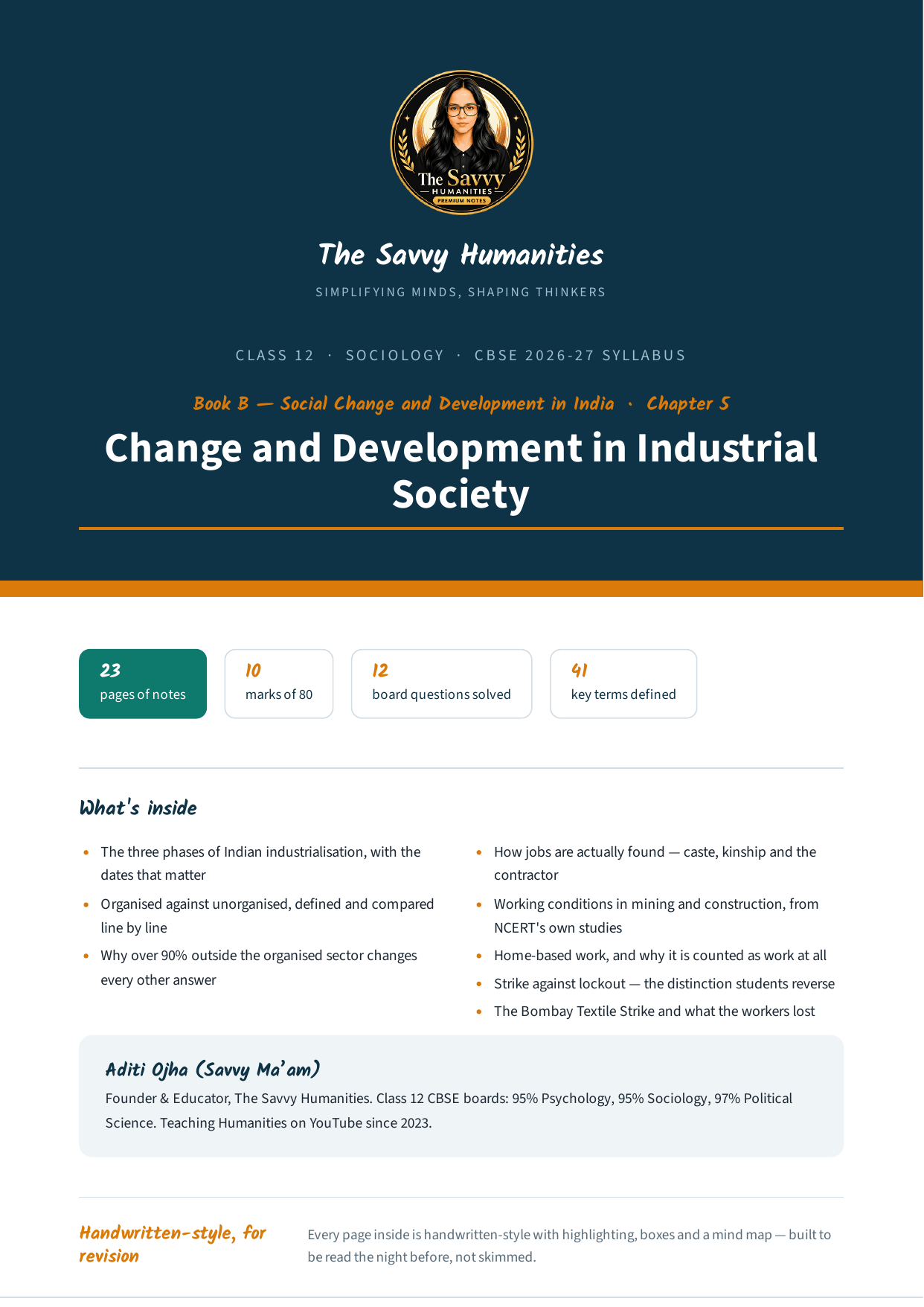
- The three phases of Indian industrialisation, with the dates that matter — the colonial phase with the Bombay mills from 1854 and TISCO at Jamshedpur in 1907, state-led industrialisation and the mixed economy after 1947 with the dams and steel plants Nehru called the temples of modern India, and liberalisation from 1991
- Organised against unorganised, defined and compared line by line — registration, salary, job security, benefits and legal coverage, with the under-10% and over-90% shares that decide the answer
- Why that one proportion changes every other answer — how to turn a general claim into a specific one: labour law protects workers on paper and reaches under a tenth of them
- How people actually get jobs — caste, kinship and the contractor — the jobber of the textile mills and his modern descendant, why whole trades in one city come from one district, and why the worker is tied to the contractor rather than to the company
- Working conditions from NCERT’s own studies — underground against open-cast mining, and construction running almost entirely on migrant families living on site, with the warning not to call these workers “unskilled” when what they lack is recognition and bargaining power
- Home-based work, and why it is counted as work at all — bidis, agarbattis, papads and zari, paid by piece rate, done by women and children, and recorded as housework rather than employment
- Strike against lockout — the distinction students reverse — a table of who acts and what happens, because writing “strike” when management shut the gate costs the mark
- The Bombay Textile Strike of 1982 — Datta Samant, a quarter of a million workers, close to two years, and the defeat: mills that never reopened, production moved beyond the unions’ reach, and what the mill land became
- Liberalisation and the new insecurity — disinvestment and privatisation, contractualisation, casualisation, voluntary retirement schemes and the golden handshake, outsourcing and BPO work
- A 41-term glossary of every definition the paper can ask for
- 12 board-pattern questions with full model answers, across the 1, 2, 4 and 6 mark formats
- A revision tracker to tick off each topic as read, practised and revised
Written for the 2026-27 syllabus
Nothing from CBSE’s list for this chapter is left out, and nothing is padded in. Rural work, land and agriculture belong to Unit 11, Change and Development in Rural Society, and are not repeated here.
Three chapters printed in this book are not covered at all, because CBSE removed them from the 2026-27 syllabus: The Story of Indian Democracy, Globalisation and Social Change, and Mass Media and Communications. That is also why the store jumps from Chapter 2 to Chapter 4 — Chapter 3 is one of the removed ones.
The file
- Format: PDF, A4 — works on a phone and prints cleanly
- Length: 23 pages plus cover
- Delivery: instant download link after payment, plus a copy by email
- Free updates: if CBSE changes the syllabus or a correction goes in, the updated file is sent to you at no cost. You never pay twice for the same chapter.
By Aditi Ojha (Savvy Ma’am) — Founder and educator, The Savvy Humanities. Teaching Humanities on YouTube since 2023. These notes pair with the free chapter video; QR codes inside the file link to it.