Exam-oriented handwritten-style notes — every page laid out like class notes, with highlighting, boxes and a mind map, built to be read the night before rather than skimmed.
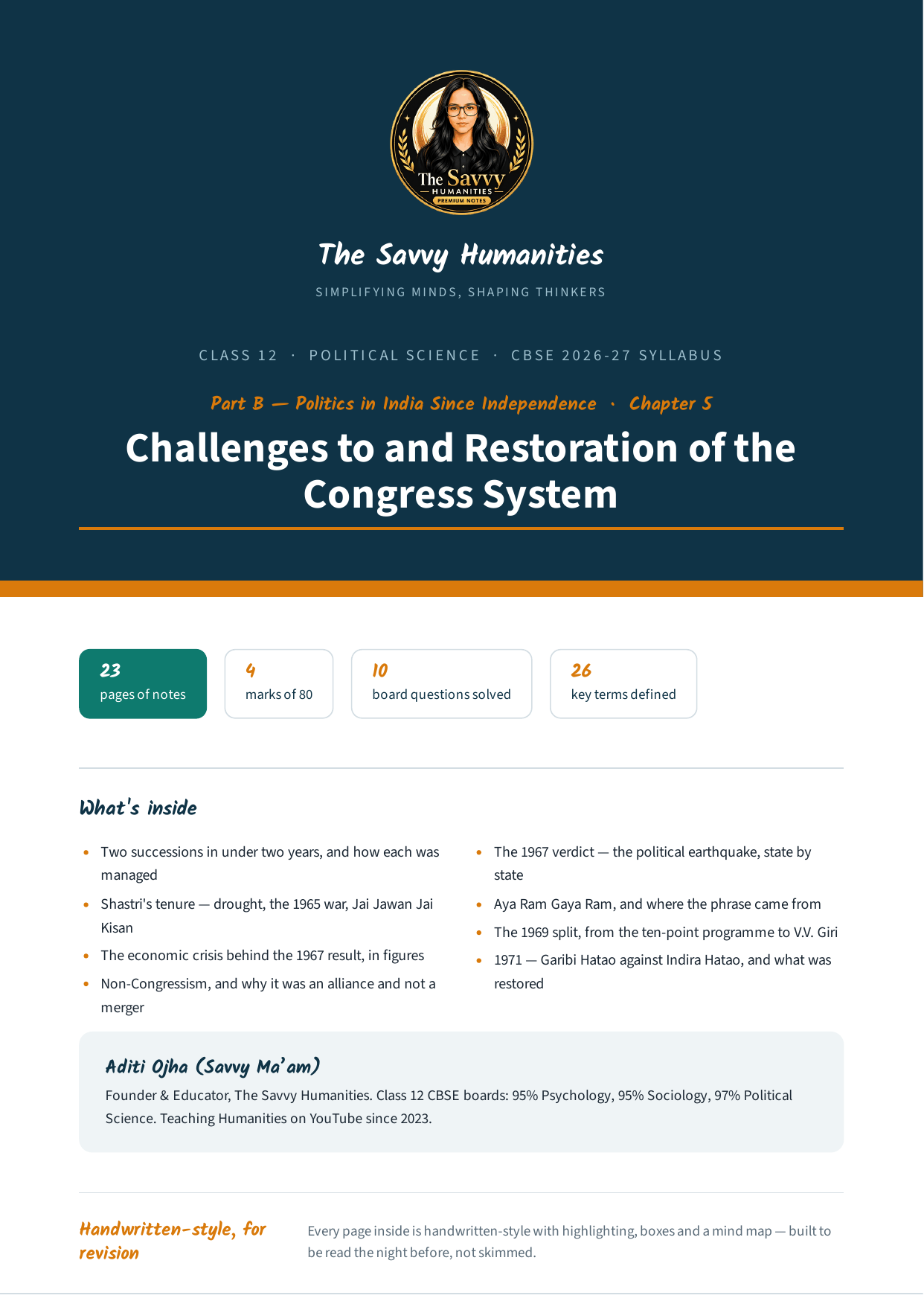
Unit 5 of Part B in the CBSE Class 12 Political Science paper carries 4 marks out of 80, checked against CBSE’s own 2026-27 curriculum document, which lists four sub-topics: political succession from Nehru to Shastri to Indira Gandhi, the fourth general election of 1967, the Congress split, and the restoration after 1971.
Two successions in under two years, and how each was managed
The question of the period was “after Nehru, what?” — not merely who would replace him, but whether India’s democratic system itself would survive a succession. The notes keep that distinction, because it is the one the examiner is testing. K. Kamaraj built the consensus that made Lal Bahadur Shastri Prime Minister in 1964; after Shastri’s sudden death at Tashkent on 10 January 1966, the Congress Parliamentary Party elected Indira Gandhi over Morarji Desai by secret ballot.
Shastri’s tenure — drought, the 1965 war, Jai Jawan Jai Kisan
Two crises at once: the war with Pakistan, and a food crisis caused by failed monsoons and drought. Jai Jawan Jai Kisan is the slogan that tied them together, and the notes explain what it was actually answering rather than treating it as a quotable line.
The economic crisis behind the 1967 result, in figures
Devaluation is the fact most answers omit: after it, the US dollar cost more than seven rupees, having cost less than five before. Set beside drought, food shortage and a fall in industrial production, it explains the verdict rather than merely preceding it.
Non-Congressism — an alliance, not a merger
Ram Manohar Lohia’s argument was that Congress rule was undemocratic and against the interests of ordinary people, so the opposition parties had to unite to defeat it. The notes are careful about what that produced: Samyukt Vidhayak Dal governments were joint legislative parties, not fused ones — the Bihar SVD held the SSP, PSP, CPI and Jana Sangh together at the same time. That distinction is the answer to a common question.
The 1967 verdict — the political earthquake, state by state
How contemporary observers described the results of February 1967. The notes go state by state rather than giving a national summary, and cover what followed: defection, and Aya Ram Gaya Ram — the phrase came from Gaya Lal, a Haryana MLA who in 1967 changed party three times in a fortnight, the last change within nine hours.
The 1969 split, from the ten-point programme to V.V. Giri
Set out as a sequence, with each step given as it happened: the ten-point programme of May 1967; the death of President Zakir Husain in 1969 leaving the office vacant; N. Sanjeeva Reddy as the Syndicate’s nominee and official Congress candidate; the call for a conscience vote, which in practice meant defying the whip issued by Congress President S. Nijalingappa; and V.V. Giri’s win as an independent. The party divided into Congress (O), the Syndicate-led Organisation Congress, and Congress (R), the Requisitionists’ Congress.
1971 — Garibi Hatao against Indira Hatao
The two slogans are given as the campaigns themselves framed them: the Grand Alliance of the SSP, PSP, Bharatiya Jana Sangh, Swatantra Party and Bharatiya Kranti Dal ran on Indira Hatao, a campaign against a person; Garibi Hatao was backed by a programme of public-sector growth, land and property ceilings and the abolition of princely privileges. Bank nationalisation and the privy purse are covered as the measures behind the claim.
What was restored, and what was not: Congress dominance returned after 1971, but resting on the popularity of the leader rather than on the old party organisation and its factions. The notes make that the point of the chapter, because it is what the title is asking.
What else is in the file
- Chapter at a glance — a one-page mind map of the whole chapter
- A 26-term glossary of every definition the paper can ask for
- 10 board-pattern questions with full model answers — 10 rather than 13 because a 4-mark unit carries no 6-markers
- A revision tracker to tick off each topic as read, practised and revised
The file
- Format: PDF, A4 — works on a phone and prints cleanly
- Length: 23 pages plus cover
- Delivery: instant download link after payment, plus a copy by email
- Free updates: if CBSE changes the syllabus or a correction goes in, the updated file is sent to you at no cost. You never pay twice for the same chapter.
By Aditi Ojha (Savvy Ma’am) — Founder and educator, The Savvy Humanities. Teaching Humanities on YouTube since 2023. These notes pair with the free chapter video; QR codes inside the file link to it.