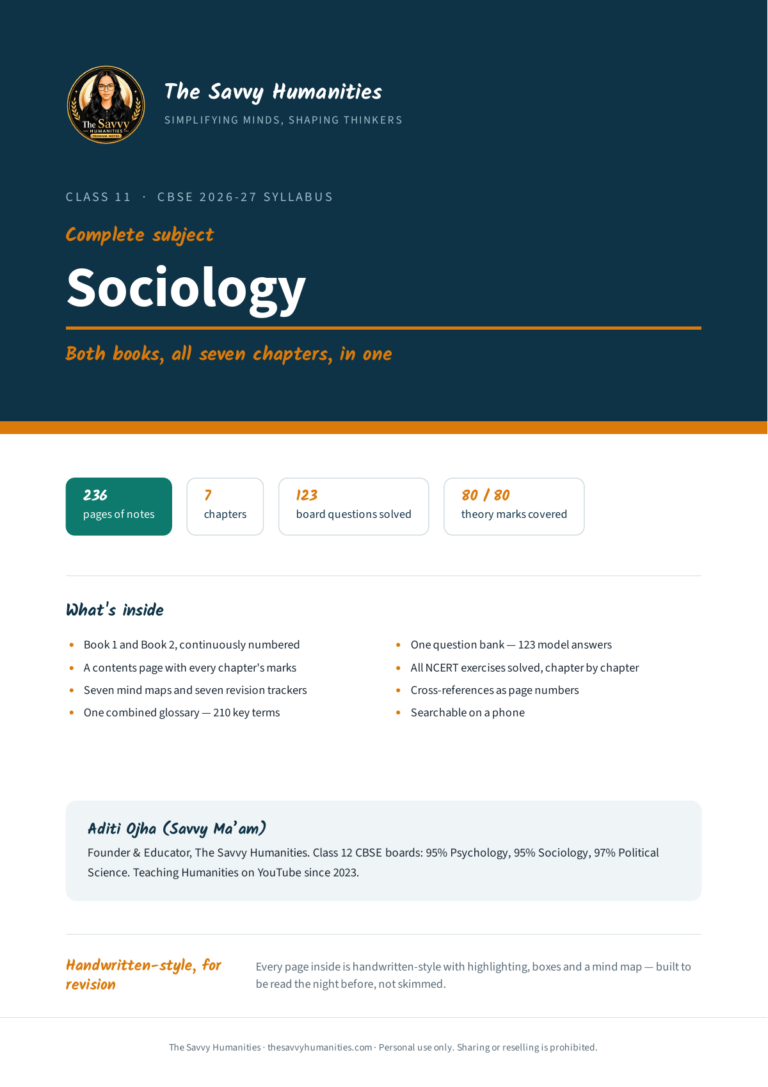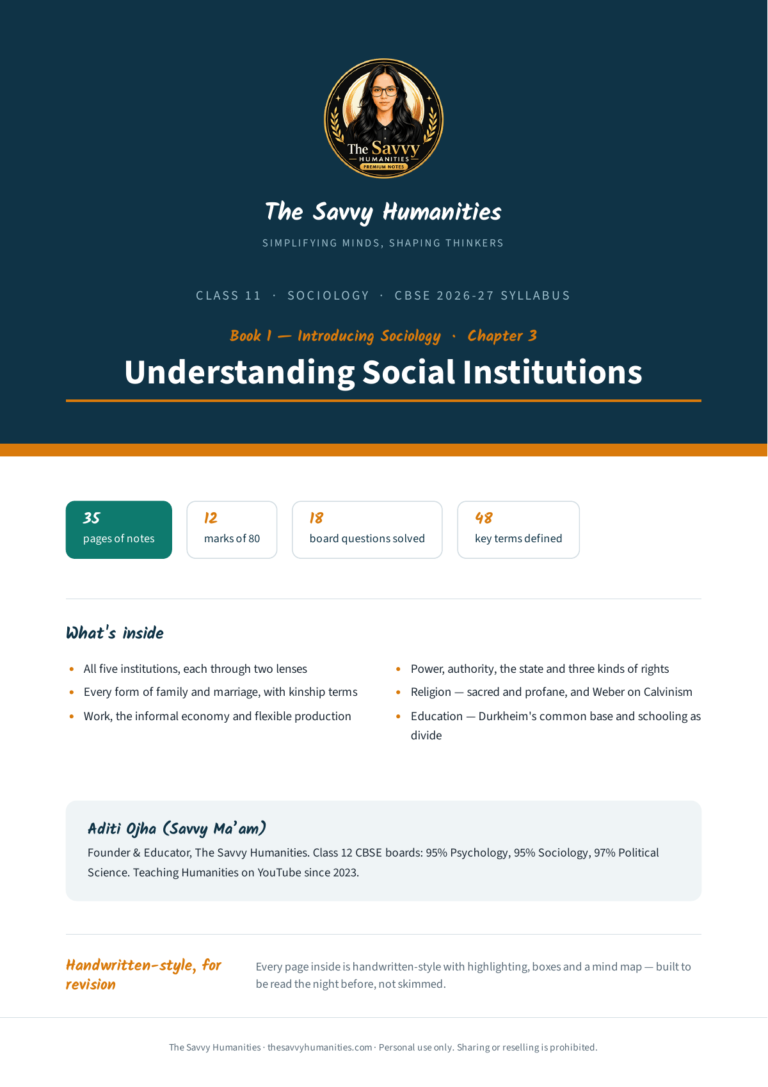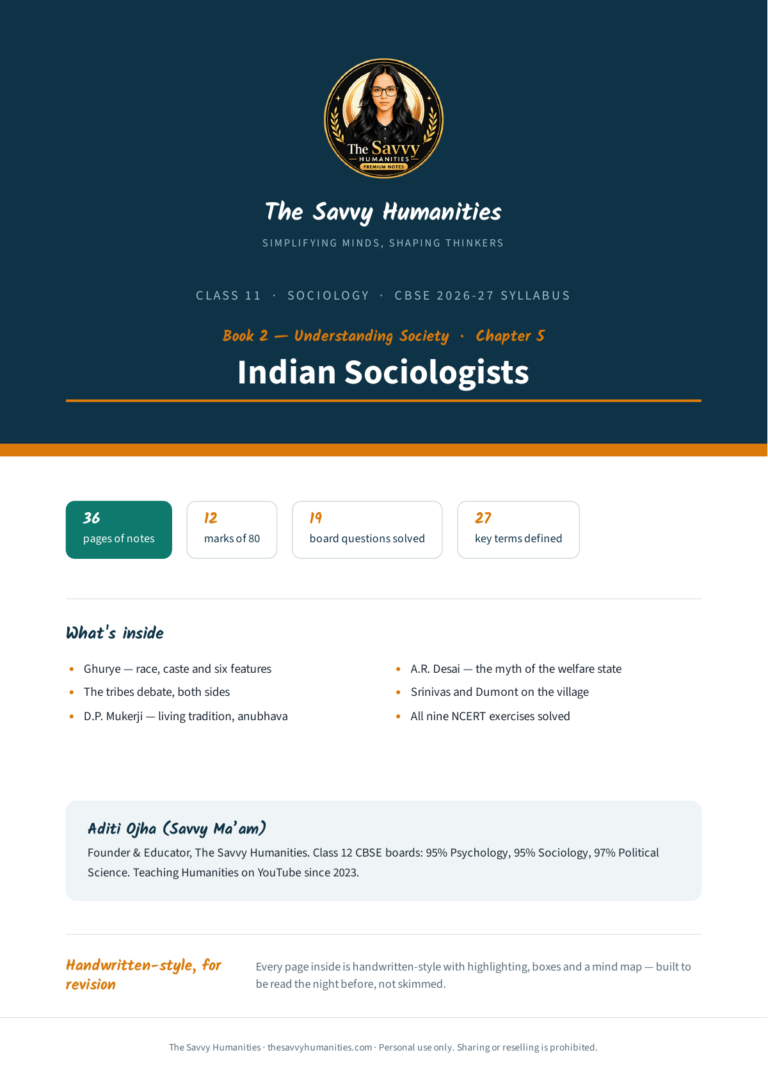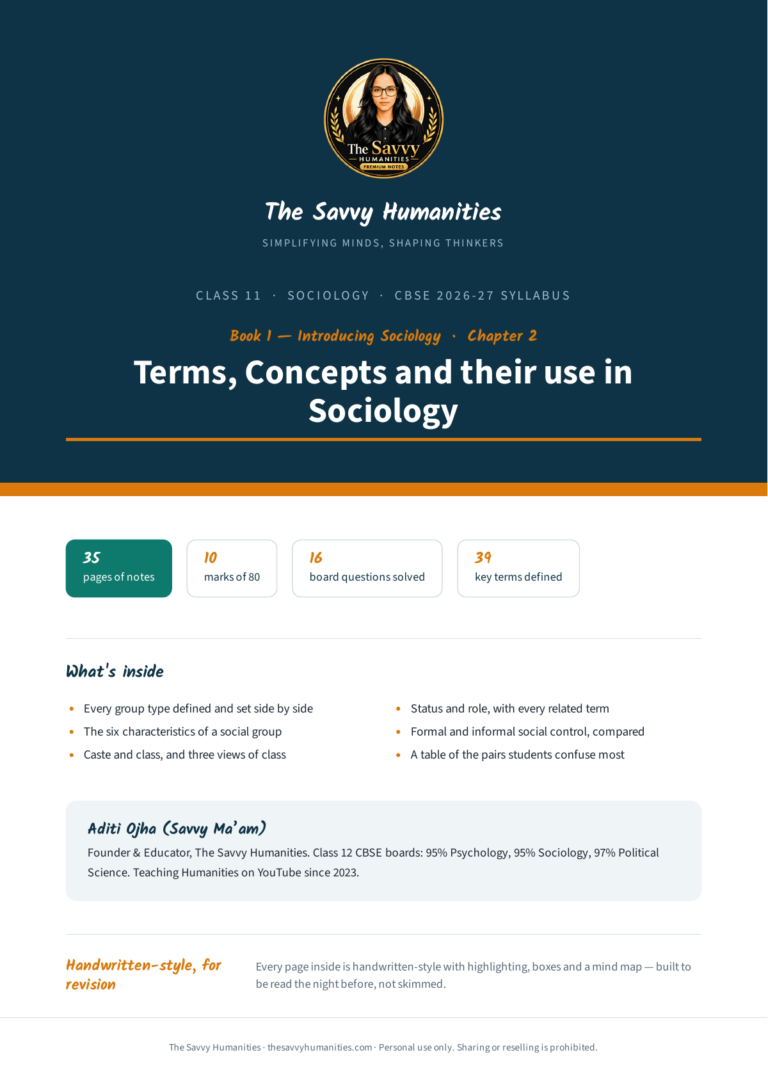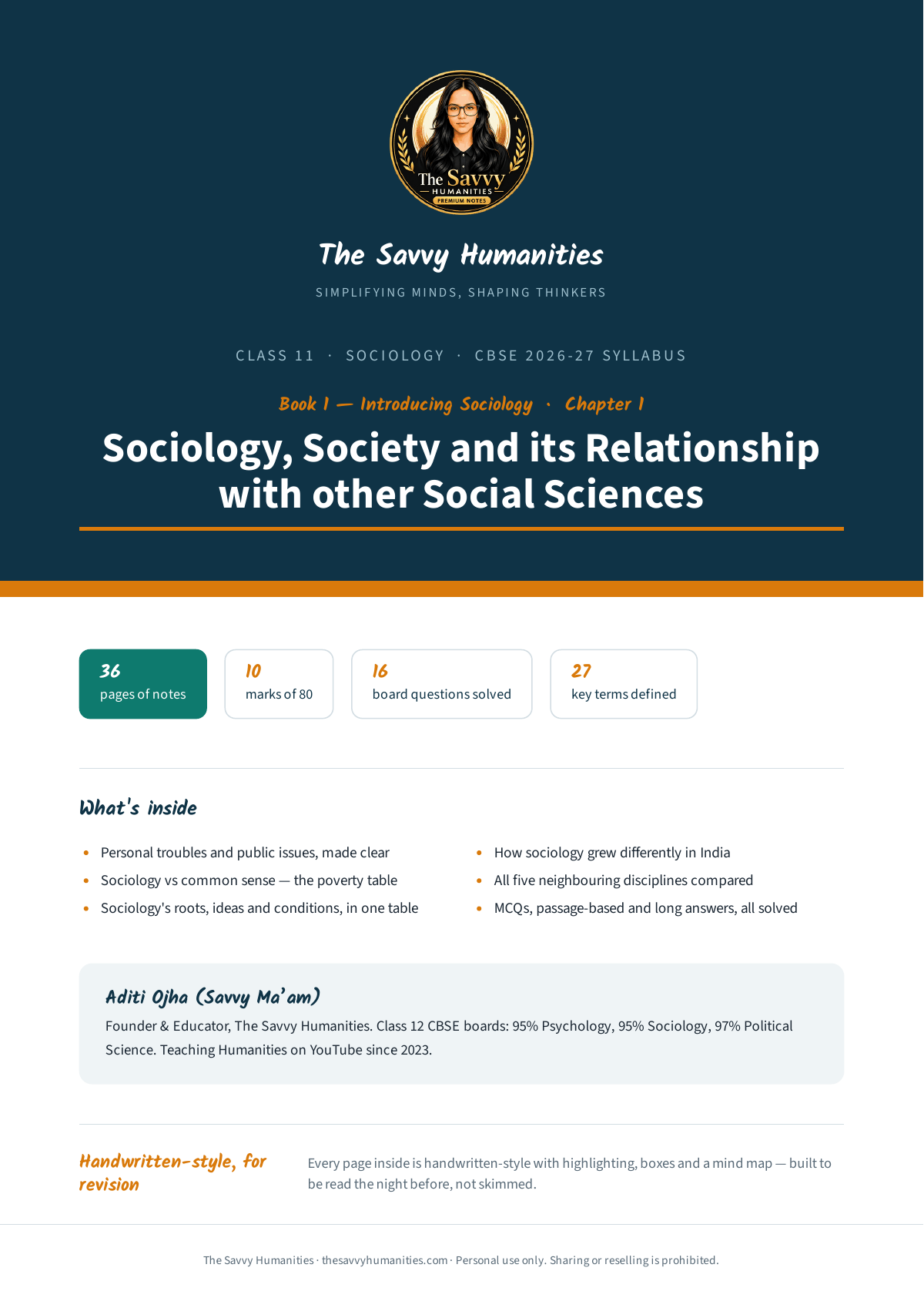
Exam-oriented handwritten-style notes — every page laid out like class notes, with highlighting, boxes and a mind map, built to be read the night before rather than skimmed.
Unit 1 of the CBSE Class 11 Sociology paper carries 10 marks out of 80. It opens Book 1, Introducing Sociology, and sets up every idea the rest of the course builds on.
What is the difference between a personal trouble and a public issue?
A personal trouble is one person’s problem; a public issue is the same problem seen as a pattern across society. The notes take C. Wright Mills’ sociological imagination slowly, with examples, because it is the idea the whole subject rests on.
How is sociology different from common sense?
Common sense explains things by what “everyone knows”; sociology asks for evidence. The chapter’s own poverty example is laid out as a table — the common-sense view and the sociological view side by side.
How did sociology begin, in Europe and in India?
Its roots are set out in one table — the intellectual ideas (the Enlightenment) and the material conditions (the Industrial Revolution) — followed by how sociology grew differently in India.
How is sociology related to the other social sciences?
All five neighbours the syllabus names are compared one by one: economics, political science, history, psychology and social anthropology — what each studies, and where sociology differs.
What else is in the file
- Chapter at a glance — a one-page mind map of the whole chapter
- A 27-term glossary of every definition the paper can ask for
- 16 questions solved with full model answers — board-pattern MCQs, passage-based and long answers (including 4 NCERT exercise questions), 1, 2, 4 and 6 markers
- A revision tracker to tick off each topic as read, practised and revised
The file
- Format: PDF, A4 — works on a phone and prints cleanly
- Length: 36 pages plus cover
- Delivery: instant download link after payment, plus a copy by email
- Free updates: if CBSE changes the syllabus or a correction goes in, the updated file is sent to you at no cost. You never pay twice for the same chapter.
By Aditi Ojha (Savvy Ma’am) — Founder and educator, The Savvy Humanities. Teaching Humanities on YouTube since 2023. These notes pair with the free chapter videos; QR codes inside the file link to them.